

Even Leonardo DaVinci thought about the possibility of building a machine which could divide the day in equal time bins and show the progress of time. His sketch of what can be identified as verge fusee movement drawn in 1490 had been adapted from an even earlier drawing.
Springs were first employed to power clocks in the 15th century, to make them smaller and portable. These early spring-driven clocks were much less accurate than weight-driven clocks. Unlike a weight on a cord, which exerts a constant force to turn the clock’s wheels, the force a spring exerts diminishes as the spring unwinds. The primitive verge and foliot timekeeping mechanism, used in all early clocks, was sensitive to changes in drive force. So spring-driven clocks slowed down over time as the mainspring unwound. This problem is called lack of isochronism.
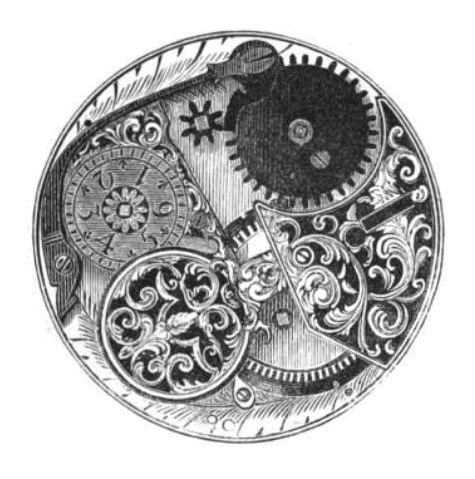

Two solutions to this problem appeared with the first spring driven clocks; the stackfreed and the fusee systems. The stackfreed, a crude cam compensator, added a lot of friction and was abandoned after less than a century. Picture credits (2).

The fusee was a much more lasting idea. As the movement ran, the tapering shape of the fusee pulley continuously changed the mechanical advantage of the pull from the mainspring, compensating for the diminishing spring force. Clockmakers apparently empirically discovered the correct shape for the fusee, which is not a simple cone but a hyperboloid. The first fusees were long and slender, but later ones have a more squat compact shape. Fusees became the standard method of getting constant force from a mainspring, used in most spring-wound clocks, and watches when they appeared in the 17th century.
At first the fusee cord was made of gut, or sometimes wire. Around 1650 chains began to be used, which lasted longer. Gruet of Geneva is widely credited with introducing them in 1664, although the first reference to a fusee chain is around 1540. Fusees designed for use with cords can be distinguished by their grooves, which have a circular cross section, where ones designed for chains have rectangular-shaped grooves.
At first watch cases do not have transparent covers, the lids are intricately pierced the way to enable time reading on the dial. Towards 1630 cut rock crystal is used and 1650 sees the slow introduction of glass.
It is not known where the first watches have been created. Several European towns such as Blois and Paris in France or Nuremberg and Augsburg in Germany lead the list. In future the manufacture of portable watches in Germany will stand behind the ever growing trade in France, England and later Switzerland.
Ref.:
 Antiquarian Horology