

During the 17th century England and France developed their own style of watch manufacturing. The distinction started with the case, the movements were almost identical in manufacture. The movements of all types show a single hour hand until the introduction of the concentric minute hand towards 1673. After these two major producers of watches, also the Netherlands, Switzerland (more precisely Geneva) and Germany got involved, but mostly following the French style. In 1675 the balance spiral spring was introduced, leading to fierce discussions about who to credit as its inventor. After an erratic phase, which lasted 5 years, the spiral spring got a normal feature of portable watches, increasing their precision considerably.
The leading watch producer was England in terms of number and quality followed by France and Geneva. The Swiss, who will lead the watch market by the early 20th century, were mostly involved in copying English work even usurping well known names such as Thomas Tompion and Daniel Quare, sometimes misspelling their names or even inventing non-existing English watchmakers to sell their lower quality products. This practice will continue until mid 19th century where also well known French watchmakers will be copied.
The English watchmakers were very prolific, especially towards the end of the 17th century, taking advantage of the Protestant exodus from France, which included many talented watchmakers. The English clients preferred simple round or oval watches (Puritan style), with a few exceptions being octagonal with rather plain surfaces. Until 1630 the lids were plain and out of metal, the watch lid needed to be opened to read the time. Between 1630 and 1650 cut rock crystal was used, starting from about 1650 glass started to be used as watch crystal. The decoration of the cases was limited to engraving and leather covering.

Some leather covered cases got decorated with gold or silver ‘piqué’ work, small needles chased through leather and metal to form different shapes, such as coat of arms. Different materials were used fro making cases, such as gold and silver, tortoise shell and some times hard stone and even ivory. The dials were exlusively out of metal, gold or silver, with Roman numerals for the hours and Arabic numerals for the minutes.
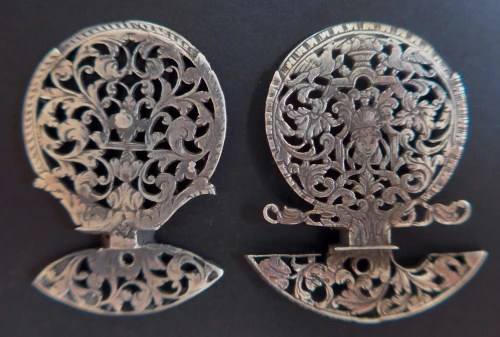
The cocks, at the beginning identical to the French ones, developed towards 1680 slowly to a D shaped single foot with a broad cock surface to protect the balance, which got bigger towards the end of the 17th century.
This evolution was due to the invention of the balance spring most probably by Christiaan Huygens, a Dutch Mathematician, Physicist and Astronomer. To accomodate the balance spring, the balance needed to be increased in diameter and got three- sometimes four- armed replacing the earlier, smaller two armed versions. The introduction of the balance spring triggered a strange phase where removing the fusee from the movement construction was thought to be a logical consequence. This phase lasting from 1675 to 1680 left us with strange watches having a balance spring but with no fusee by Thomas Tompion and other watchmakers in France such as Isaac Thuret, Balthazar Martinot and others. As the precision of the watch suffered from the lack of the fusee, it got reintroduced. One other new development from an English watchmaker revolutionised the trade: the introduction of the minute hand by Daniel Quare (the invention of the minute hand being attributed to Huygens). Daniel Quare is also thought to have invented the earliest repeating mechanism.
 Antiquarian Horology