

The revocation of the Edict of Nantes in October 1685 by Louis XIV, the grandson of Henry IV, drove an exodus of Protestants, and increased the hostility of Protestant nations bordering France. Among these people were also many good watchmakers. This contributed to the decline of French production as compared to England. In France the cases, apart from the usual round or ovoid forms, remained oddly shaped.

One can find watches with heart, ivy, cross, ball, shell, skull and tulip shaped forms. Most of these watches have rock crystal front pieces to enable to read the time without opening the case (glass was only available for watches from about 1650).
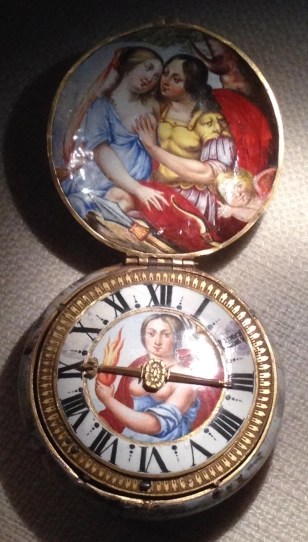
Towards 1630 many cases got intricately enamelled with biblical or mythological scenes. Also the dials got colourful. This style got introduced in France, especially in Paris, Blois and Limoges. Most of the later work from 1660 on was made in Switzerland, Geneva being the most renowned. During the reign of Louis XIV, the watches got round again, and huge. Due to their big size and rounded form they are called ‘ognions’. Their diameter can reach 55mm with a distance between the plates of 17mm. The gilt brass cases are usually engraved, the dials are of enamelled brass with big black or blue roman numerals. Some dials are of gilt brass with enamelled cartouches for the hours. Some watches already bear astronomical information such as day/date, moon phase, astrological signs and even equation of time.
Timepieces were a privilege of the wealthy and especially under the reign of Louis XIV they were regarded a status symbol, hence the big size. The king himself was very fond of horology enabeling scientific research on the subject.
 Antiquarian Horology