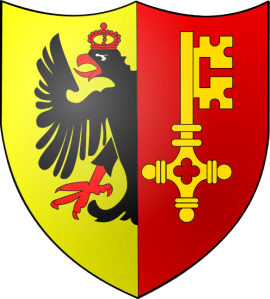
Geneva, once part of the Kingdom of Burgundy, then conquered by the Germans and ruled by the House of Savoy, struggled for independence for a long time. In 1387, Bishop Adhémar Fabry granted the town its great charter, the basis of its communal self-government. Still, the House of Savoy countered the continuous struggle for independence with invasions, then the 20.2.1526 Geneva signed a treaty of alliance with Fribourg and Bern, hence joining the Swiss Federation. The Protestant leader John Calvin was based in Geneva from 1536 to his death in 1564 (save for an exile from 1538 to 1541) and became the spiritual leader of the city, a position created by the Grand Council as the city turned Protestant. During the next centuries Geneva became the gathering continental city of protestants especially fleeing from France.
Many of these refugees were watchmakers who learned their trade in Paris, Limoges, Rouen or Blois.
Towards 1630 Geneva rose to one of the most prolific producers of watches and especially enamelled watch cases. This specialisation integrating the respective styles through time continued with interruptions until the end of the 18th century. During the 17th century well known watchmakers worked in Geneva such as Jean Rousseau and his apprentice Jean – François Lachis. Jean Rousseau was the great – grandfather of what will become one of the best known philosophers in history: Jean-Jacques Rousseau (28.6.1712 – 2.7.1778). In his writings Jean – Jacques Rousseau mentions that he used to visit his father Isaac Rousseau in his watchmakers atelier and disassembled and reassembled watches there.
 Antiquarian Horology