
Inspired by liberal and radical ideas, the Revolution profoundly altered the course of modern history, triggering the global decline of theocracies and absolute monarchies while replacing them with republics and democracies. Historians widely regard the Revolution as one of the most important events in human history. The causes of the French Revolution are complex and are still debated among historians. Following the Seven Years’ War and the American Revolutionary War, the French government was deeply in debt and attempted to restore its financial status through unpopular taxation schemes. Demands for change were formulated in terms of Enlightenment ideals and contributed to the convocation of the ‘Etats-Généraux’ in May 1789. The first year of the Revolution saw members of the Third Estate taking control, the assault on the Bastille in July, the passage of the Declaration of the Rights of Man and of the Citizen in August, and a women’s march on Versailes that forced the royal court back to Paris in October.

A central event of the first stage, in August 1789, was the abolition of feudalism and the old rules and privileges left over from the ‘Ancien Régime’. The next few years featured political struggles between various liberal assemblies and right-wing supporters of the monarchy intent on thwarting major reforms. The Republic was proclaimed in September 1792 after the French victory at Valmy. The Committee of Public Safety came under the control of Maximilian de Robespierre, a lawyer, and the Jacobins unleashed the Reign of Terror (1793 – 1794). In a momentous event that led to international condemnation, Louis XVI and Marie Antoinette were executed in January and October 1793 respectively. According to archival records, at least 16,594 people died under the guillotine or otherwise after accusations of counter-revolutionary activities.

The modern era has unfolded in the shadow of the French Revolution. Almost all future revolutionary movements looked back to the Revolution as their predecessor. Its central phrases and cultural symbols, such as ‘La Marseillaise’ and ‘Liberté, Egalité, Fraternité’, became the clarion call for other major upheavals in modern history, including the Russian Revolution over a century later. Dogged by charges of corruption, the Directory collapsed in a coup led by Napoleon Bonaparte in 1799, widely seen as the final year of the Revolution. Napoleon, who became the hero of the Revolution through his popular military campaigns, went on to establish the ‘Consulate’ and later the ‘First Empire’, setting the stage for a wider array of global conflicts in the Napoleonic Wars.
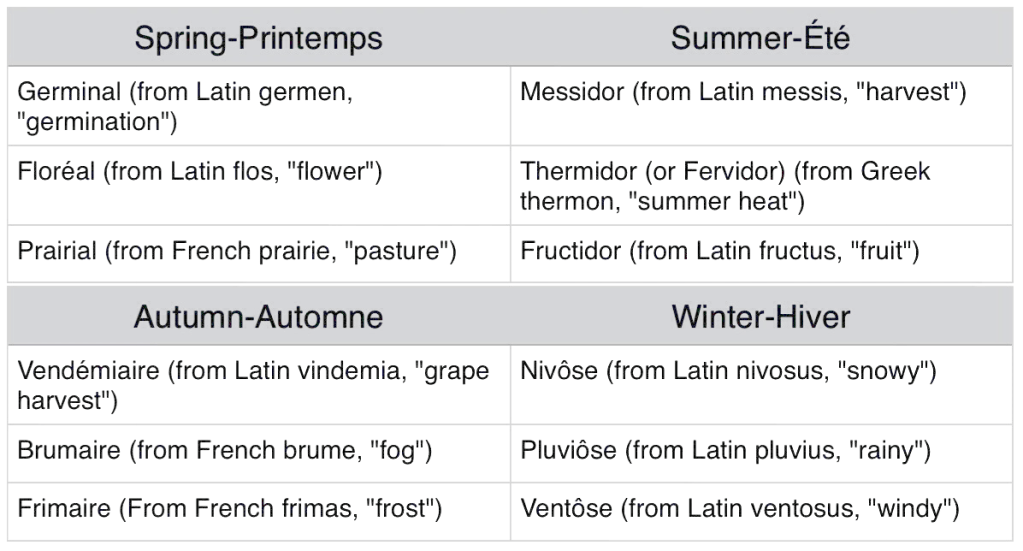
The French Republican (or Revolutionary) Calendar (calendrier républicain (révolutionnaire) français) was a calendar created and implemented during the French Revolution, and used by the French government for about 12 years from late 1793 to 1805, and for 18 days by the paris Commune in 1871. The revolutionary system was designed in part to remove all religious and royalist influences from the calendar, and was part of a larger attempt at decimalisation in France (which also included decimal time of day, decimalisation of currency, and metrication). Even the years were abolished and zeroed, making 1792 year I.
Decimal Time

In 1788, Claude Boniface Collignon proposed dividing the day into 10 hours or 1000 minutes, each new hour into 100 minutes, each new minute into 1000 seconds, and each new second into 1000 tierces (Latin for “third”). A variant of this Decimal time was officially introduced during the French Revolution. Jean – Charles de Borda made a proposal for decimal time on 5 November 1792. The National Convention issued a decree on 5 October 1793. Although clocks and watches were produced with faces showing both standard time with numbers 1–24 and decimal time with numbers 1–10, decimal time never caught on; it was not officially used until the beginning of the Republican year III, 22 September 1794, and mandatory use was suspended 7 April 1795 (18 Germinal of the Year III), in the same law which introduced the original metric system.
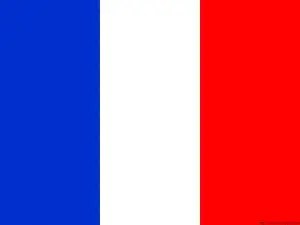
Apart of the decimal time, also symbols belonging to the revolutionary movement are shown on watch dials (tricolour flag, Phrygian cap, balance, mottos like: ‘ça ira’ (it will be OK)). Watches are used as political statement and to show support for the new republican system.
 Antiquarian Horology