
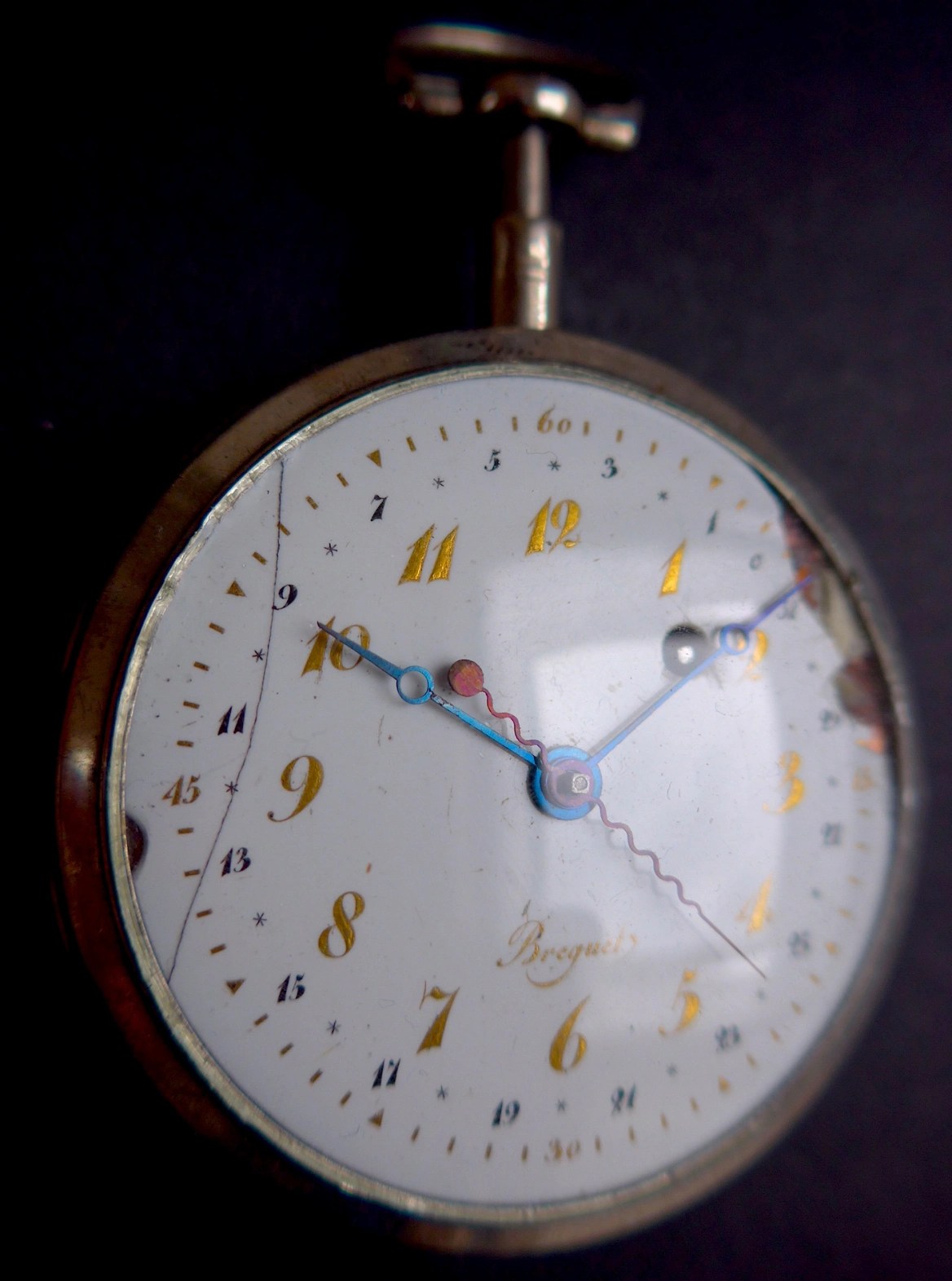


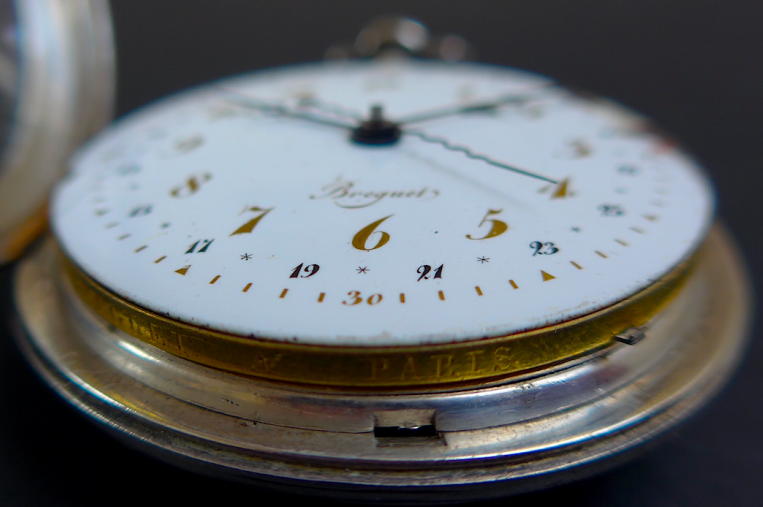
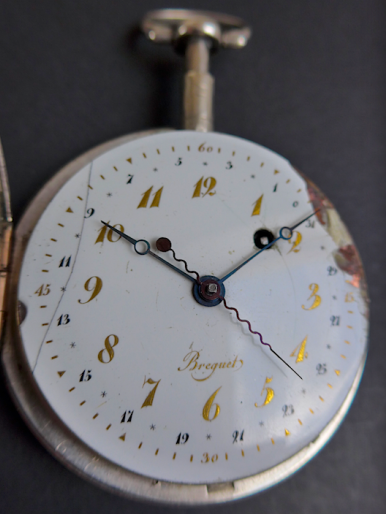


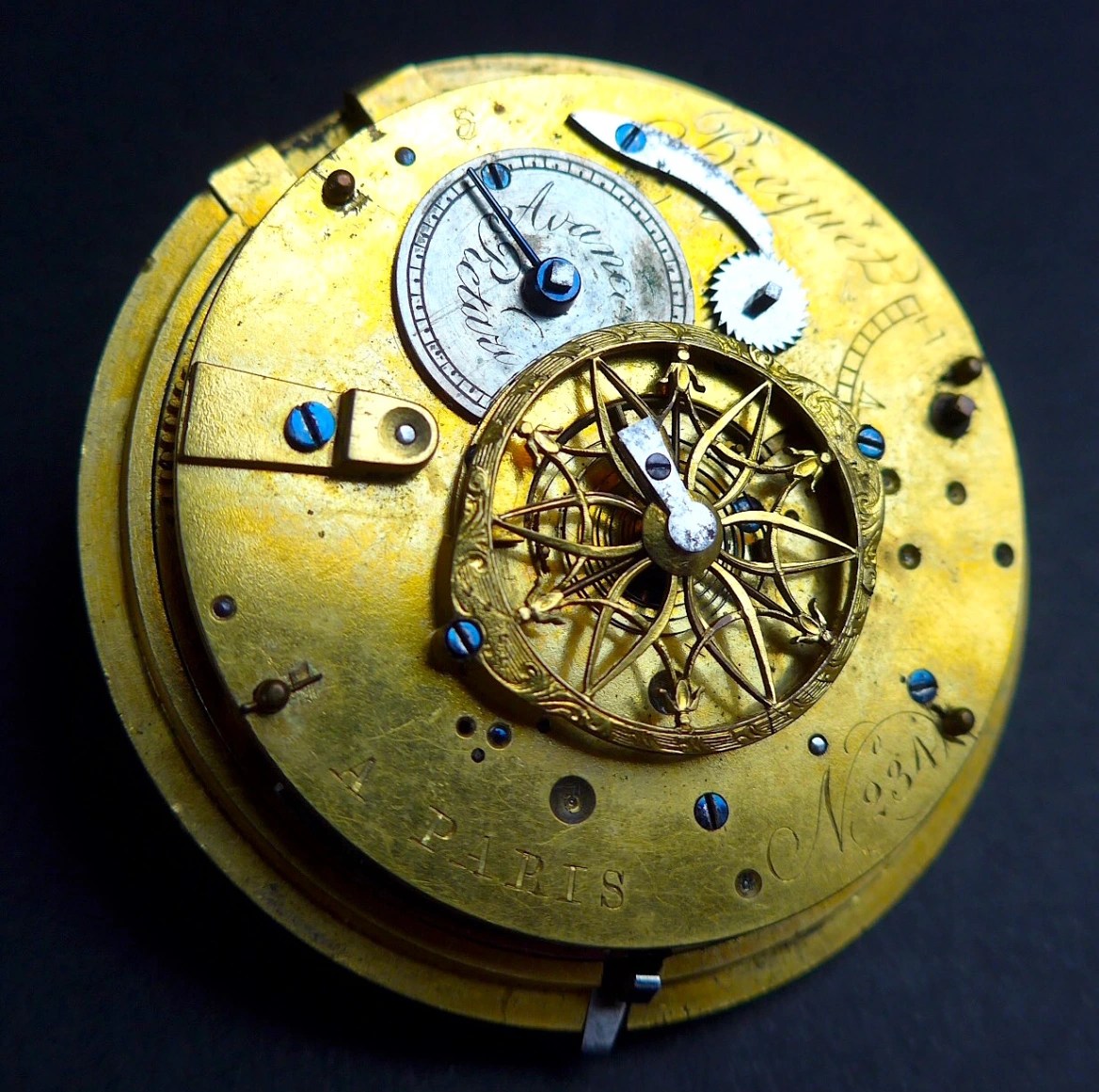

Description: Silver consular cased, gilt brass, full plate, front wound quarter repeating à toc movement (49mm), verge escapement, three armed plain balance, spiral steel spring with silver regulator dial, fusee and chain. Small cock with geometrical decoration and steel cockerel. Rim of front plate engraved with ‘BREGUET A PARIS No. 234 (2nd series). Backplate with same engraving as rim. White enameled copper dial with early, gold cursive ‘Breguet’ signature used until 1795. Dial fixed by one screw and one pin on the rim. Gold Arabic hour numerals and minute markings. Black, counterclockwise date numerals. Every second date number is replaced by a star. Counter enamel hand signed ‘(P) Dauphine 1793’ and hand numbered with the movement number ‘234’. Place Dauphine was the location of the enamelers regularly employed by Breguet and other watchmakers of the ‘Île de la Cité’ for the enamelwork on the dials. Most dials lack the inscriptions on the counter enamel though. Blued steel hands (restored).
Additional Info:
Conventional repeating work wound by chain and pulley as perfectioned by Julien Le Roy almost half a century before. These movement types have been used before 1795 and were slightly modified from commercial repeating movements. These represent the earliest stage, still using the pre 1787 type (conventional caliber with winding by pump pendant, pulley and chain) before changing to an intermediate caliber (No. 203) and the later used ‘nouveau calibre’ (No. 726, made from 1790 – 1815. Latter with single hammer à toc, for hours and fractions of an hour) which superseded the earlier versions.
This early repeating movement comes most probably from the commercial stock provided by Xavier Gide. As in other examples based on conventional commercial pieces such as No. 165, the finishing of this movement is of extraordinary quality as compared to similar contemporary pieces made in other workshops. This movement is larger, but of the same type as the repeating movement used for No. 179 sold to Marie – Antoinette in 1792. Furthermore No. 234 has been constructed just a few months before Breguet had to flee Paris (12.8.1793) to gain Switzerland.
The use of gold numerals and gold signature on the dial was also featured on dials of other makers. This style was introduced by Jean – Antoine Lépine. There is only one other known watch of this style by Breguet using gold numerals and signature on enameled dial (No. 231 sold at Antiquorum Geneva, 14.4.1991, Lot. 4, catalogue P.: 24, 25). Latter watch, of almost identical construction as the movement presented above, helps further to date No. 234, as it entered Breguet’s books the 2.1.1793. One further similar piece shown in A. Chapiro’s book ‘Taschenuhren aus vier Jahrhunderten’, P.: 219, 220, Pic.: 464, 465, has proven to be a contemporary forgery. A different and later quarter repeating watch, No. 1899, also features gold Arabic numerals, indexes and the signature ‘BREGUET ET FILS’, sold 1806 to the Duke of Newcastle.
Breguet’s date complication

The counterclockwise application of the date numerals is typical of Breguet’s early work. In this movement type, having a concentric date work and being front wound, the date hand stopped on the ‘0’ mark for the owner to move to ‘1’ by hand. To avoid that the owner forgets to move the hand, the ‘0’ mark was placed in projection of the winding hole. When the owner had to wind his watch, usually once a day, he needed to move the date hand out of the way of the winding hole an did thus automatically move it to the ‘1’ position. This very simple but ingenious system shows the practicality of Breguet’s inventions.
 Antiquarian Horology


