


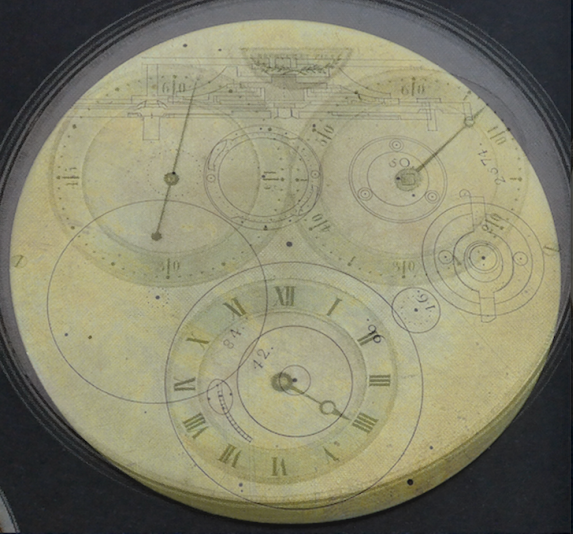

Description: Brass disc caliber 1:1 template (diameter 70mm) bilaterally engraved for the manufacture of six-minutes tourbillon movements. The engraving showing the size of the wheels, barrel and fusee with with individual numbers for the teeth. The center of the wheel templates finely pierced. Also the shape, position and dimensions of the back plate are shown with the position of the round pillars indicated as small double circles. One side numbered ‘2574’ which is the production number of one of the three existing six – minutes tourbillons (see below). Only three, six minutes tourbillon were made by Breguet. This is the only caliber template known to us, which bears the production number of a specific watch.
Provenance: Caliber template: Ex Cayette & Cheval, 11.6.1983, Lot. 202, Ex private collection Jean – Claude Sabrier (F)
Watch: Sold to Sir Thomas Brisbane in 1816; Ex private collection Seth Atwood, Time Museum, Rockford, Illinois (USA); Ex Sotheby’s New York, 11.12.1986, Lot. 141; Ex Antiquorum 2001
Additional Info:
Such caliber templates were handed over to the main worker of a specific type of watch movement. Nos. 2520 and 2522 seem to have been made following the template quite precisely. As can be seen when looking at watch No. 2574, some details differ from the template such as the recesses for the movement attachment, the overall shape of the back plate and the blocking mechanism for the mainspring barrel. The lower picture shows the virtual overlay of the dial (left) and the movement (right) of watch No. 2574 onto the caliber template. The virtual overlay shows the placement of the different wheels and pinions and the mentioned differences in manufacture between the template and the final product. According to George Daniels, Breguet encouraged his workers to apply their own ideas to the movements as long as the overall quality and looks remained Breguet conform.
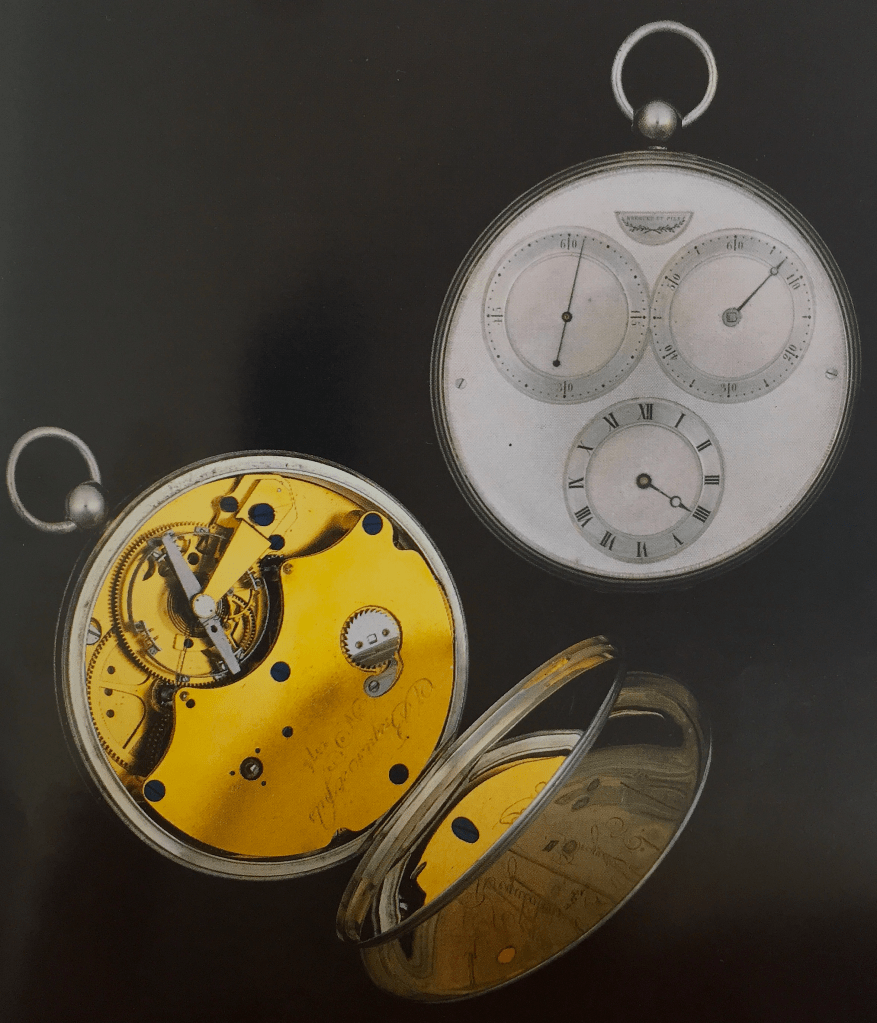
Many caliber templates (marked FH (Frédéric Houriet) and caliber number) are known from the workshop of Jacques – Frédéric Houriet, which now are conserved at the Watch Museum Château des Monts in Le Locle (Switzerland). Houriet also perfectionned, together with Breguet, the idea of John Arnold to compensate for the disturbing influence of earth’s gravity on a watch movement which finally led to the development of the tourbillon system. Houriet’s workshop made many tourbillon movements for Breguet following Breguet’s instructions. 9 pieces were delivered to Paris 1809. These were Nos. 2566 – 2572 and 2728 – 2729. The caliber template used for latter watches was FH 64, used form 1806 to 1818.
Breguet’s tourbillon

A tourbillon (French: ‘whirlwind’) is an addition to the mechanics of a watch escapement. Developed around 1795 and patented by Abraham – Louis Breguet on 26.6.1801. Most probably it was John Arnold who had the idea of such a system and shared it with his friend Abraham – Louis Breguet, who finalised the development most probably together with Jacques – Frédéric Houriet. After two experimental models (the watch n° 169 gifted to the son of London-based horologer John Arnold in 1808, and watch N° 282 completed in 1800 and sold much later by Breguet’s son), the first Tourbillon would not be commercialised until 1805. The following year, the invention was presented to the public at the National Exhibition of Industrial Products that was held in Paris on the Esplanade des Invalides in September and October 1806.
A tourbillon aims to counter the effects of gravity by mounting the escapement and balance wheel in a rotating cage, to negate the effect of gravity when the timepiece (thus the escapement) is stuck in a certain position. The biggest obstacle for a watchmaker regulating a watch, even today, is getting a similar result from the escapement no matter the position it is kept in. This has been made infinitely easier with accurate timing machines which give instantaneous timing results, whereas in Breguet’s time all that watchmakers had was another watch to regulate from. So, results were not very exact and it could take weeks to get them. Effects of gravity on an escapement can have quite significant effects with slight variations of position. Even if a pocket watch was kept most of the time in a breast pocket, the exact position could still vary over 45°. A tourbillon quite neatly compensates for this problem. The watchmaker now only needs to regulate for 3 different positions, instead of 6 as before. Those are two horizontal positions, dial up and down, and four vertical positions, crown at 12, 3, 6 and 9 o’clock.
The tourbillon is considered to be one of the most challenging of watch mechanisms to make (although technically not a complication itself) and is valued for its engineering and design principles. The first production tourbillon mechanism was produced by Breguet for Napoleon in one of his carriage clocks.
Sie Thomas Brisbane (23.7.1773 – 27.01.1860)

Thomas Brisbane was born at Brisbane House in Noddsdale, near Largs in Ayrshire, Scotland, the son of Sir Thomas Brisbane and Dame Eleanora Brisbane. He was educated in astronomy and mathematics at the University of Edinburgh. He joined the British Army the 38th (1st Staffordshire) Regiment of Foot in 1789 and had a distinguished career in Flanders, the West Indies, Spain and North America. He served under the Duke of Wellington, and in 1813 he was promoted to Major-General. He saw much action during the Peninsular War, including leading a brigade in the 3rd Division that broke through at the Battle of Vitoria. He continued as a brigade commander in the War of 1812, where in 1814 he led a brigade at the Battle of Plattsburgh, which Brisbane claimed they could have won if they had been allowed to launch a full infantry attack. During the battle, he used the Charles C. Platt Homestead as his headquarters. For his services in the Peninsula, Brisbane received the Army Gold Cross with one clasp for the battles of Vitoria, the Pyrenees, Nivelle, Orthez, and Toulouse; and the silver war medal with one clasp for the Nive.
In 1821, on the recommendation of Wellington, Brisbane was appointed Governor of New South Wales, a post he held until 1825.
Brisbane left Sydney in December 1825 and returned to Scotland. In 1826 he added the name of Makdougall before Brisbane, and settled down to the life of a country gentleman and took interest in science, his estate, and his regiment. He was elected president of the Royal Society of Edinburgh (1832) in succession to Sir Walter Scott, and in 1836 he was created a baronet. In the same year he was offered the command of the troops stationed in Canada and two years later the chief command in India, but declined both. He continued his astronomical researches, and did valuable work.
He was the first patron of science in Australia, and as such was eulogised by Sir John Herschel when he presented Brisbane with the gold medal of the Royal Astronomical Society in 1828. Oxford and Cambridge Universities gave him the honorary degree of DCL, and he was elected a fellow of the Royal Societies of both London and Edinburgh. He was created KCB in 1814 and GCB in 1837.
Brisbane was a keen astronomer throughout his career. He had an observatory built at his ancestral home in 1808. From this observatory he was able to contribute to the advances in navigation which took place over the next hundred years. He took all his instruments and two astronomical assistants, Carl Ludwig Christian Rümker and James Dunlop to New South Wales with him, first properly equipped Australian observatory at Parramatta. While waiting for Macquarie to complete his final arrangements, interested himself in making astronomical observations. In 1822 he established an observatory at Parramatta west of Sydney. In 1828 he won the Gold Medal of the Royal Astronomical Society. He published The Brisbane Catalogue of 7,385 stars of the Southern Hemisphere in 1835. The Observatory was used until 1855.
When Brisbane returned to Scotland he continued his studies and built a further observatory on his wife’s estate, Makerstoun, near Kelso in the Borders. He was a member of the Royal Society of Edinburgh and received their Keith Prize in 1848. He was elected president in 1833 after the death of Sir Walter Scott, and in the following year acted as president of the British Association for the Advancement of Science. He founded a gold medal for the encouragement of scientific research to be awarded by the Royal Society of Edinburgh.
Brisbane died much respected and honoured in 1860 in Largs. His four children predeceased him. The Australian city of Brisbane and many other geographical and astronomical sites are named after him.
 Antiquarian Horology

