

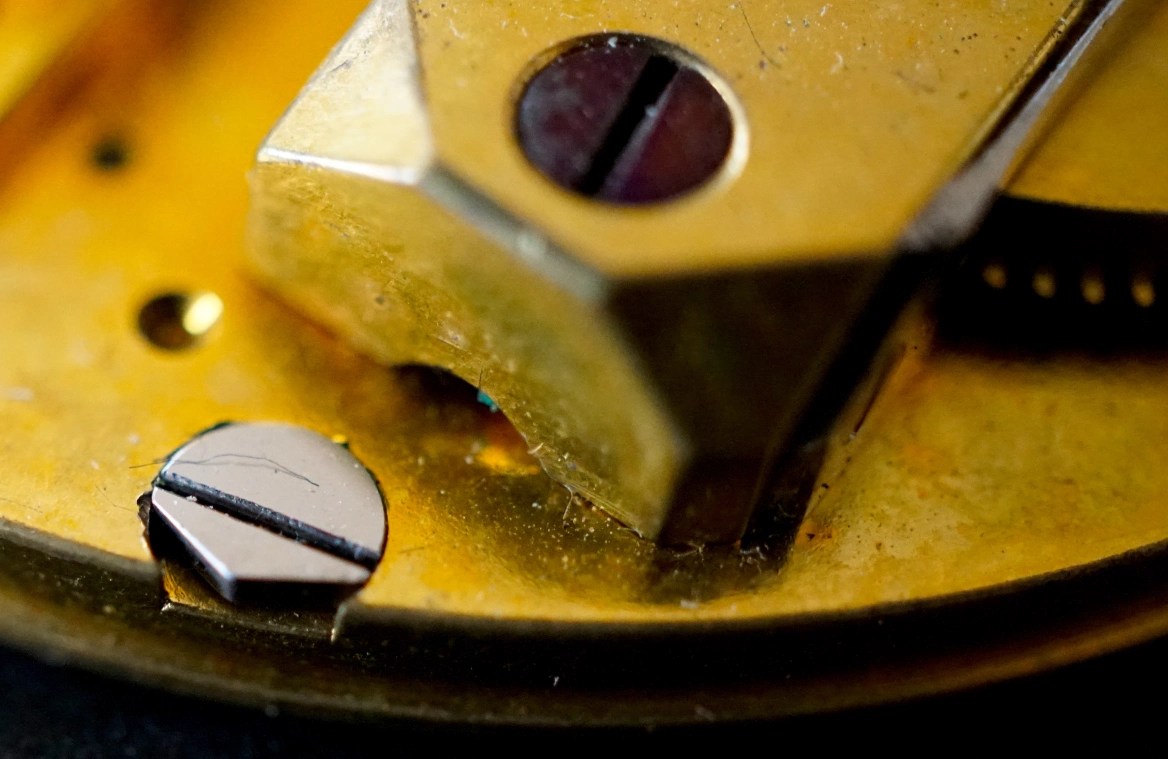


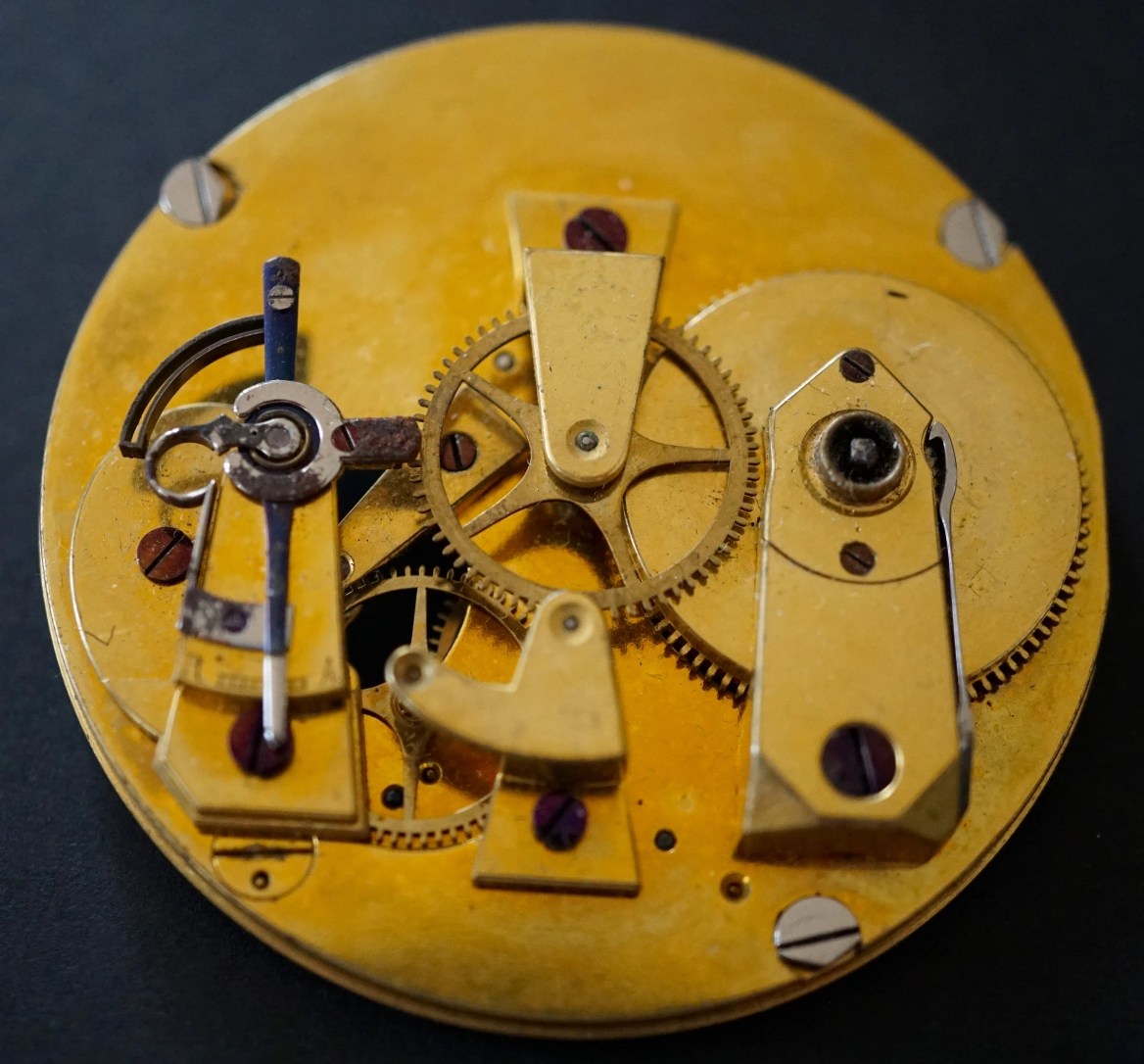
Description: Gilt brass, back wound, ruby cylinder (now missing) movement, ‘montre simple, nouveau calibre; deuxièmme classe’ type. Brass balance, flat, blued steel balance spring (both detached). Parachute of the latest type, earlier long temperature compensation curb, with blued steel part. Bridges aligned parallel to each other with the third wheel bridge inverted compared to the usual design. Unsigned and un-numbered plate. Bridges feature small semicircular indentations for easier removal. Lacking dial, which would have been of guilloched silver and attached with one screw at six to the purpose made steel bridge. Original, late type, flat ‘Breguet’ hands.
Additional Info:
This movement represents the final design of Breguets simple movements, which overall constitute the rarest versions made by the workshop, as most watches were equipped with repeating works for use in the dark or with other complications. Breguet developed this design from the ‘souscription’ watches to retain a most clean and symmetrical construction. The movement is not signed as sometimes seen in later work (after 1794), it would have been signed ‘Breguet et fils’ on the dial and the cuvette, both now missing. Some watches of this type are sublimed by the addition of second hand work, date, jumping hour system or more elaborated balance spring adjustments.
The dating is made with respect to several construction details. The earliest versions of this movement have a small, narrow bridge holding the fourth wheel, the other wheels are on the dial side. Later versions, as this one, show a split bridge which holds the apparent third and fourth wheels. The parachute is a later type, after 1800. Also the regulator hand is of later construction after 1810. The semicircular indentations of the bridges already appeared for some early ‘perpetuelles’, around 1795, were then completely omitted and sporadically re-entroduced around 1815. The attachment screws for retaining the un-hinged movement inside the case are also a good indicator: early ones (around 1795) are slim, getting broader towards 1805. Latter still have rounded edges and at some point also blued steel versions appear for higher quality work. Later, from 1815 until about 1820, these screws get a sharp and pointy back end which will be replaced by a completely flat end starting from about 1820. Of course these screws are often replaced and the design is not linear in evolution with overlapping use of different types as usual for the Breguet workshop. Also the bridge for the dial attachment is constructed out of steel, instead of gilt brass, as seen only in later pieces, starting from about 1815
 Antiquarian Horology