
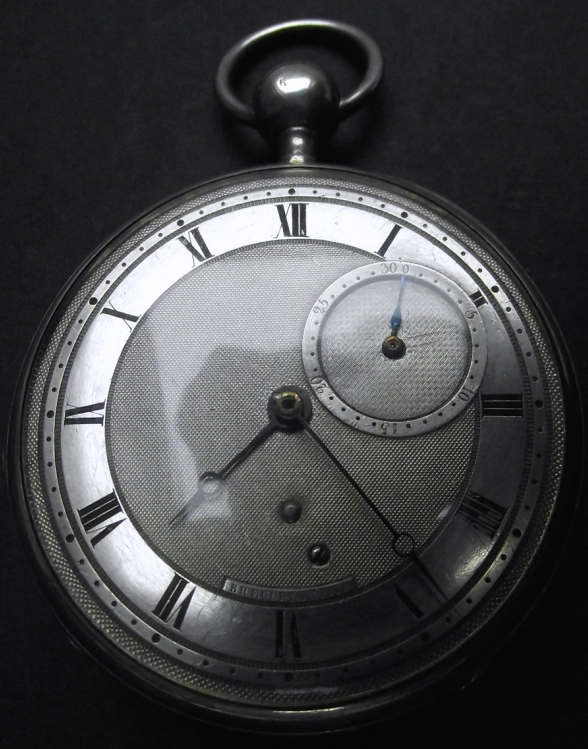
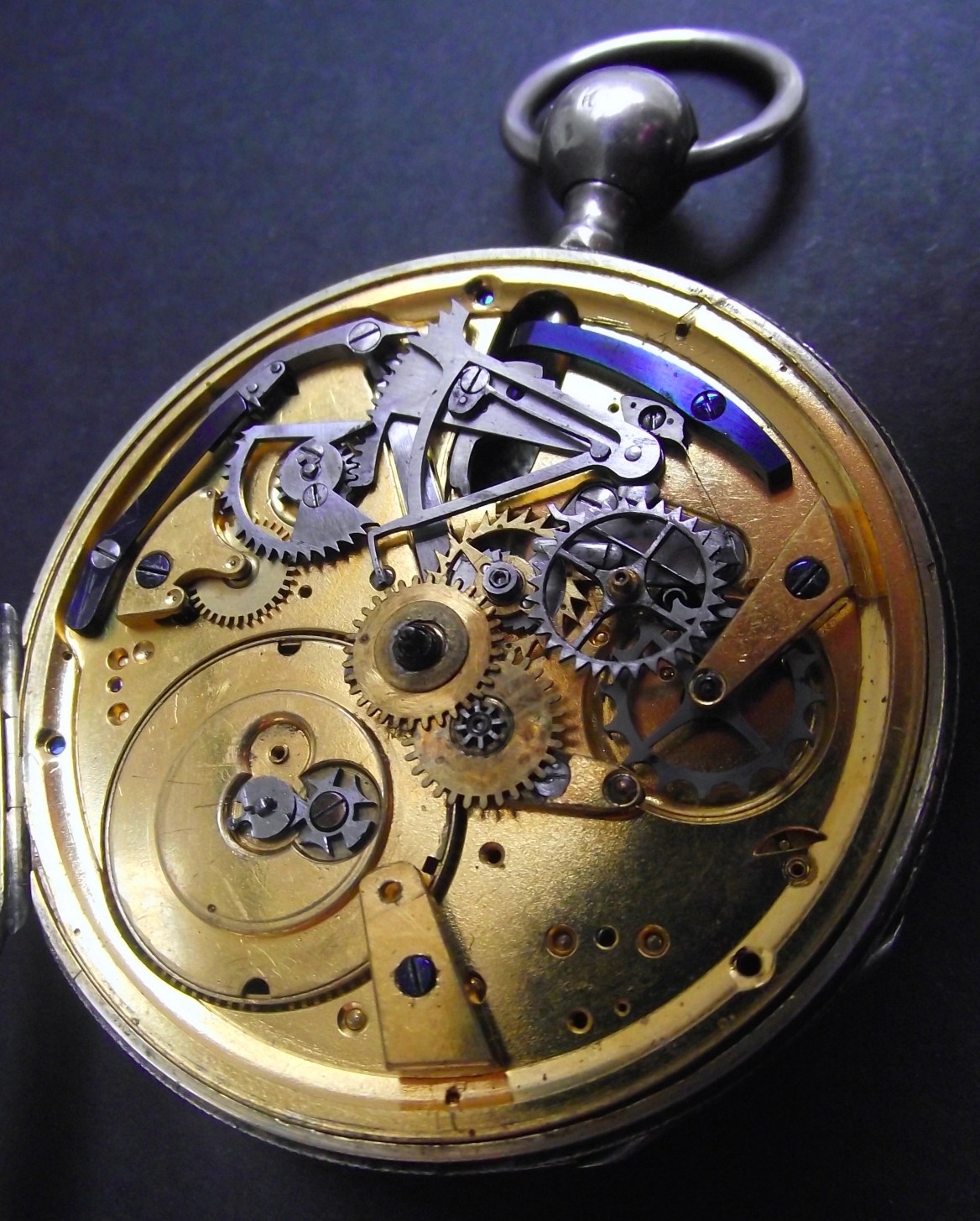
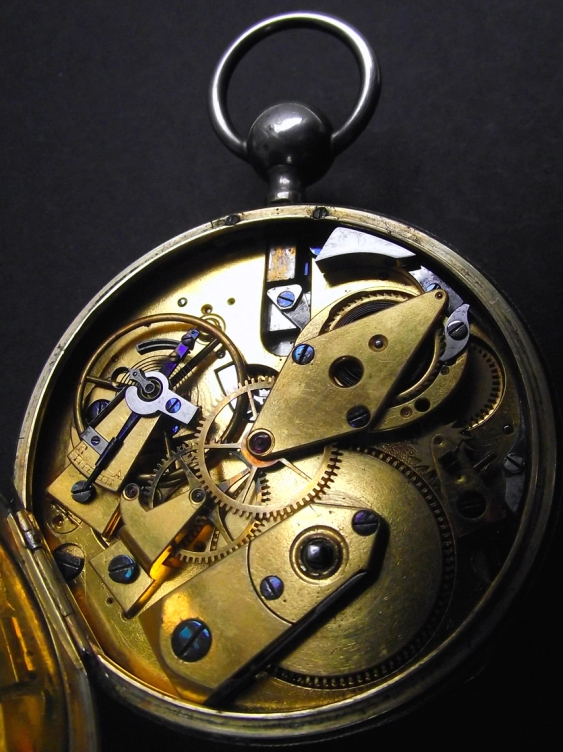
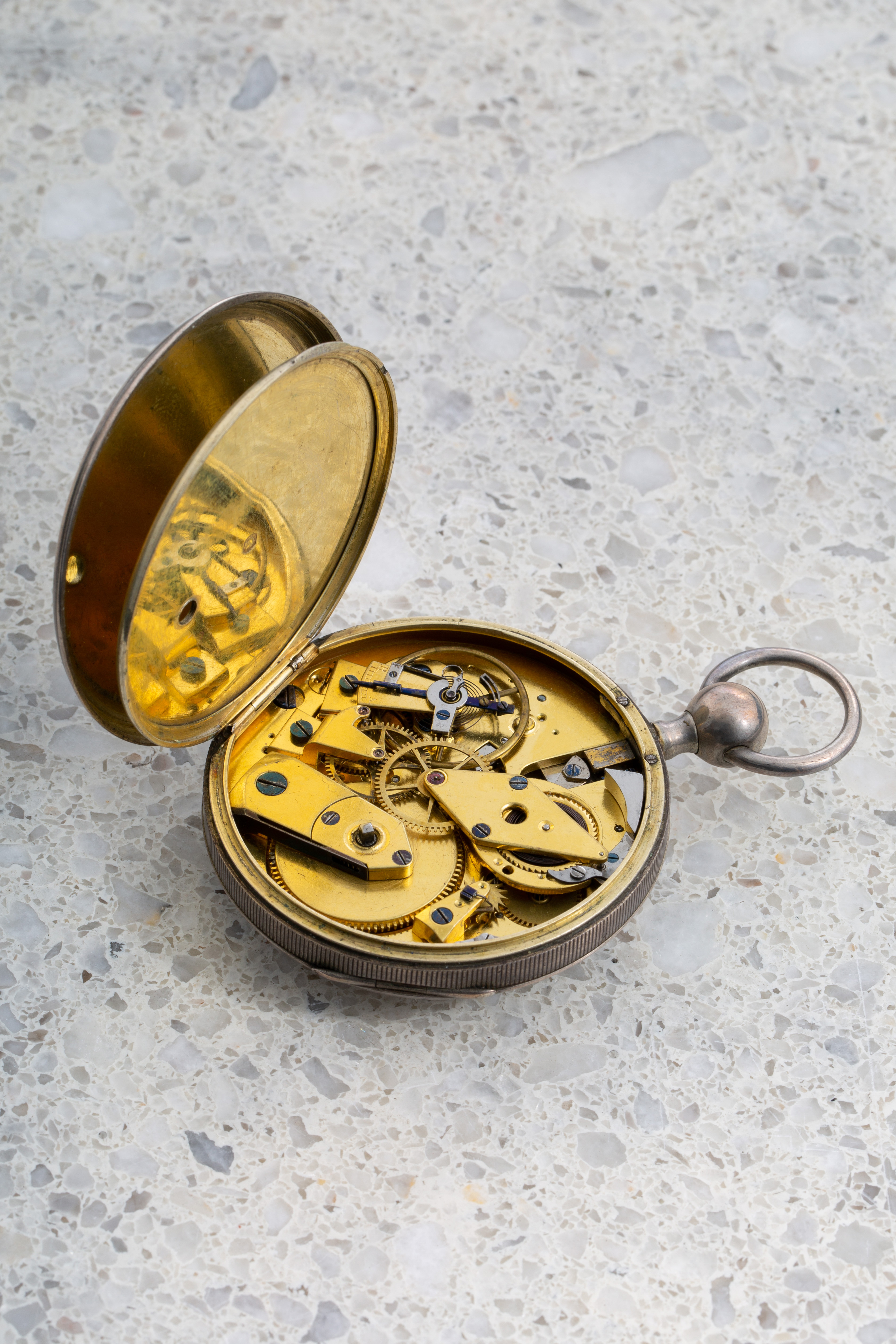

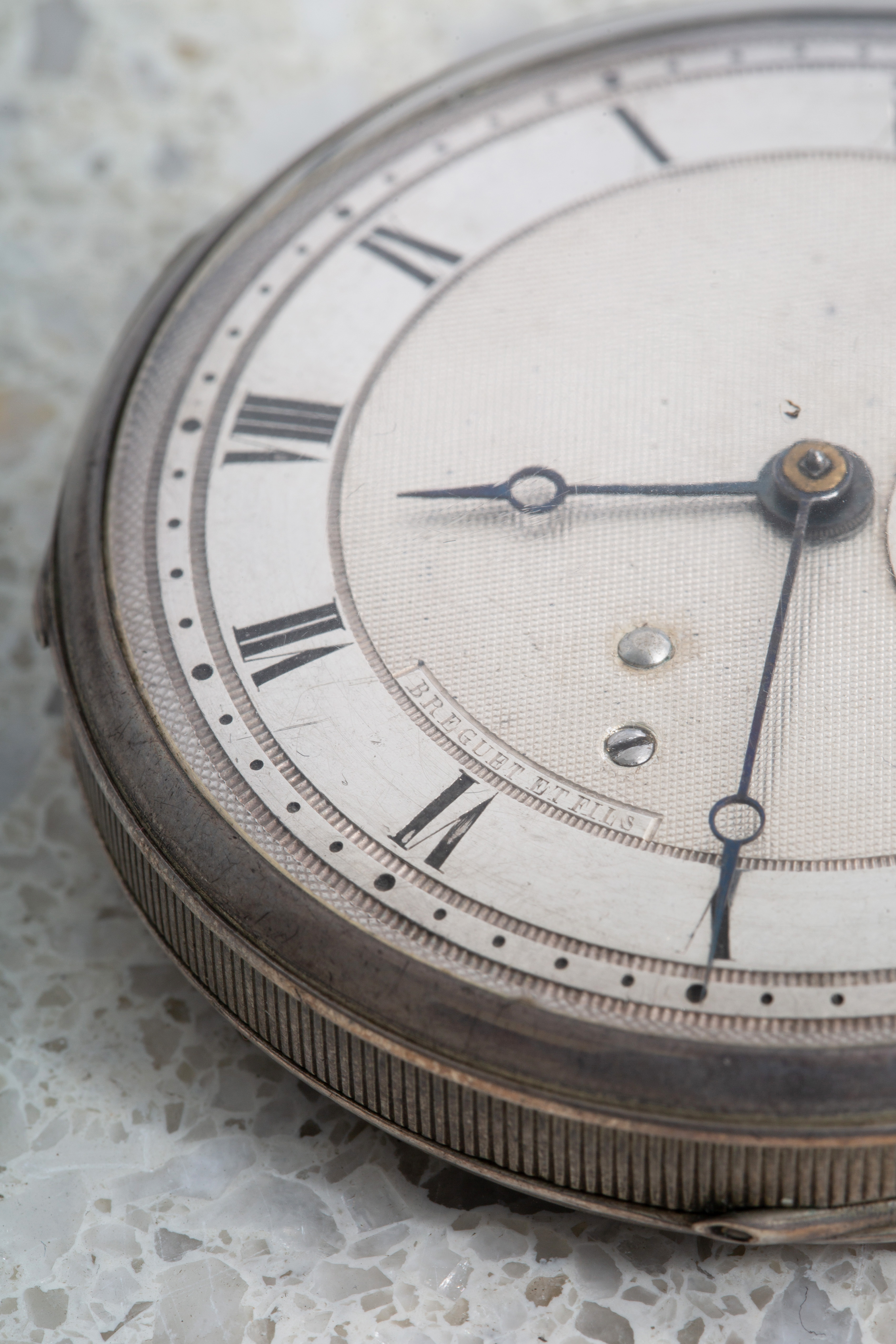
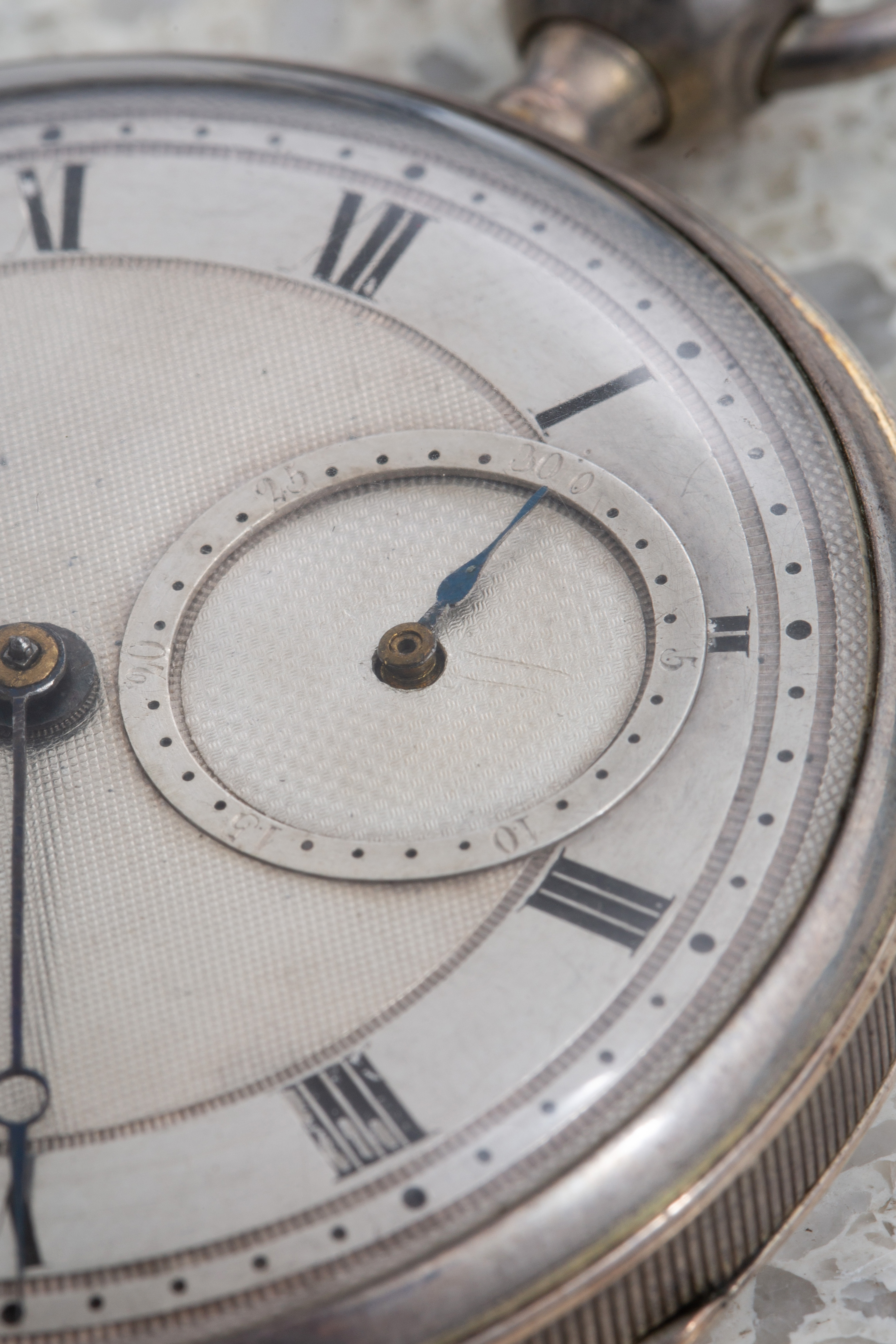
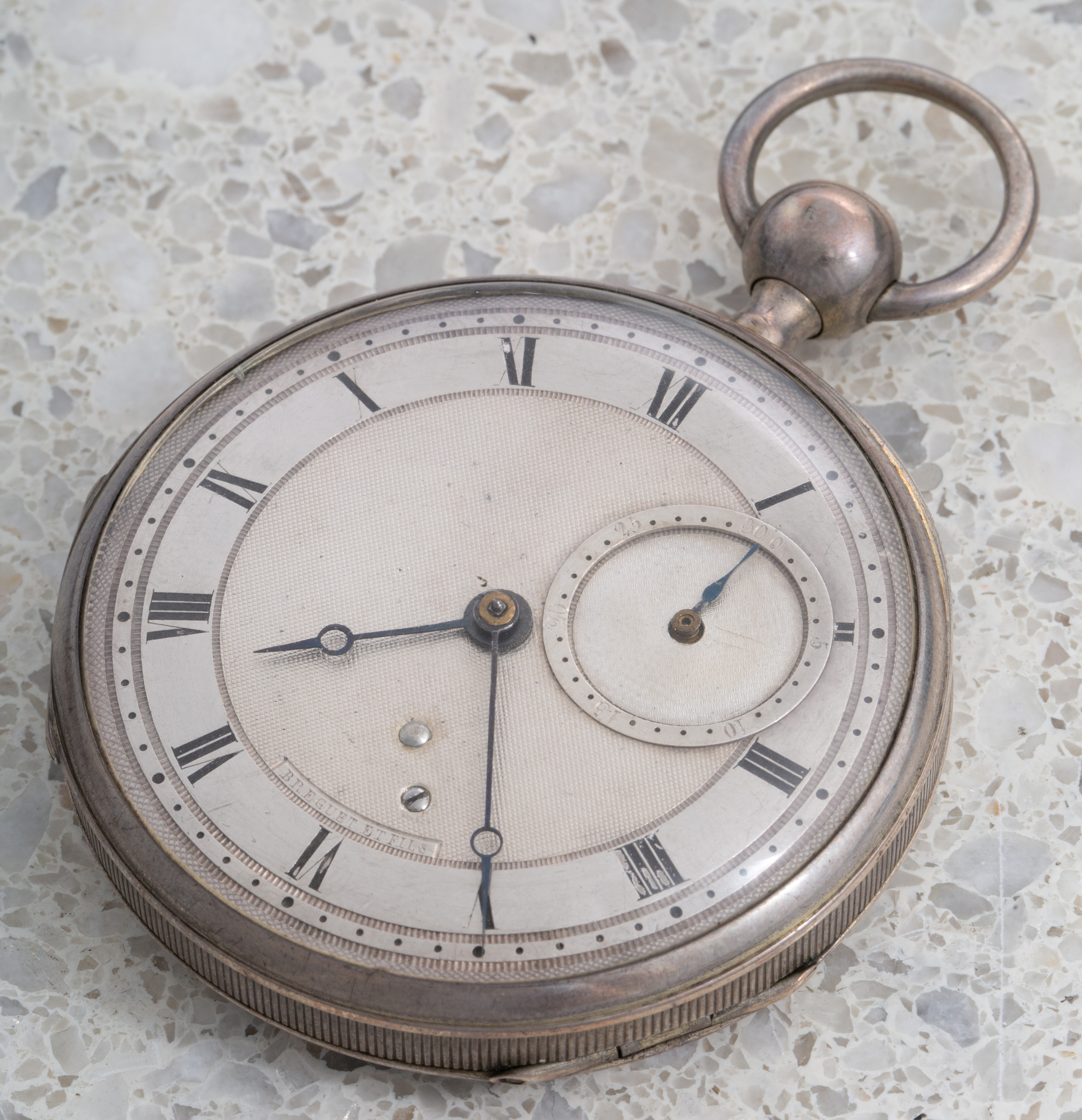
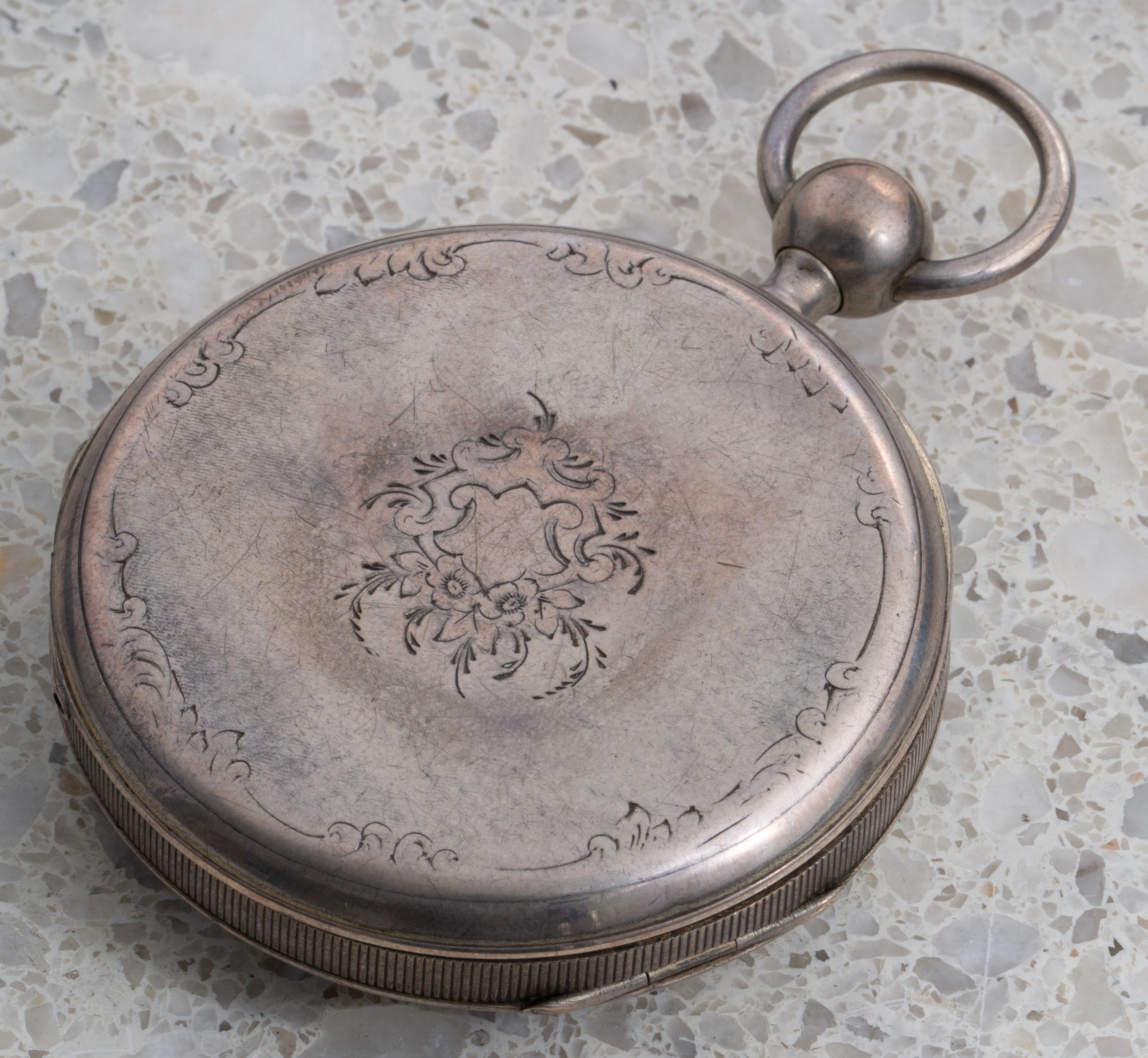
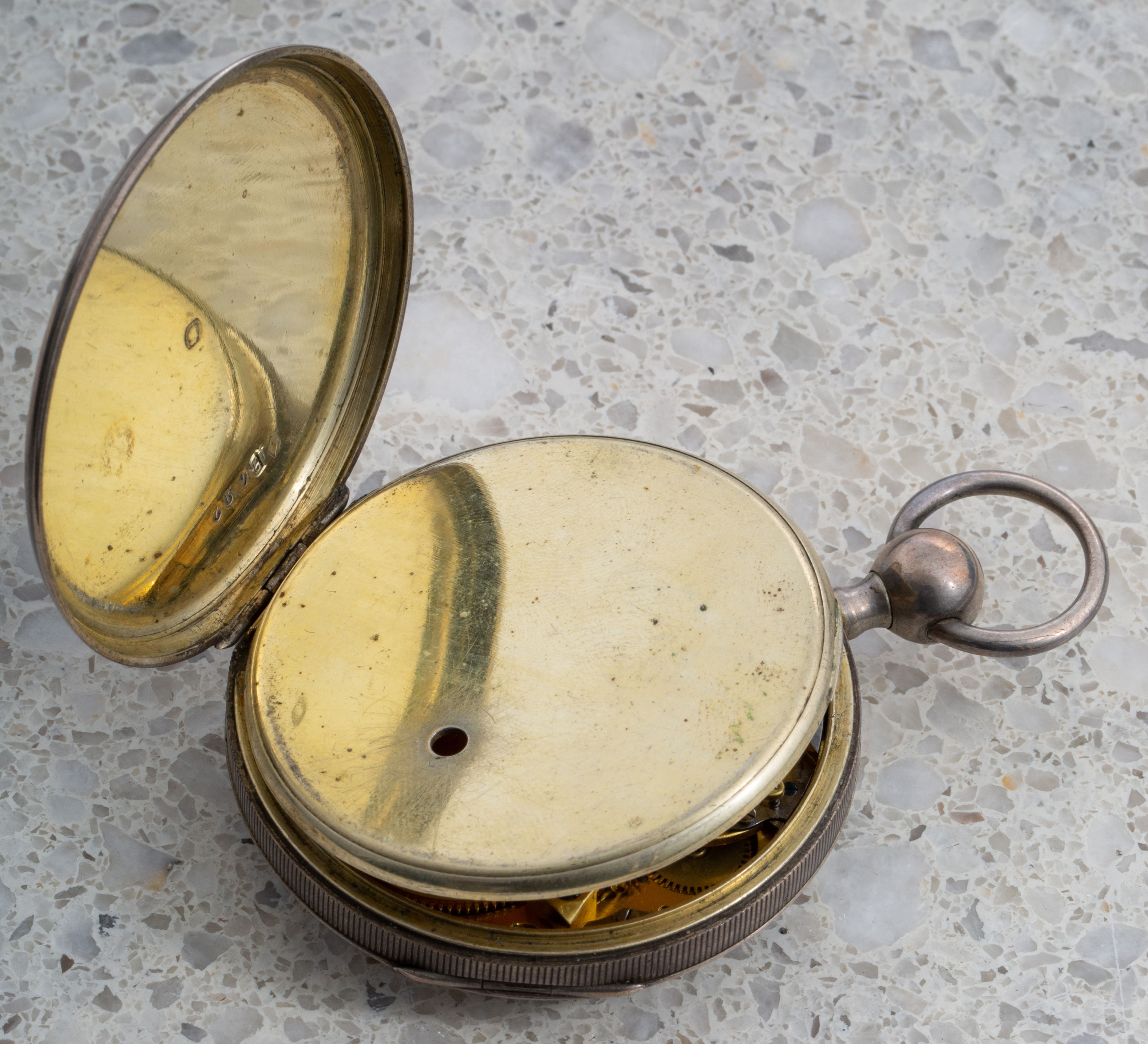
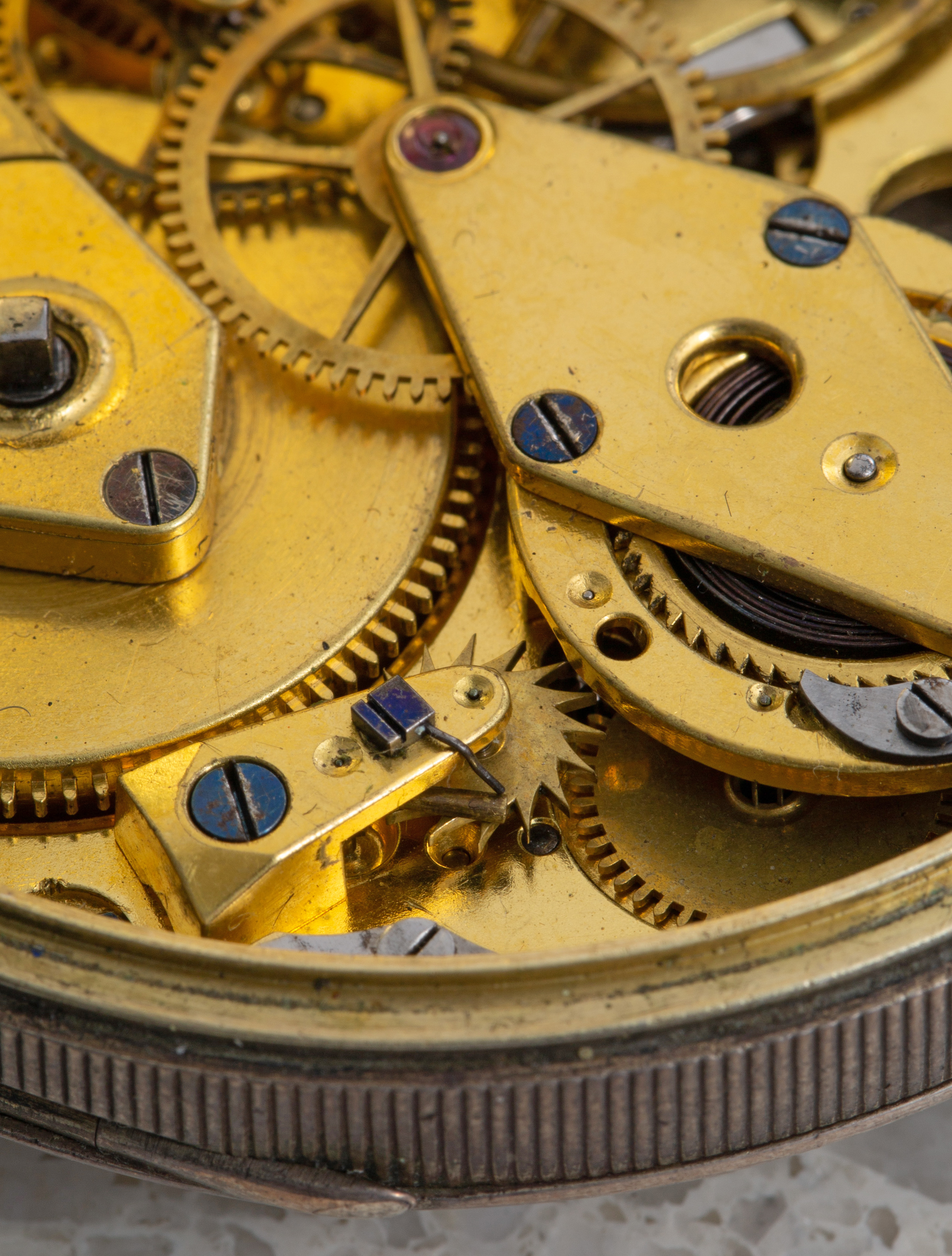
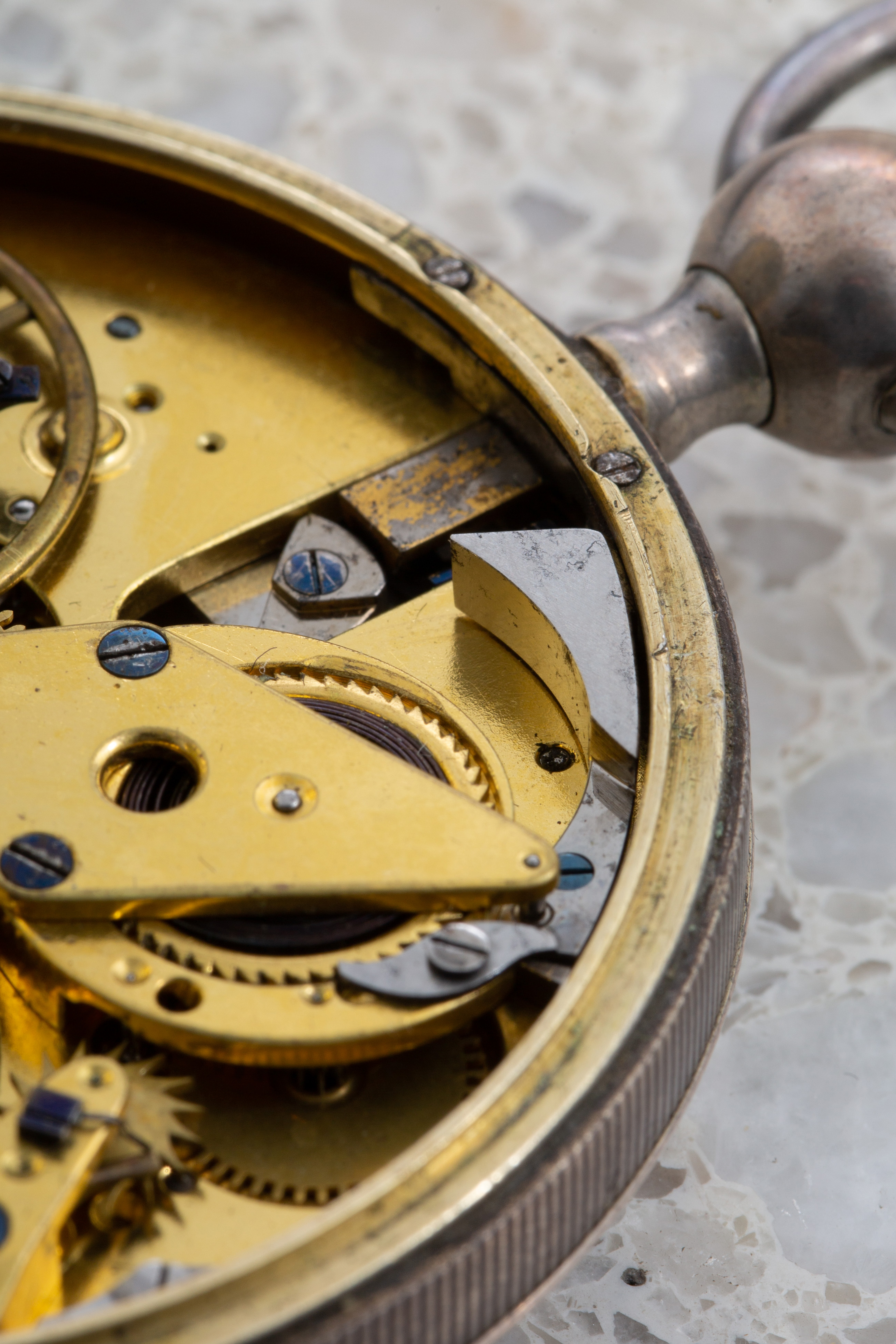
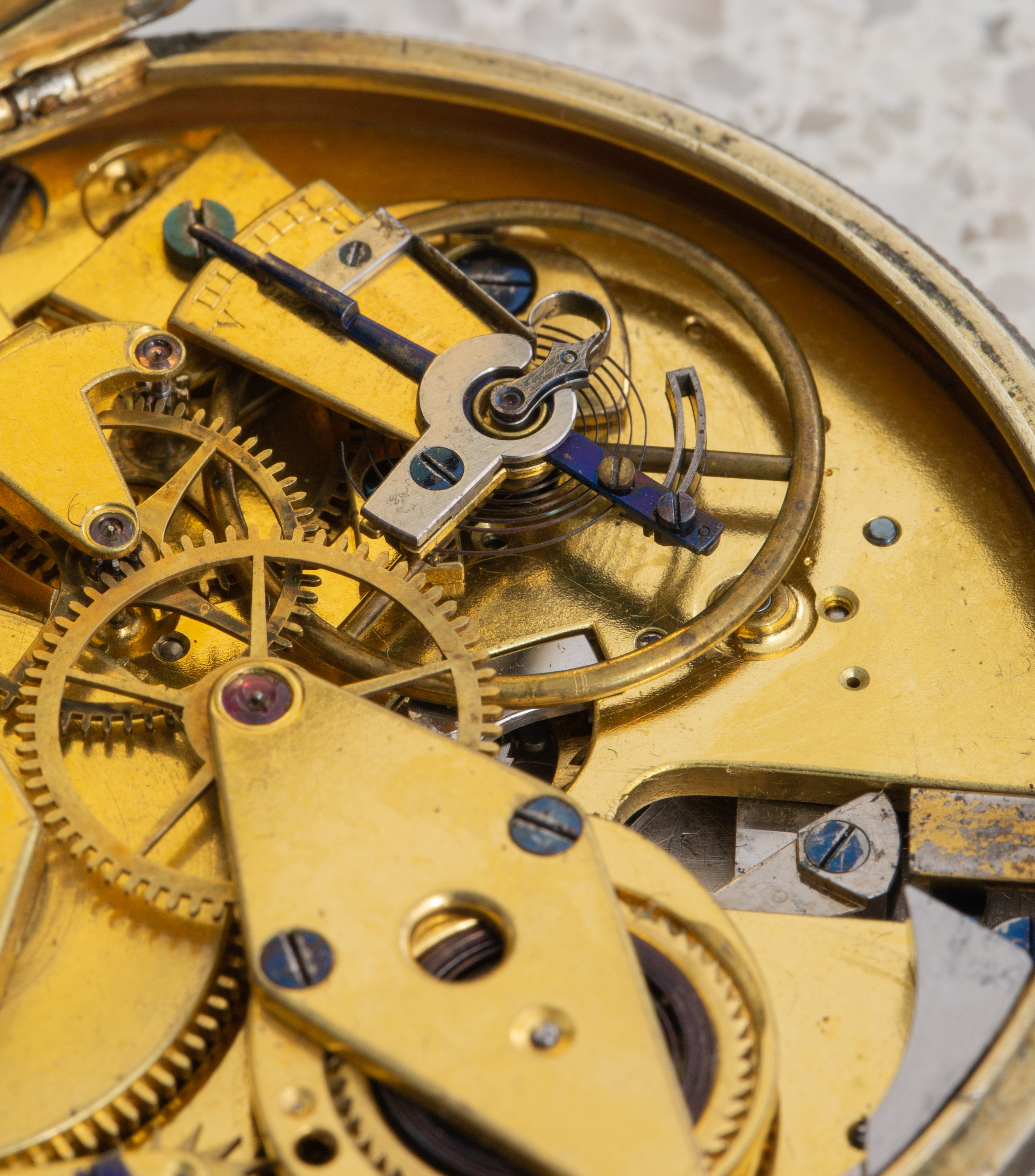
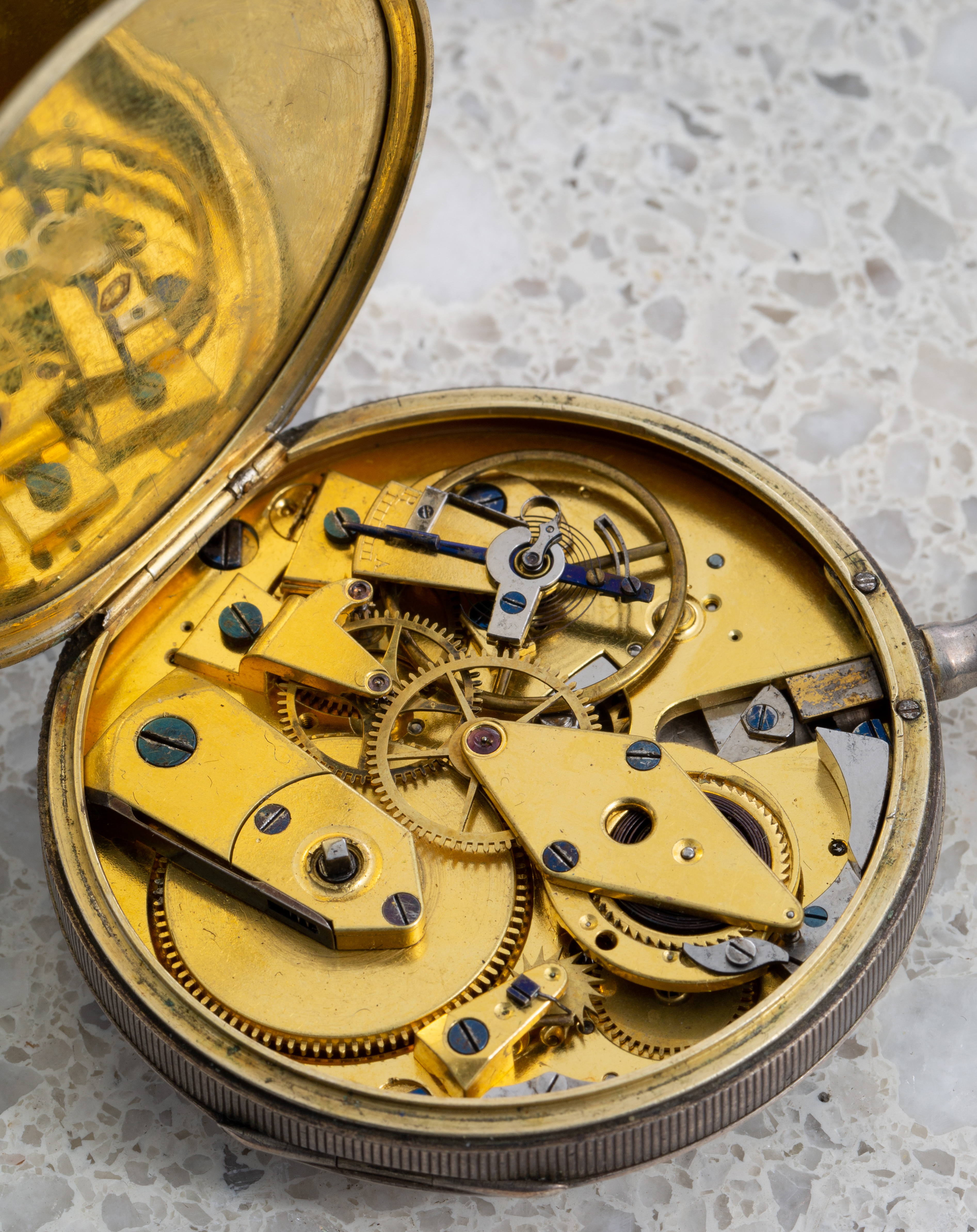
Description: Silver cased, gilt brass ‘répétition à ponts’ movement, back wound quarter repeating à toc, ruby cylinder escapement, three armed plain balance with round rim for later examples, spiral steel spring with regulator, compensation curb and early parachute. Slightly later silver guilloched dial made by Pierre-Benjamin Tavernier engraved with ‘Breguet et Fils’ signature (signature introduced 1806). Dial is fixed by one screw. Round blued steel ‘Breguet’ hands.
Provenance: Ex private collection A. Chapiro (F)
Published: Chapiro A., Taschenuhren aus vier Jahrhunderten, Callwey, Munich, 1995, P: 244, 245, Fig.: 511
Additional Info:
This watch was most probably constructed having an enamelled copper dial, which got exchanged in the Breguet workshops for a custom made guilloched silver one after 1806, either because it broke or to adapt the watch for the new fashion of the early 19th century in France. It has a fully developed repeating work with rocking snail all-or-nothing mechanism, single hammer à toc. Additionally the watch features a simple date work, eccentrically located at two o’clock.
Breguet’s repeating mechanism
There are two different types of repeating movements used by Breguet before 1806. The first type is the conventional full plate system featuring a repeating work wound by chain and pulley as perfectioned by Julien Le Roy with two hammers à toc as seen in watches Nos. 203 and 234. This type is used by Breguet before 1787 and until 1800, as well as by most contemporary watchmakers.
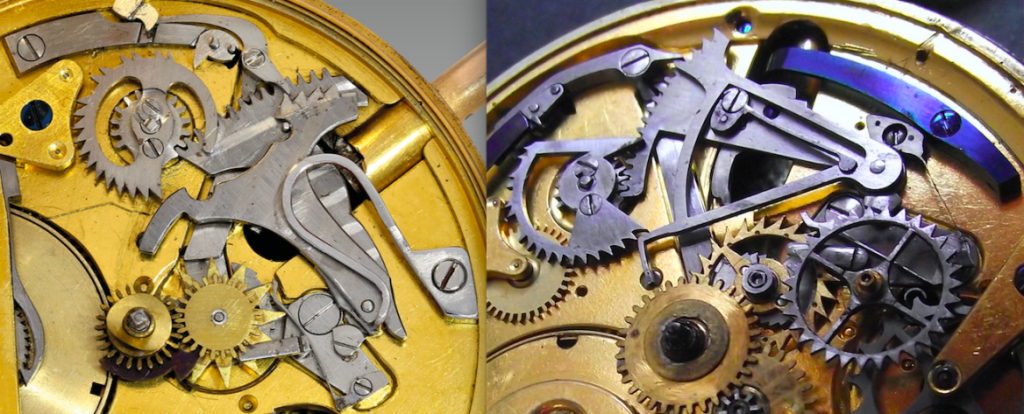
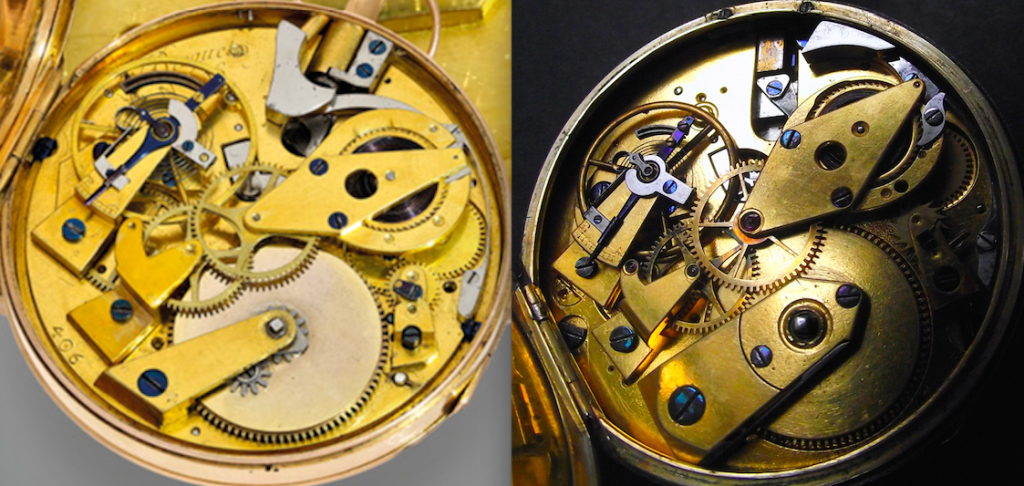
In the second types seen in No. 406 above and as a slightly later version in No. 726, the barrel is held by a separate bridge, like in the end version of the souscription watches. This repeating work has been developed by Breguet by modifying Stodgen’s system who took it from Julien Le Roy. It’s integrated in the ‘nouveau calibre’ (1790 – 1815), Lépine’s repeating calibre (1797 – 1805) and the ‘répétition à ponts’ (1800 – 1830). Most repeating watches of the second type have a ‘parachute’. All versions have one hammer, the earliest versions like the ones above, strike directly onto the case (à toc).
Later examples strike on one gong by interaction with a small steel spring. Most other watchmakers used two hammers on two gongs, Breguet adopted latter style for later watches of minor quality. Pre 1795 models lack the parachute and the fusee, they’re wound from the dial and they retain Stodgen’s system with pulley and chain.
Pictures credit: Yves Müller – http://www.visiuns.com
 Antiquarian Horology
