

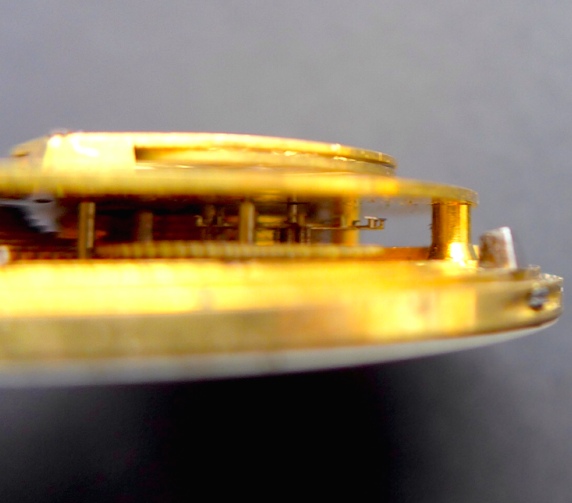
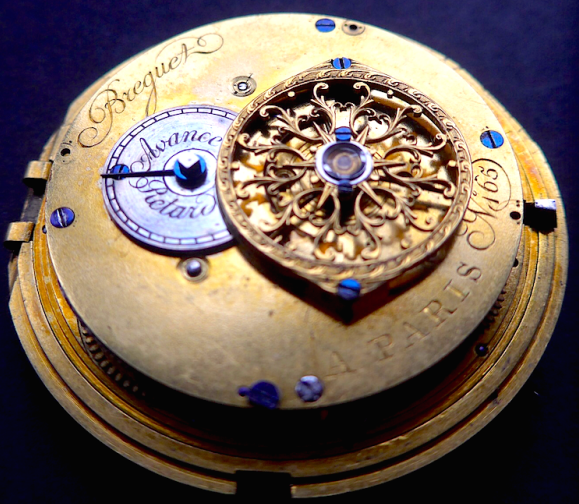
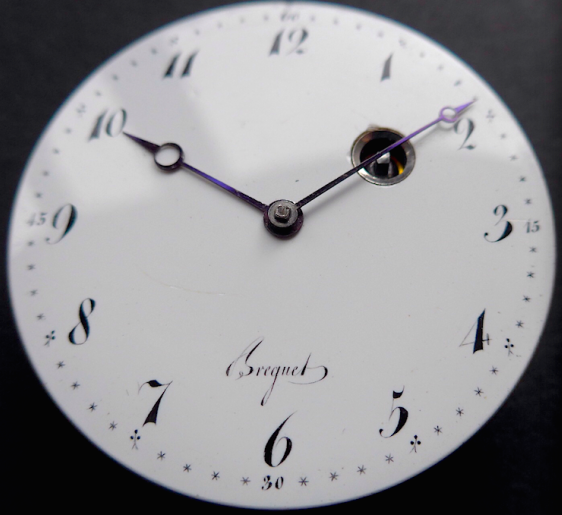
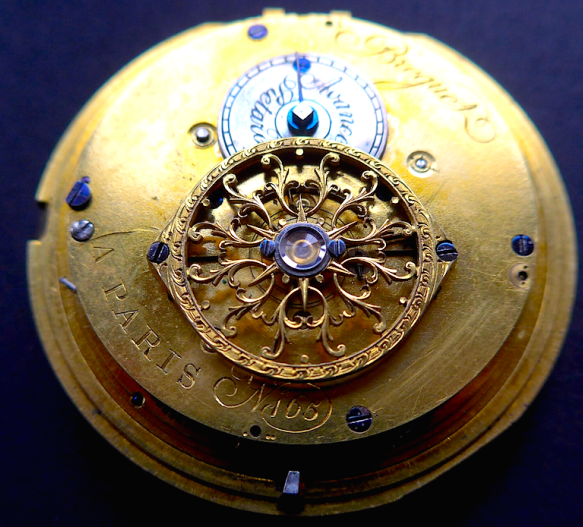
Description: Gold cased, gilt brass, front wound full plate movement (49mm diameter). Three arm brass balance with four armed English type steel cylinder escapement. Back plate screwed to the round pillars, as in marine – or high grade pocket chronometers. English jeweling (sapphire) to the cock, separately cocked escape wheel (not fixed between the plates), this separate internal cock called potence is covered by a steel cockerel. Back plate neatly engraved ‘Breguet A PARIS No. 165 (2nd series). The addition ‘A PARIS’ is used by Breguet until 1795. Enamelled copper dial having a steel winding hole protection, with Arabic ‘Breguet’ numerals, indexes marked with ‘Fleur de Lys’ for the five minutes and stars for the minutes, symbols only used on dials by Breguet until 1793. Dial signed with early cursive ‘Breguet’, a style rarely used until 1795 which more realistically reproduces Breguet’s actual signature than the other forms of cursive signatures. Flat blued steel ‘Breguet’ hands of the first type.
Additional Info:

Two versions of this rare dial signature exist with differently written ‘r’, No. 165 bearing the same version as No. 17 and No. 148 (both 2nd series). The first numbering style with the fractional numbering was abandoned towards 1788, No. 112 having the same style of numbering on the back plate as No. 165 and dates from 1789. This type of movement seems to arise from the ‘lower quality’ commercial movements used during the partnership of Breguet with Xavier Gide and is one of only about five surviving of this type and the only and earliest known to us being a ‘montre simple’ with no complication. The finishing of this movement exceeds by far all other French style ‘simple’ movements of this period one can encounter. The elaborate finishing of this movement coincides with Xavier Gide’s description of Breguet’s work, which for him was too slow because Breguet was paying attention to unnecessary details instead of producing more pieces of less perfect quality. This difference in working ethics and philosophy contributed to the premature ending of the collaboration in 1791.
There is much evidence for Breguet having used English steel cylinder escapements for some of his earliest pieces such as No. 128 5/85, made in 1785. He visited London repeatedly in 1790 and 1791 where he tried to finalise important sales and had several watches jewelled (sapphires), this movement possibly being one of those pieces brought to England and jewelled there. The art of jeweling was not much developed by French watchmakers at that time and the best jeweling was provided by English specialists. Later Breguet modified the cylinder escapement (with trapezoid pallets) to be used with his version of ruby cylinder system.
Also France was suffering enormous economic problems after the revolution which peaked in 1790 and it is possible, that this watch was commissioned by an English client in English style.
English influence
In No. 165 above, the English style jeweling of the cock, the use of an English type steel cylinder escapement and the screwed back plate reflect the tight exchange with English watchmakers such as John Arnold in London. Many early watches made in Breguet’s workshop testimony of the big influence of English watchmaking. Breguet visited London several times starting from 1785 then again three times in 1790 and 1791. When forced to quit France in 1793 Breguet worked for some time in London after his stay in Switzerland, hosted by Jacques – Frédéric Houriet in Le Locle. John – Roger Arnold, John’s son was Breguet’s apprentice (1792 – 1794). Louis – Antoine Breguet, Abraham – Louis’ son was apprentice to John Arnold. These mutual exchanges ensured a refinement of watchmaker skills in both countries and the development of the so called ‘Breguet-style watches’ which came into fashion in France and England starting from about 1810.
Breguet (and to some extent Lépine before him) adopted and refined from English watchmakers: big size of watches (chronometers; J. Harrison, J. Arnold, Th. Earnshaw and others), cylinder escapement (G. Graham), lever escapement (Th. Mudge), temperature compensation for spiral spring (J. Harrison), ruby cylinder escapement (J. Arnold), Tourbillon (J. Arnold), compensation balance (J. Arnold), jeweling (J. Arnold and others), balance spring overcoil (J. Arnold).
English watchmakers later also adopted French features (mostly from Lépine and Breguet): bridged caliber (Lépine), aesthetics and disposition of bridges (Breguet), parachute (Breguet), guilloched metal dials (Breguet, adopted from J. Arnold), ‘Breguet’ hands (Lépine/Breguet), repeating system on gongs (Breguet).
 Antiquarian Horology
