
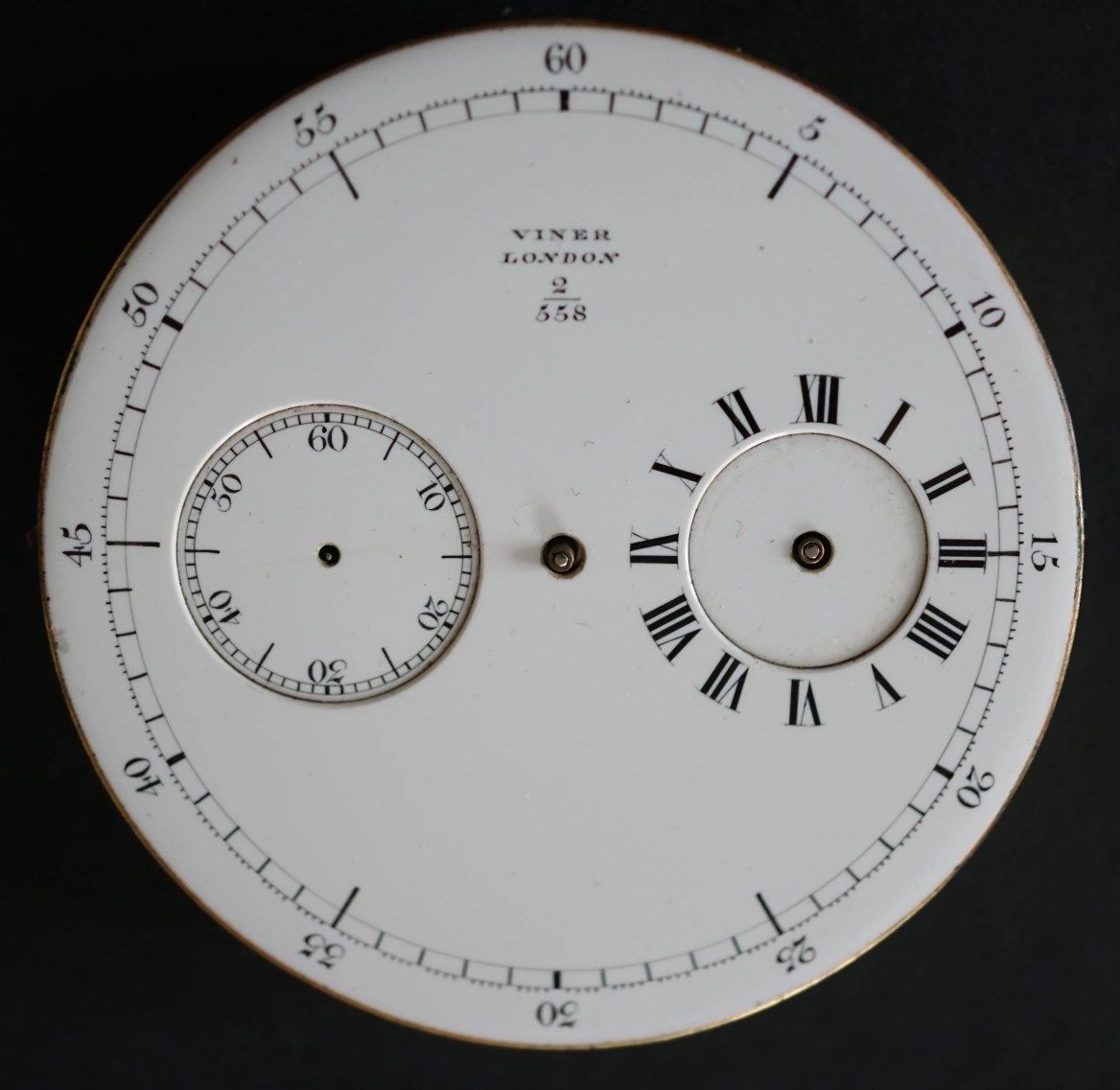
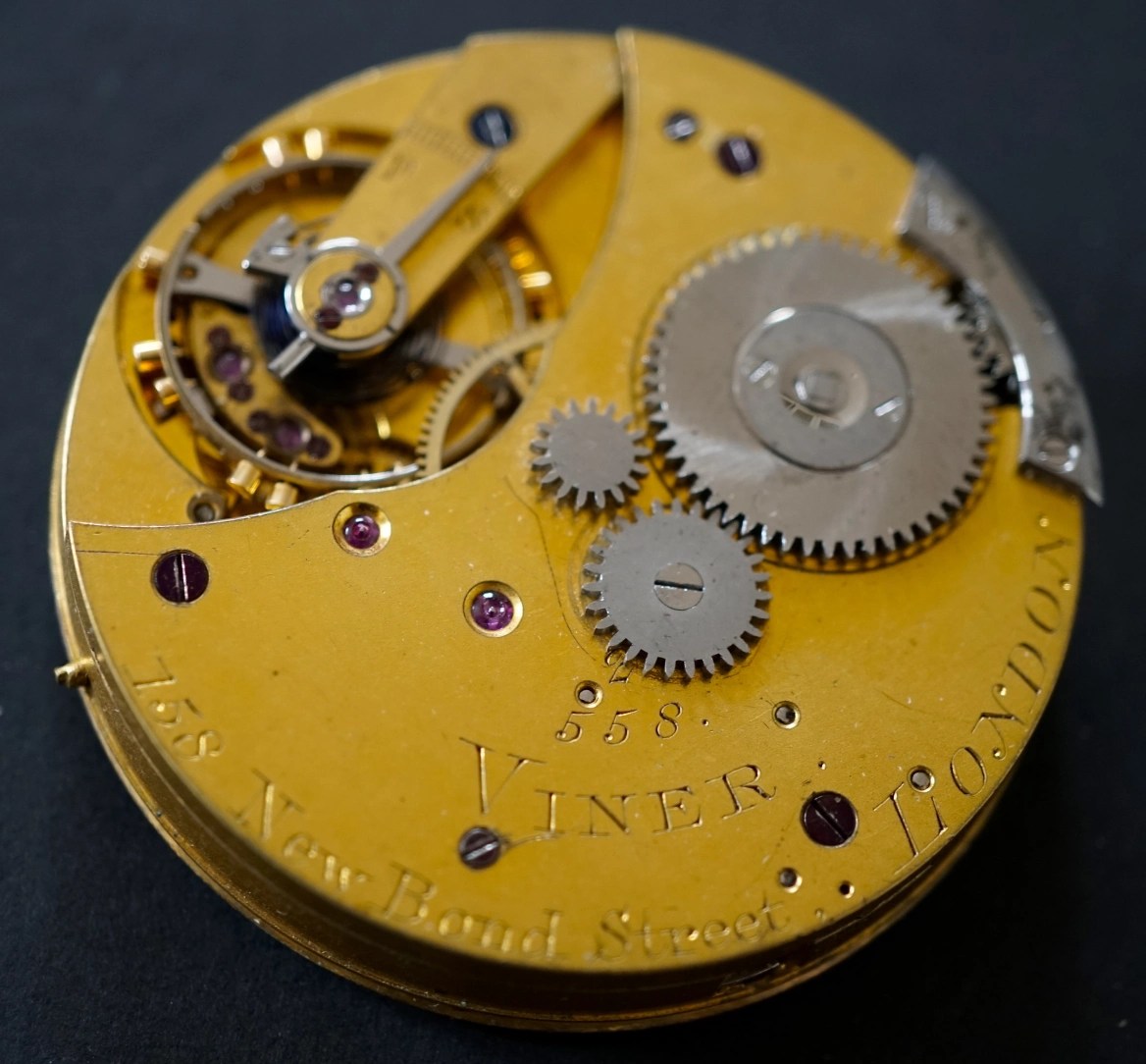

Description: Plate-less three-quarter plate keyless (hunter set) going-barrel movement (44.5mm diameter). Cap jewels on balance, lever and escape, the chronograph work mounted under the dial and the frame stamped with Nicole’s numbers 6004 and 6118. Single-roller detached lever escapement, roller with triangular jewel. Compensation balance, blued-steel balance-spring with overcoil. Signed ‘Viner London’ enameled copper dial of ‘regulator’ layout, as often used by Nicole on their chronographs at this period. Dial numbered ‘2/588’. (A)
Additional Info:
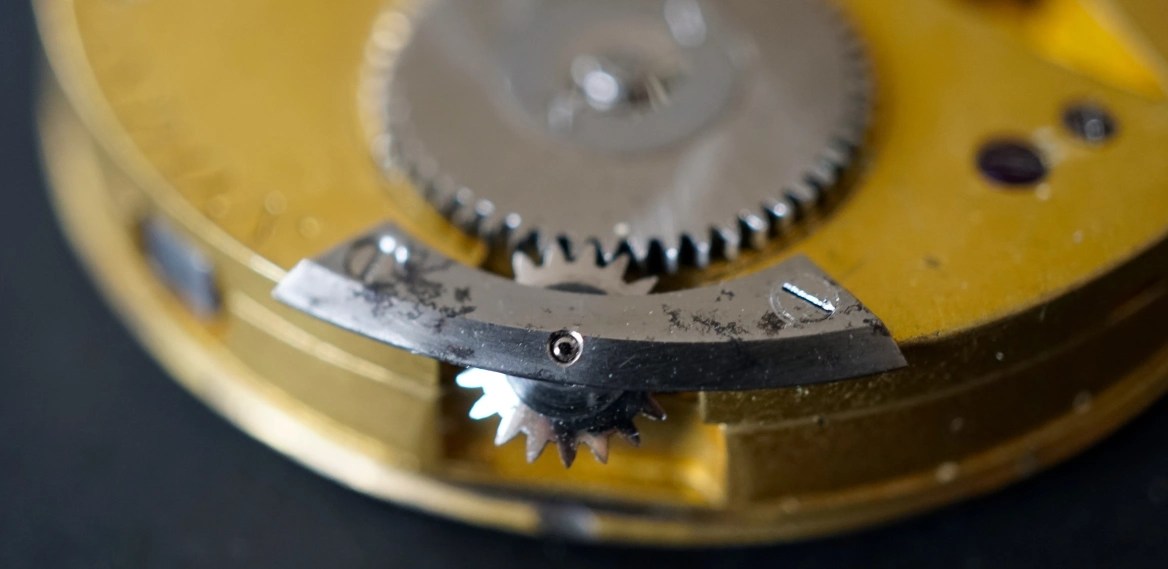
Please note that the intermediate wheel is no longer attached to the setting wheel as in earlier versions, but to the winding wheel (A).
Pierre Frederick Gougy Patent Chronograph system, 1839
Adolphe Nicole, Patent No 10,348 of October 1844, includes the ‘heart shaped cam’ controller for true, start/stop/return to zero chronographs. This movement, however, is a rare example of Pierre Frederick Gougy’s earlier Patent No. 8308 of December 1839, in which two separate seconds hands are connected by a spiral hairspring, the outer end of which is connected to a steel disc (lacking in this movement) with ratchet teeth at its edge. Pushing on a pin in the band allows a sprung lever to stop the disc and thus one of the hands, and the time can be noted. Releasing the push allows the hand to catch up with the standard seconds hand with which it then continues to revolve as one (A).
Charles Edward Viner (1788 – 1875) completed an apprenticeship with Thomas Savage in London from 22.09.1802. On 03.05.1813 he became a member of the Clockmakers Company. He was first based in Sweetings Alley, Cornhill, then moved to 233 Regent Street, London, where he worked from 1826 to 1835. He was then based at 235 Regent Street, Royal Exchange until 1855. He also had properties in Old Bond Street between 1844 and 1857, Sackville Street 1856-1867 and New Bond Street 1868-1869. He made pocket and marine chronometers with movements by Parkinson & Frodsham and pocket watches with duplex escapement, the latter also with pump winding. In 1824 he became a business partner of Hoskins for many years. Mann traded under the name Viner & Hoskins and Viner & Co. According to Herbert Blockley, he was the successor to Viner.
 Antiquarian Horology

