
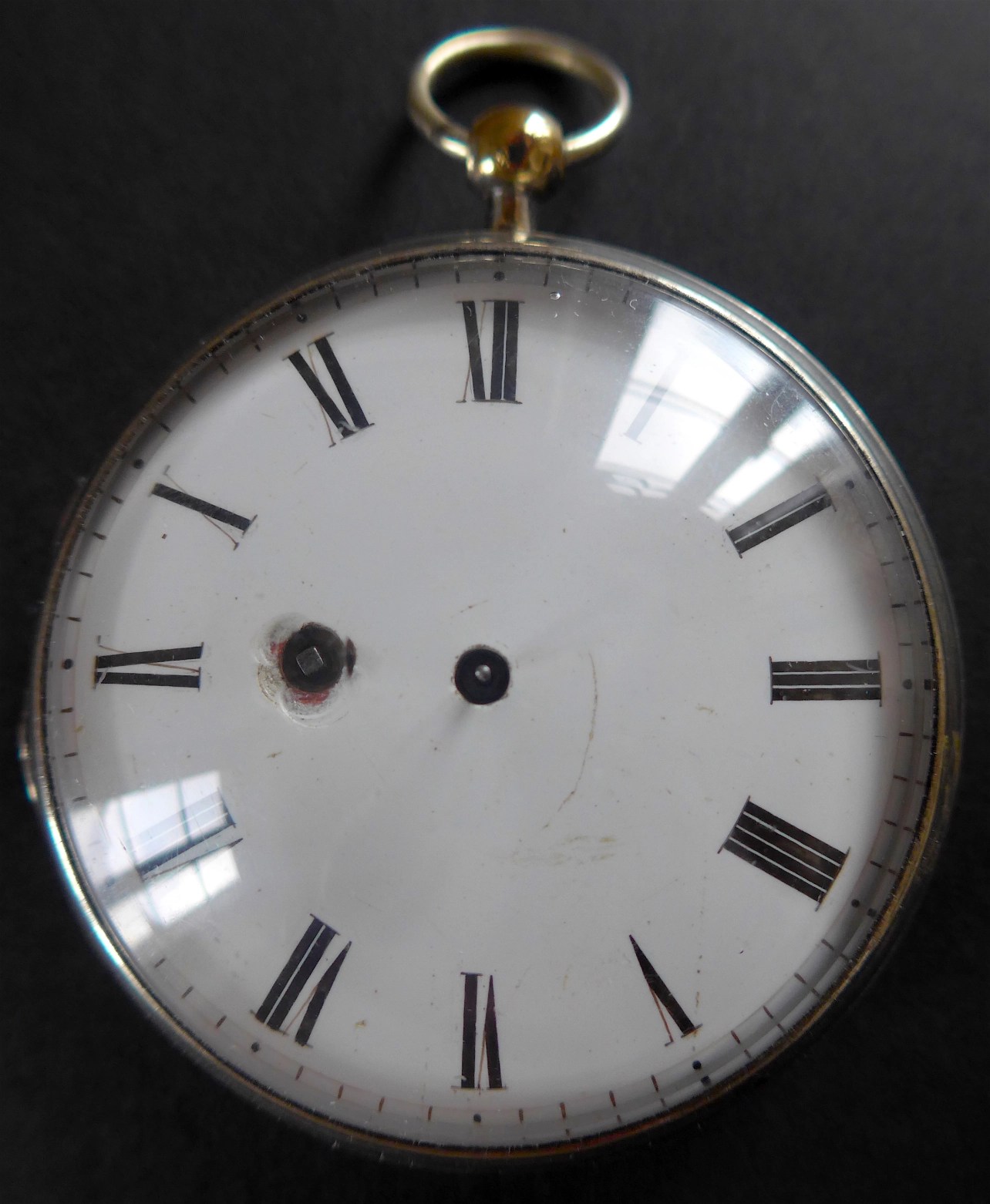

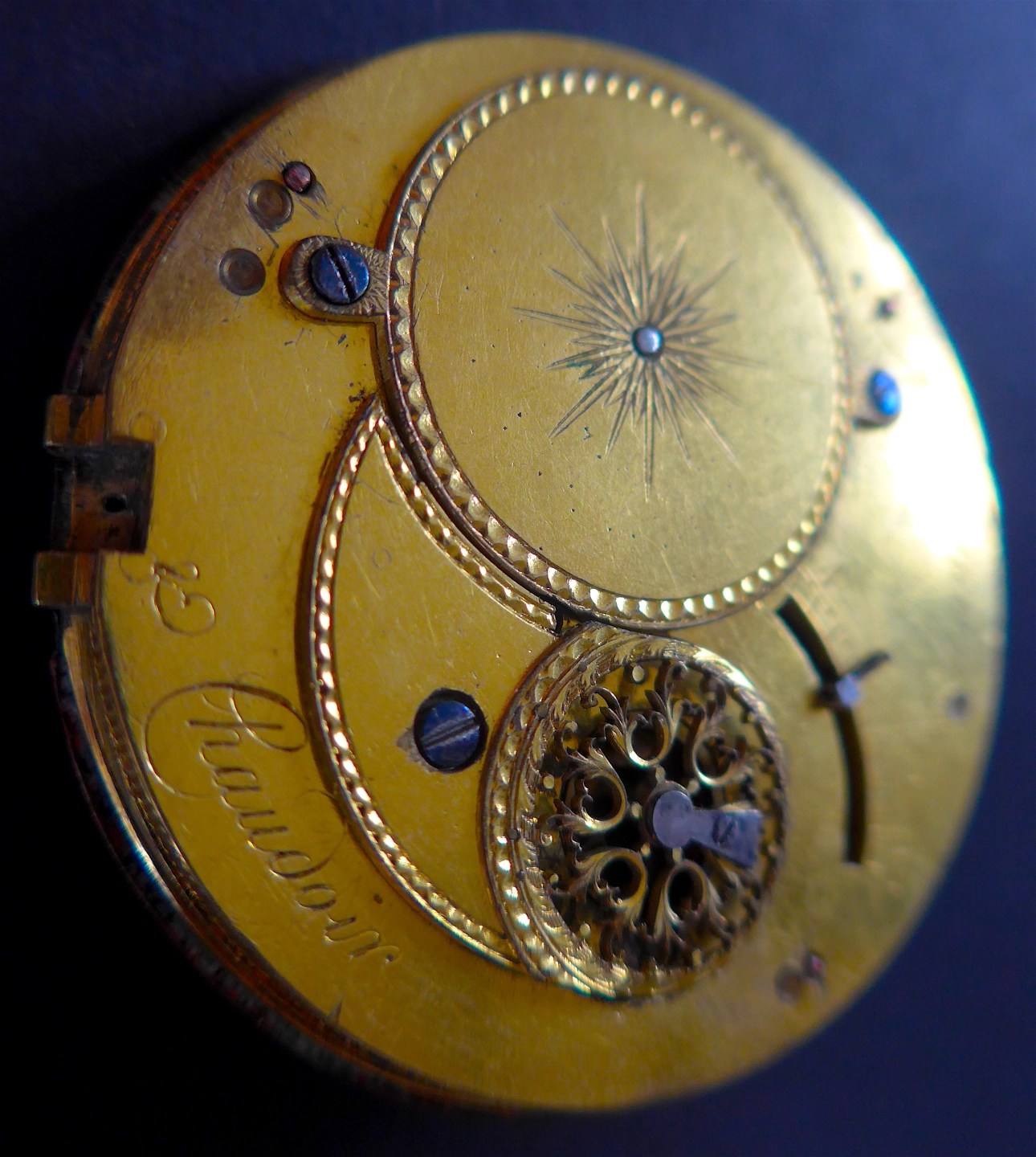
Description: Silver, consular cased, gilt brass, front wound, Lépine-Hessen virgule, semi-full plate movement (53.8mm diameter). Unique cock retaining the pierced design of earlier versions, but being one footed. The foot is curved as in the ‘hanging barrel Lépine caliber’. The wheel train is completely enclosed. Balance spring tension regulator arm piercing through the ‘back plate’ as later used by Abraham – Louis Breguet. The movement is signed ‘Al(exan)dre Patry & Chaudoir’. Unsigned, enamelled copper dial.
Additional Info:
The the round spring barrel cover is typical of the second version (Type II) made by André Hessen, whereas the wavy decoration on the edges of the spring barrel cover and the cock foot is typical of Geneva work. Please note the new use of the single-footed, Lépine-style cock retaining the Louis XVI style decoration.
This movement represents the second version (Type II) of the adaptation of Lépine’s new principles by André Hessen and uses a lever escapement. This new variant with enhanced escapement was now used by much more watchmakers, as the more ‘primitive’ verge version. Watchmakers in Paris used it, but it was most popular in Geneva, most probably because the rough movements were made in Geneva or Ferney. Watchmakers using this type of movements include: ‘Le Blond l’ainé à Paris’, ‘ Rouvière à Paris’, ‘Duchène et Comp’, ‘Moré & Dupont à Geneva’
Alexandre Patry 23.11.1758 – 21.12.1822 ; François – Guillaume Chaudoir 1770 – X
Alexandre Patry, born in Geneva from a dynasty of goldsmiths became master around 1780. From 1791 to 1796 he was associated with Louis – François – Guillaume (Hubert) Chaudoir (born in Berlin). The output was signed ‘Al(exan)dre Patry & Chaudoir’ or ‘Patry & Chaudoir’. After 1798 another association with Pierre Chenevière (1766 – 1849) arose with their output named ‘Patry & Genevière’. In the archives of the City of Geneva another firm is mentioned: ‘Patry Oncle & Neveu’, where Alexandre was associated with his uncle whose name was also Alexandre. As both had the same first name, some confusion is sometimes encountered when attributing the pieces to one or the other.
 Antiquarian Horology
