

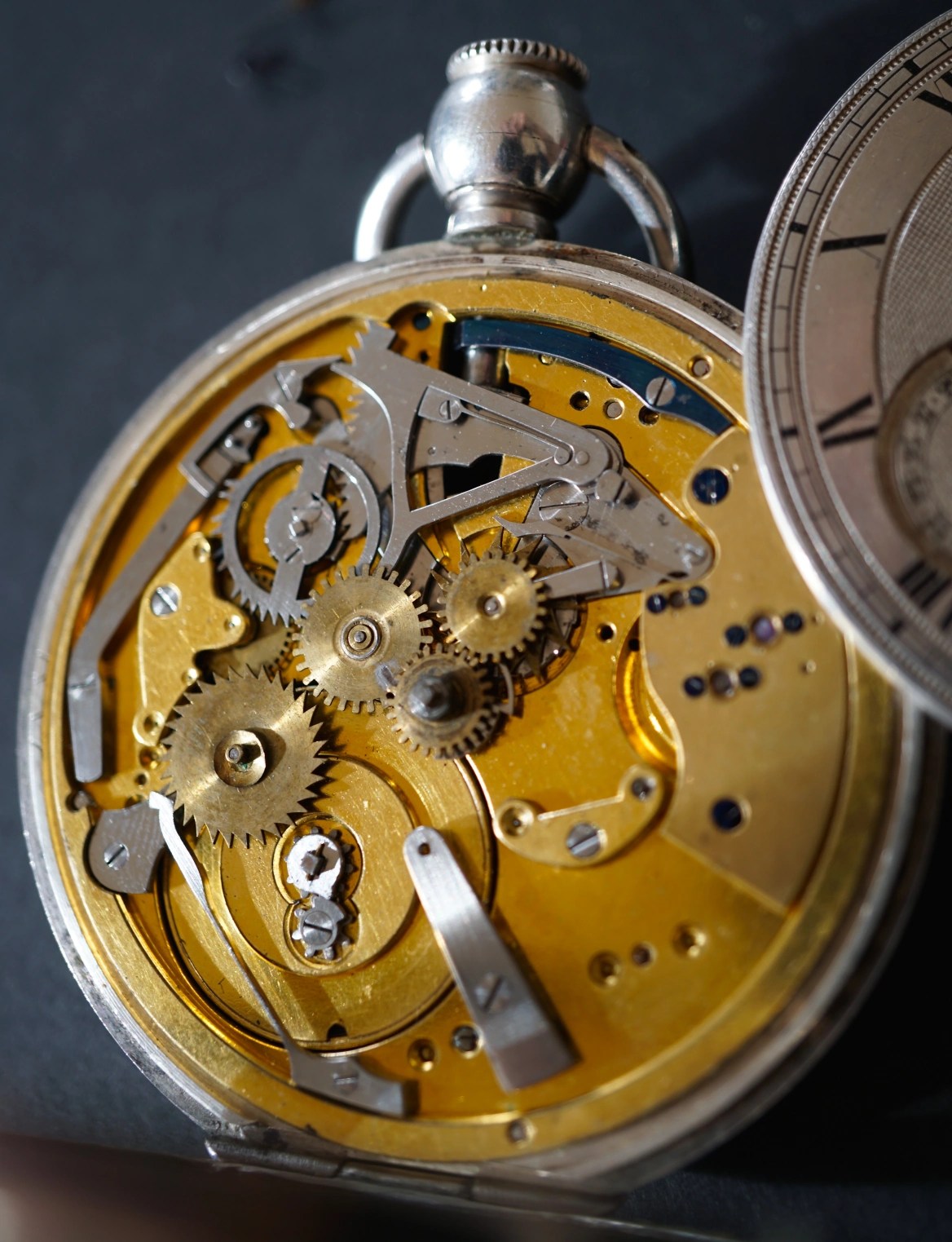
Description: Silver cased, gilt brass quarter repeating movement on gong with one steel hammer, converted (around 1910) from ruby cylinder to English lever escapement (50mm overall diameter). Later compensation balance. Jump hour system. Later (English) guillloched silver dial with two subdials (seconds and date), secured with one screw. Pull and twist activation of the repeating system. Later bimetallic compensation balance, balance spring and balance bridge. Balance bridge marked with a coventry four – arrow mid – point mark. Balance bridge well distinguishable as English by the gilding color and the index F – S instead of A – R used by Breguet and other continental workshops.
Additional Info:
This is the only watch by Breguet known to us which shows extensive modifications by another watchmaker. Moreover it is interesting to see, that the modification was done by an English workshop. Most probably the ruby shell of the escapement broke and the repairing watchmaker suggested a conversion to the more reliable lever system, which was very common at that time in England. Doing so, all parts connected to the former escapement type were updated and replaced including the bridges and the jeweling (English type with chatons and secured by two screws each). The space needed for the conversion was freed by cutting a fitting hole into the movement plate.
The repeating train corresponds to the layout invented by Breguet and shown in piece No. 729 above. The version shown here is the updated version repeating with one hammer on one gong instead of ‘à toc’ and some of the pieces of the repeating train show more elaborate manufacture. A later update will add another hammer and another gong. Latter system will be used in a simplified form by other watchmakers.

The case is a later replacement too. The original case might have been of gold and was thus scrapped. The new case shows the sponsor marks A G R for imported pieces, used by the English company ‘Robert Pringle & Co’ starting from 1907.
A very similar watch is known signed by Lépine, who used almost the same movement, provided by Breguet. Other as the movement of the watch presented here, the Lépine version is quarter repeating ‘à toc’ and has a slightly different disposition of the bridges, making the Lépine watch slightly earlier. This watch is signed ‘Lépine H(orlo)ger de l’impératrice’ and is thought to have belonged to Empress Josephine Bonaparte, wife of Napoleon Bonaparte. Latter watch was sold at auction (Crott & Schmelzer, Aix – la – Chapelle, 10.11.1984, Lot. 103)
 Antiquarian Horology