

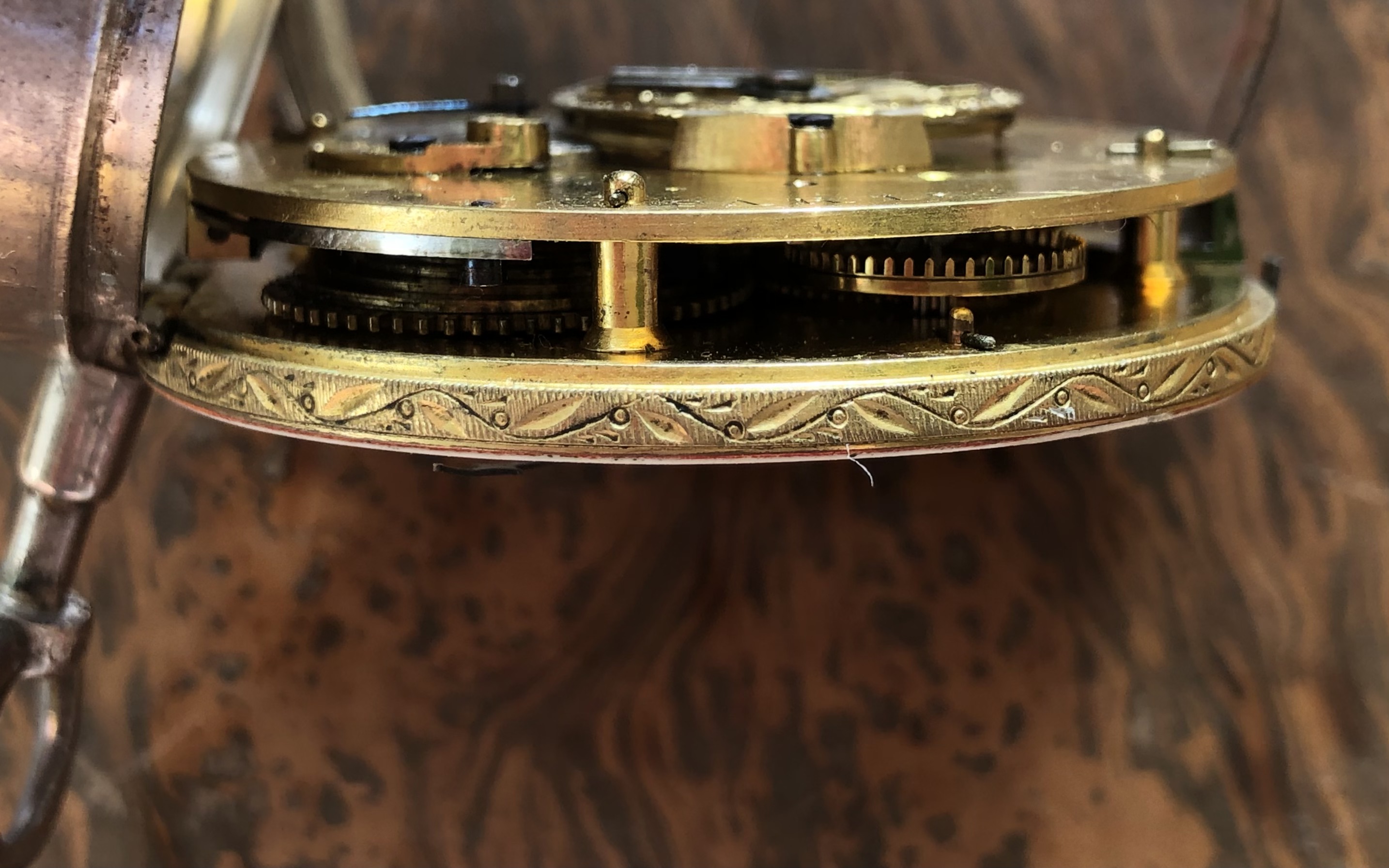


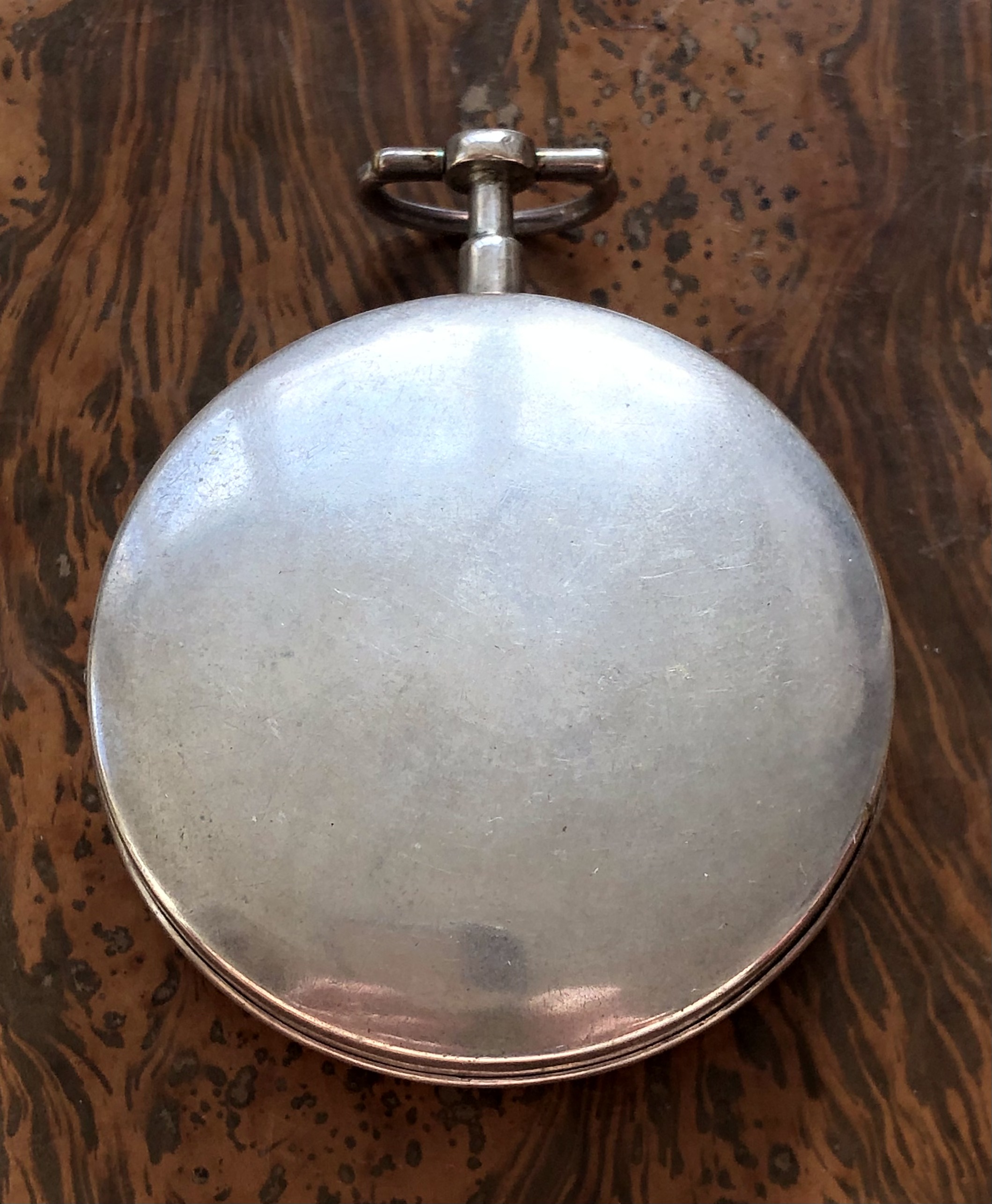

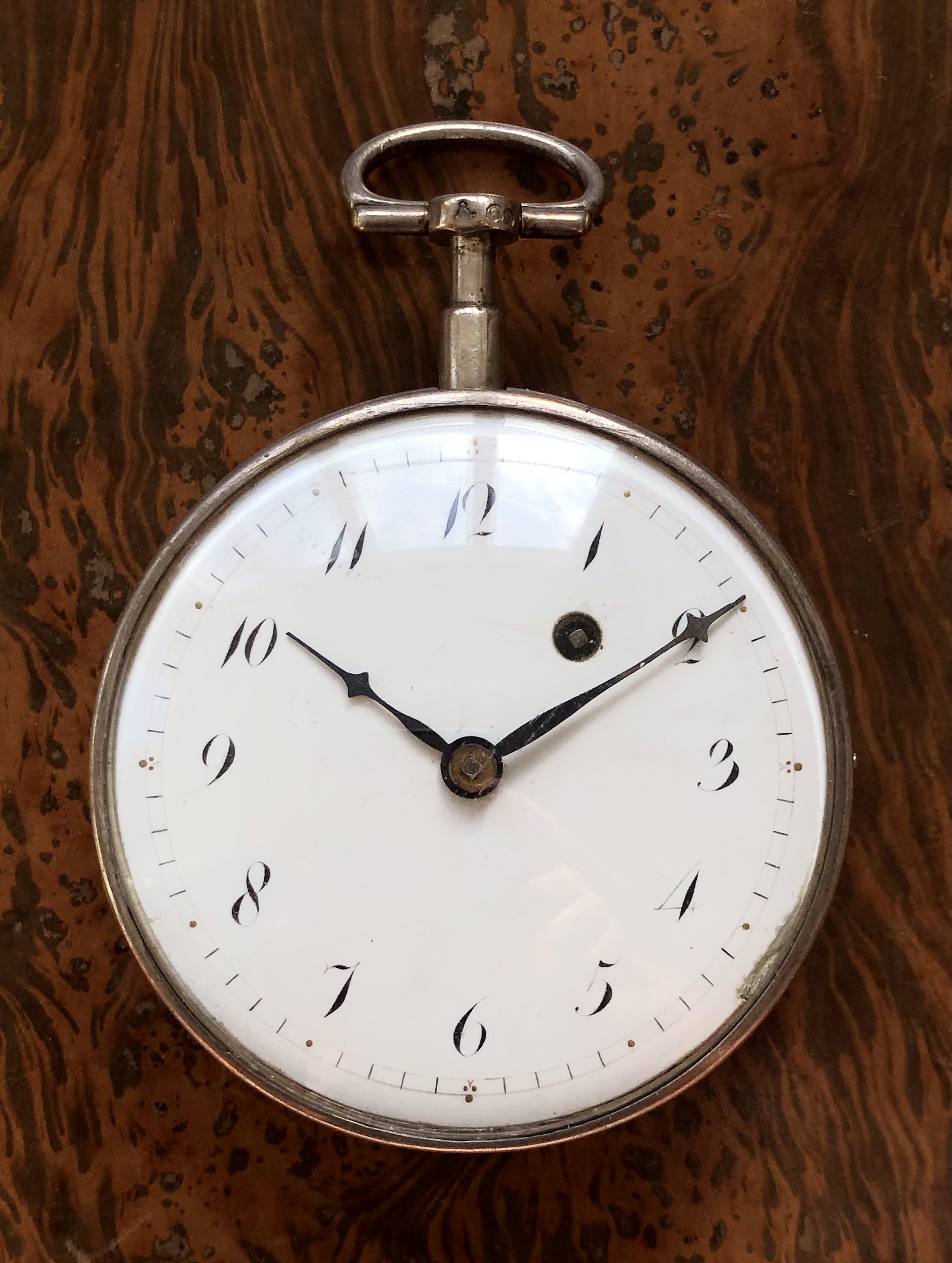
Description: Silver consular cased, gilt brass, front wound, verge watch (54mm diameter) with hidden hinge. Two plate verge movement. Small decorated cock. Silver regulation dial. Back plate signed ‘Janvier à Paris’ and numbered and dated ‘1/1804’. Rim of the top plate decorated with leaf design. Enamelled copper dial with black Arabic numerals and railway minute track. Hours marked with gold, stylised ‘fleurs de lys’ and dots. Blued steel hands.
Additional Info:
Antide Janvier is well known for his high quality clocks, and it is thought, that his workshop did not make pocket watches at all. However, as other clockmakers, Janvier is known to have sold pocket watches bearing his name. These pocket watches were bought by Janvier’s workshop either completely finished or as partial watches and finished in house. One of the reasons Janvier entered also the trade of pocket watches are his financial problems, which according to research worsened in October 1803.
This watch is one of very few pocket watches attributable to Janvier as a retailer. The quality of the finishing is comparable to Breguet’s work. Against a contemporary forgery speaks also the fact, that the original dial does not show Janvier’s name, which would be counterproductive if being a forgery. Moreover the way of numbering the movement is typical of Janvier’s style. Also the marking of the hours with gold, stylised ‘fleurs de lys’ and gold dots is encountered in several clocks by Janvier made around the same period as this watch.
Despite being marked ‘à Paris’ indicating that Janvier’s workshop was in Paris, the watch was most probably made in Besançon. Indication for this is the case hallmarks for the French Jura, the typical hand style almost only encountered in the French Jura and the decoration on the rim of the movement, which is not encountered in Parisian work, but which emphasises the typical napoleonic leaf decorations.
It is known that also Breguet had some of his watches made in the French Jura, especially during the ‘terror years’ when Breguet was exiled in Switzerland. Also these movements are exquisitely made and finished and the cases also bear the hallmarks for the French Jura.
 Antiquarian Horology
