
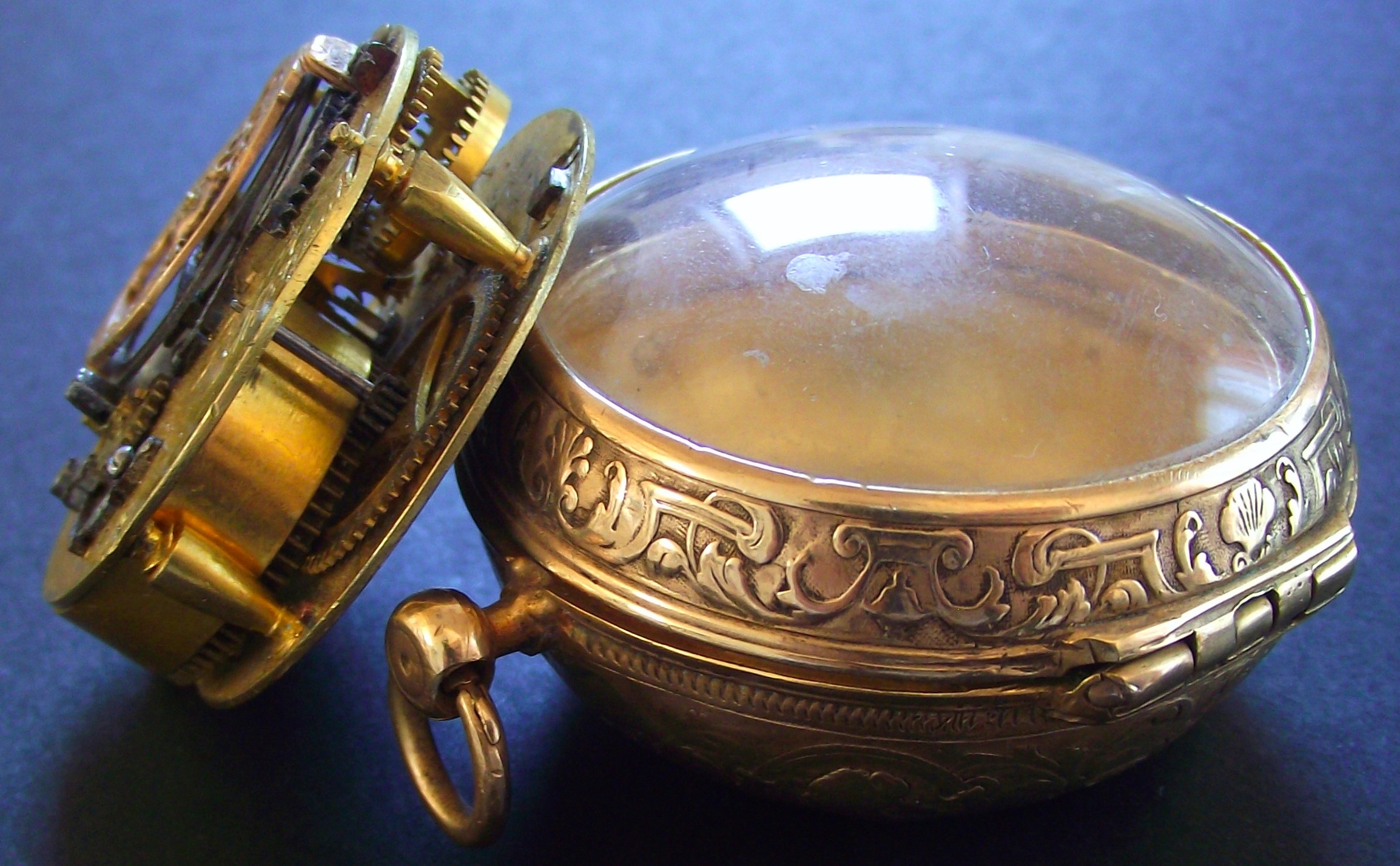
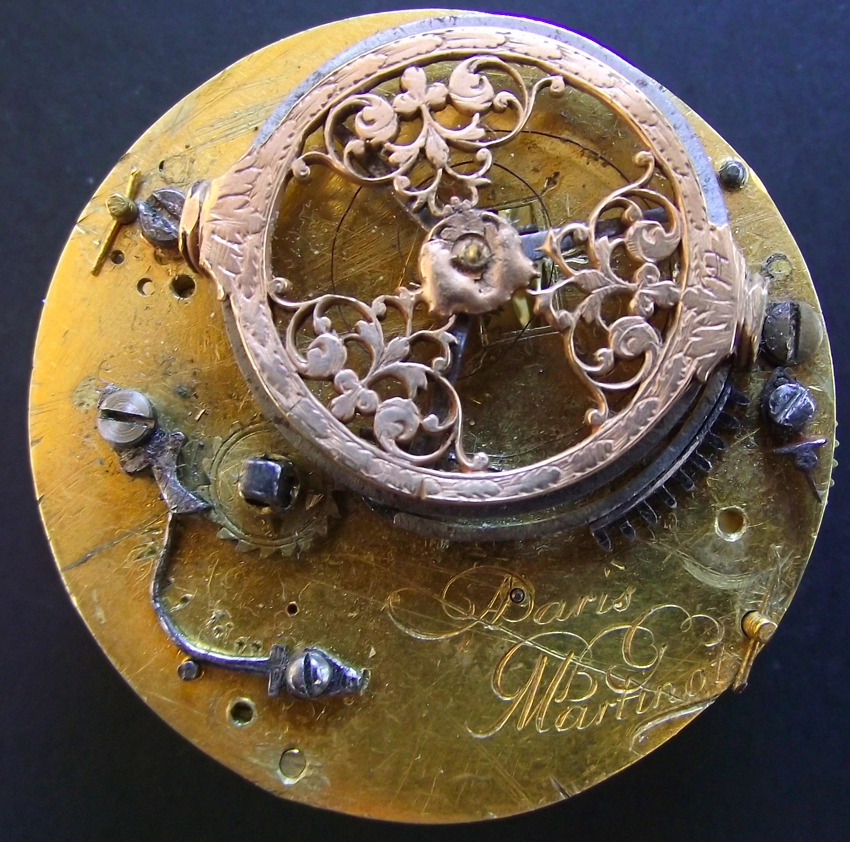
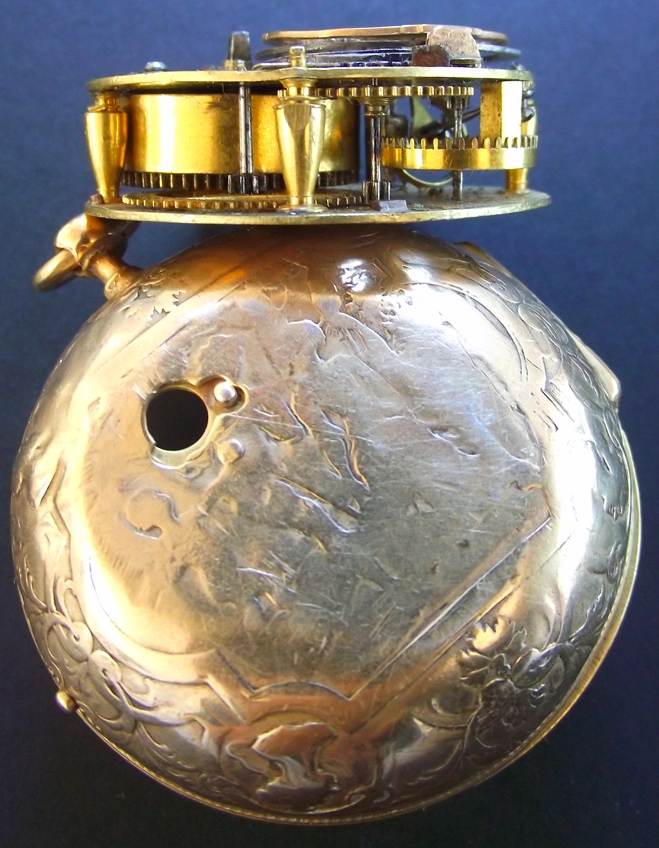
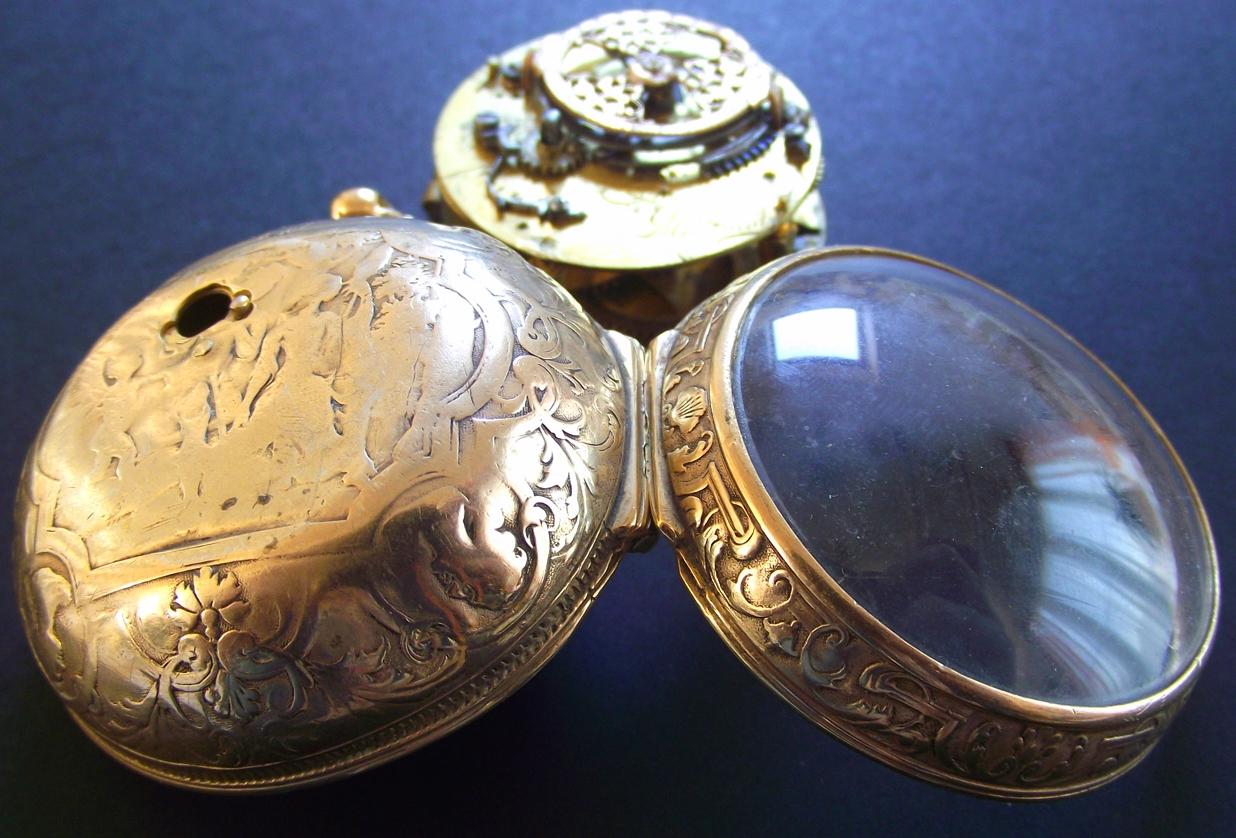
Description: Gilt brass, back wound, verge movement with NO fusee, brass three arm balance with steel balance spring. Fusee replaced by an additional fourth wheel. Gilt silver (vermeil) two footed cock. Because of the lacking chain the barrel is equipped with a wheel too, lacking hour wheel, dial plate, dial and hour hand. Cased in gilt silver (vermeil) case with typical late 17th century decoration like scallops and scrolls.
Additional Info:
The introduction of the spiral spring revolutionized timekeeping. Before the spiral spring was added, watches differed up to 40 minutes per day. The amazing gain of precision let many watchmakers (including Thomas Tompion) think that they could build simpler watches and retain the precision by omitting the fusee and the chain. A conceptual mistake, which was corrected very fast by adding the spiral spring and reintroducing the fusee. Most verge watches with no fusee of the period 1675 – 1680 were new constructions, some however are modified watches which were equipped with a fusee before. Not many of these watches have survived, as the clients realized quickly the lack of precision caused by the omitted fusee and scrapped these watches or exchanged them for examples with fusee and spiral spring.
Christiaan Huygens 14.4.1629 – 8.7.1695

In 1675 Christaan Huygens, a Dutch physicist and mathematician revolutionized precision in timekeeping by introducing the spiral spring. He moved to Paris in 1665, where he staid for 15 years, financed by Colbert, the finance minister of King Louis XIV. Huygens studied oscillations and was interested in timekeeping. 1657 he invented the pendulum as regulatory organ for big clocks, which made them achieve a precision not known until then. During further investigations on the subject he recognized the parallels between the oscillations of a pendulum and the change of shape of a spring. By adding a spring to the balance of a watch he wanted to achieve similar isochronic oscillations as with a pendulum. His original notes show that the shape he chose for such a spring was a spiral.
Huygens commissioned the construction of a watch with a spiral spring to the parisian watchmaker Isaac Thuret. The first model was completed the 22nd of January 1675. Thuret was so impressed by the precision of the watch, that he constructed a second one. In addition to this, he started to speak about this new, improved watches and he made people think, that he invented the new system. He even tried to get it patented, but Huygens intervention made him write a letter of apology in which he admits that Huygens is the inventor. The invention was then published the 25th of February 1675 in the ‘Journal des Sçavans’.
Strange enough Huygens might not be the inventor of the spiral spring after all! Jean de Hautefeuille, a French priest, inventor and scientist presented his invention of the spiral spring to the French Academia of Sciences the 7th of July 1674, who turned it down. Furthermore not him, but Huygens, who had contact with Hautefeuille got the permission (patent) to apply the spiral spring for watches, as he refined it and put the invention to application. In 1675, Hautefeuille protested against the attribution of the invention to Huygens, but he could not prove anything, so finally he abandoned.
However, also an English party claimed perfecting the spiral spring (earliest name: pendulum spring), when sometime between 1675 and 1680 Thomas Tompion and Robert Seignior developed the ideas of Hooke and Huygens in a small series of watches for the King, Dean Tillotson, Jonas Moore and others. (A)
 Antiquarian Horology
