


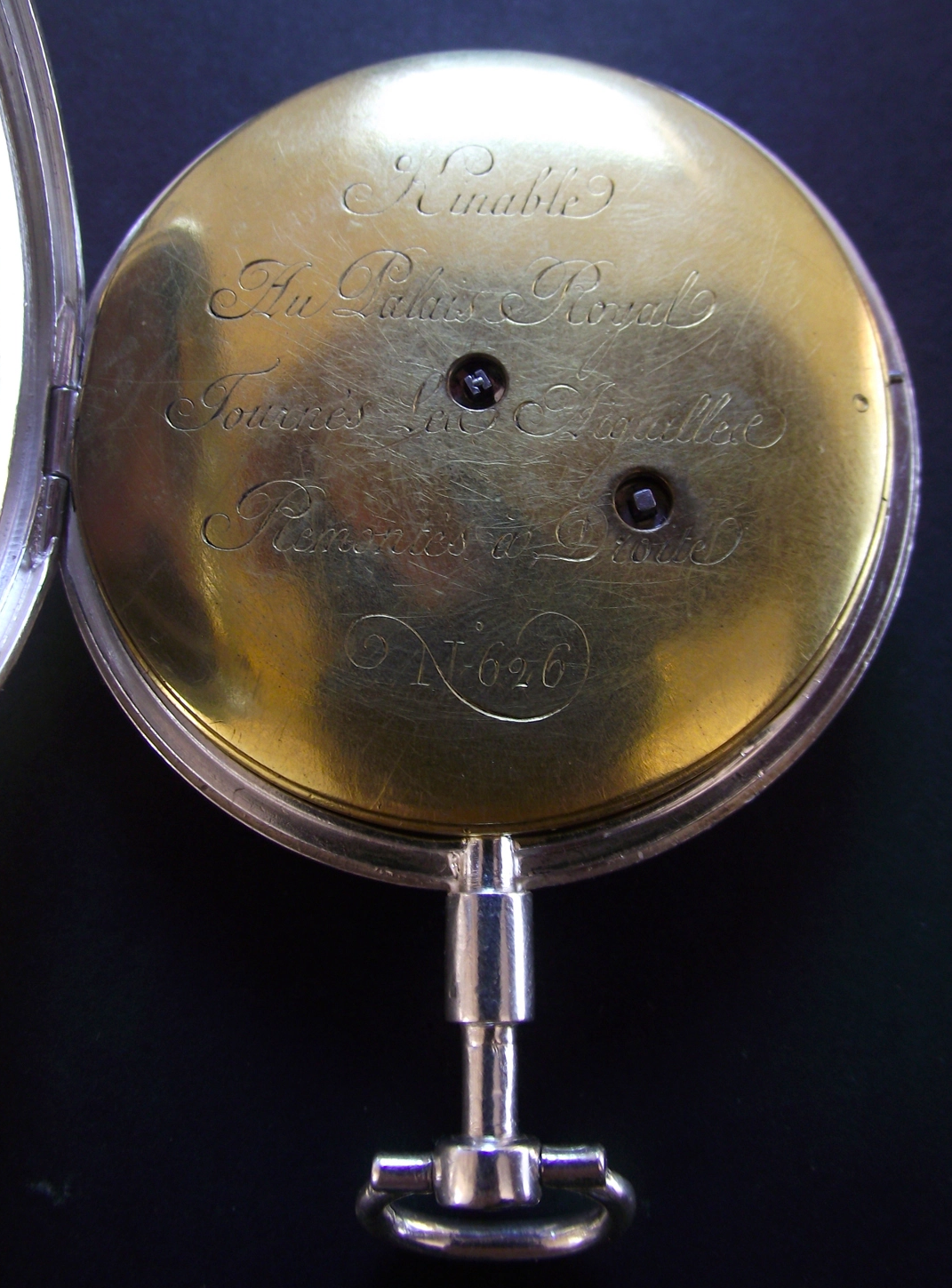
Description: Gilt brass, back wound Lépine movement, with steel cylinder escapement featuring hanging barrel. The movement lacks the typical two plate construction and represents the final step towards the development of the hanging barrel ‘Lépine caliber’. The spring barrel features a later ’circular feather’ spring. The ‘A,R’ readable on the balance bridge table, readable from the balance bridge foot side as in the intermediate versions between 1775 and 1780 (early movement, later cased and sold). Silver, plane, consular case. Gilt brass cuvette engraved with instructions for setting the time and for winding the watch, signed ‘Kinable au Palais Royal’, numbered 626. Rare and very fine, open work, blued steel ‘pear tip’ hands only used by few watchmakers in Paris other than Lépine and Breguet. Enameled copper dial signed ‘D. D. Kinable Palais Royal N. 131’.
Provenance: Ex private collection A. Chapiro (F)
Published:
Chapiro A., Jean – Antoine Lépine, 1720 – 1814, an “unknown” maker, Antiquarian Horology, September 1975, P: 448, Fig.: 5
Chapiro A., Jean – Antoine Lépine horloger (1720 – 1814), Les Editions de l’Amateur, Paris, 1988, P: 67, 68, 142
Chapiro A., Taschenuhren aus vier Jahrhunderten, Callwey, Munich, 1995, P: 170 -172
Additional Info:
Dieudonné Kinable was a watchmaker born in Liège (Belgium) and went to Paris around 1787. He specialized in lyre-shaped clocks which body is made of ‘porcelain de Sèvre’, ordering 21 pieces from the porcelain manufacture between 1795 and 1806. Judging from the similarities, it is most likely that Kinable ordered the raw movements from the same source as Breguet or that he had the watches refined and fitted by Breguet or Lépine. Kinable’s name also is mentioned in Breguet’s Repair Log. Later he signed his works just with ‘Kinable’.
 Antiquarian Horology