


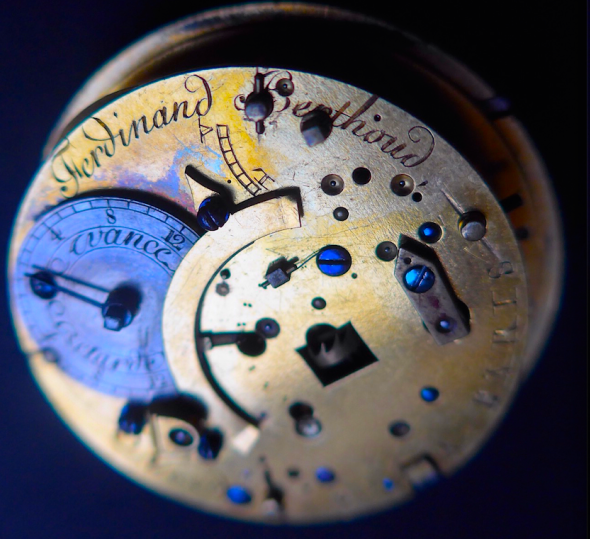

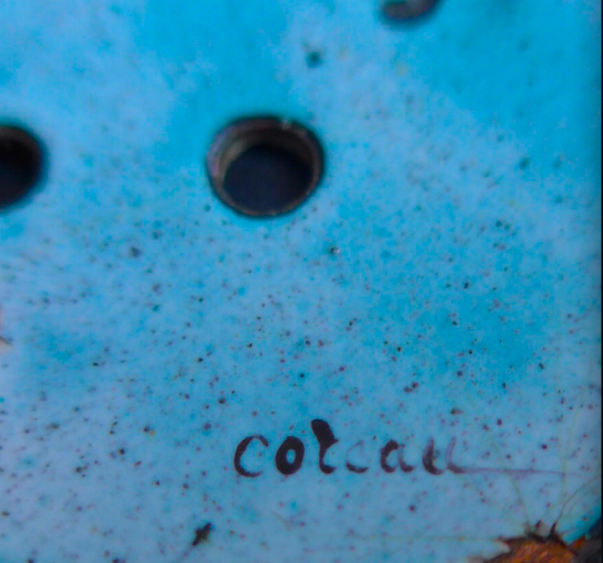


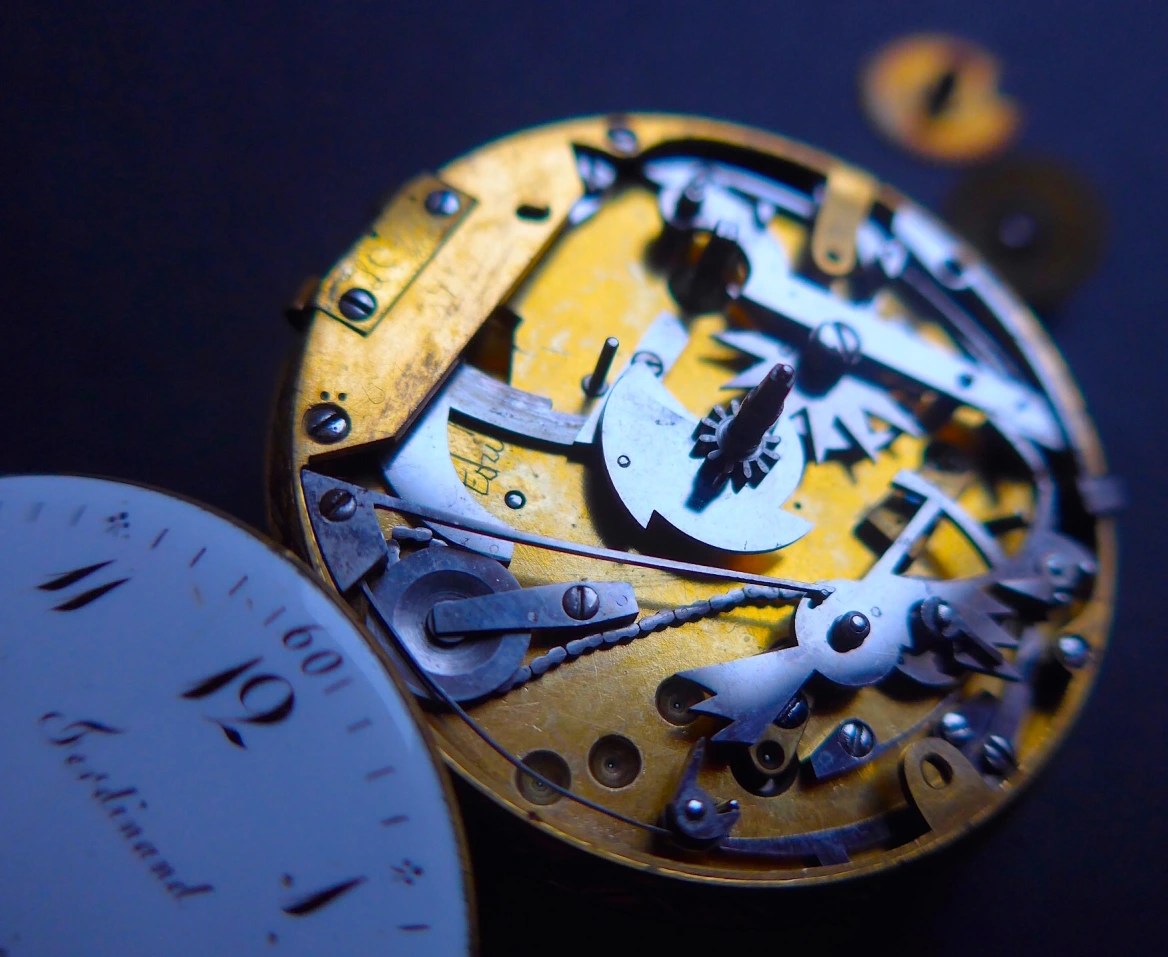

Description: Gilt brass, front wound, verge fusee, quarter repeating movement with two hammers ‘à toc’ (dial plate 40.0mm) with silver regulator dial and blued steel regulator hand. Featuring very small round baluster pillars. Back plate engraved ‘Ferdinand Berthoud A PARIS’ and numbered ‘No. 649’. Dial plate rim engraved with geometric figures and signed ‘Ferdinand Berthoud′. Enamelled copper dial with Arabic numerals, ’Fleur de Lys’ and line indexes and with the full signature ‘Ferdinand Berthoud’. Counter-enamel signed ‘Coteau’. Lacking chain.
Additional Info:
This movement was made just at the beginning of the critical period of the trials of Berthoud’s marine chronometers Nr. 6 and Nr. 8. The dating of this movement is made with help of No. 417, an experimental piece belonging to the British Museum, signed on the dial plate ‘Ferdinand Berthoud inv. et fecit. 1763’. The dating using hallmarks on the cases can be problematic, as sometimes earlier or later cases are matched (married) to movements. Also, as a normal procedure in the workshops, movements were fitted into cases years after their manufacture and were sold at this later date.

This repeating movement above is of best quality and in the style of Julien Le Roy. Also the signature on the rim of the dial plate is a Julien Le Roy workshop custom, as well as the repeating mechanism underneath the dial and the way to attach the dial with one screw. Other features are adopted from Jean – Antoine Lépine, such as the Arabic numerals on the dial. As Lépine, also Berthoud was very critic of new escapement types, preferring the very reliable verge to others. Later movements of the same type show brass cylinder escapements and centre seconds, indicating that he changed his mind tending towards the style of British precision timekeepers. Ferdinand Berthoud built very few pocket chronometers, mostly with the help of his apprentice Jean Martin, but paved the path for his nephew Louis Berthoud, who was a very prolific pocket – and marine chronometer manufacturer. Very few original pieces from the workshop of Ferdinand Berthoud survive. Even rarer are pieces bearing the full signature, they are mostly found in public collections.
Joseph Coteau (1740 – 1812)

Possibly the most famous enameler of his day, who supplied dials for the greatest clockmakers of France, such as Robert Robin, Ferdinand Berthoud and later Dieudonné Kinable. Born in Geneva, but soon he worked also in France as painter on enamel and porcelain. He became maître-peintre-émailleur at the Académie de Saint-Luc in Geneva in 1766. By 1772 he was installed in Rue Poupée, Paris. In 1778 he was received as ‘maître’. Beyond his enamel dials, Coteau was a skilled miniaturist, discovering a new method for gilt-decorated enamels. A Sèvres document states that he and Parpette (who also worked at the factory) introduced jewelled enamelling (a technique that involved enamelled gold-leaf foils) to both soft and hard paste porcelain. Coteau also experimented with various polychromes, producing a blue, that was so rare and difficult to perfect that few of his contemporaries managed to copy. He described his invented procedure: “d’appliquer solidement l’or marié avec les émaux de toutes couleurs sur la porcelaine”. Coteau worked closely with the Sèvres factory in developing their ‘jewelled’ porcelain, and his name first appears in the kiln records at Sèvres in 1780. He was appointed Peintre-émailleur du roi et de la Manufacture Royale de Sèvres in 1780. By 1784 his production was considerable and though he was in great command he fell out with Sèvres over payments and thus his contract was terminated. Coteau appears not to have enamelled watches or watch dials (this watch dial being the only one made by Coteau known to us) or small scale pieces but tended to specialise in larger works which were technically more complex due to shrinkage during firing.
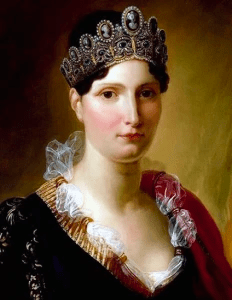
Napoleon Bonaparte as Emperor set a high standard for the men in his all-new society. He had a grand vision for France evidenced by his promotion of talented artists and craftsmen. Coteau was among the much appreciated high skilled artisans by which Napoleon Bonaparte liked to get his personal objects decorated. Subsequently Coteau worked for Elisa Bonaparte (3.1.1777 – 7.8.1820), who was a younger sister of Napoleon Bonaparte and as Princess of Lucca and Piombino, then Grand Duchess of Tuscany, she became his only sister to possess political power.
 Antiquarian Horology


