
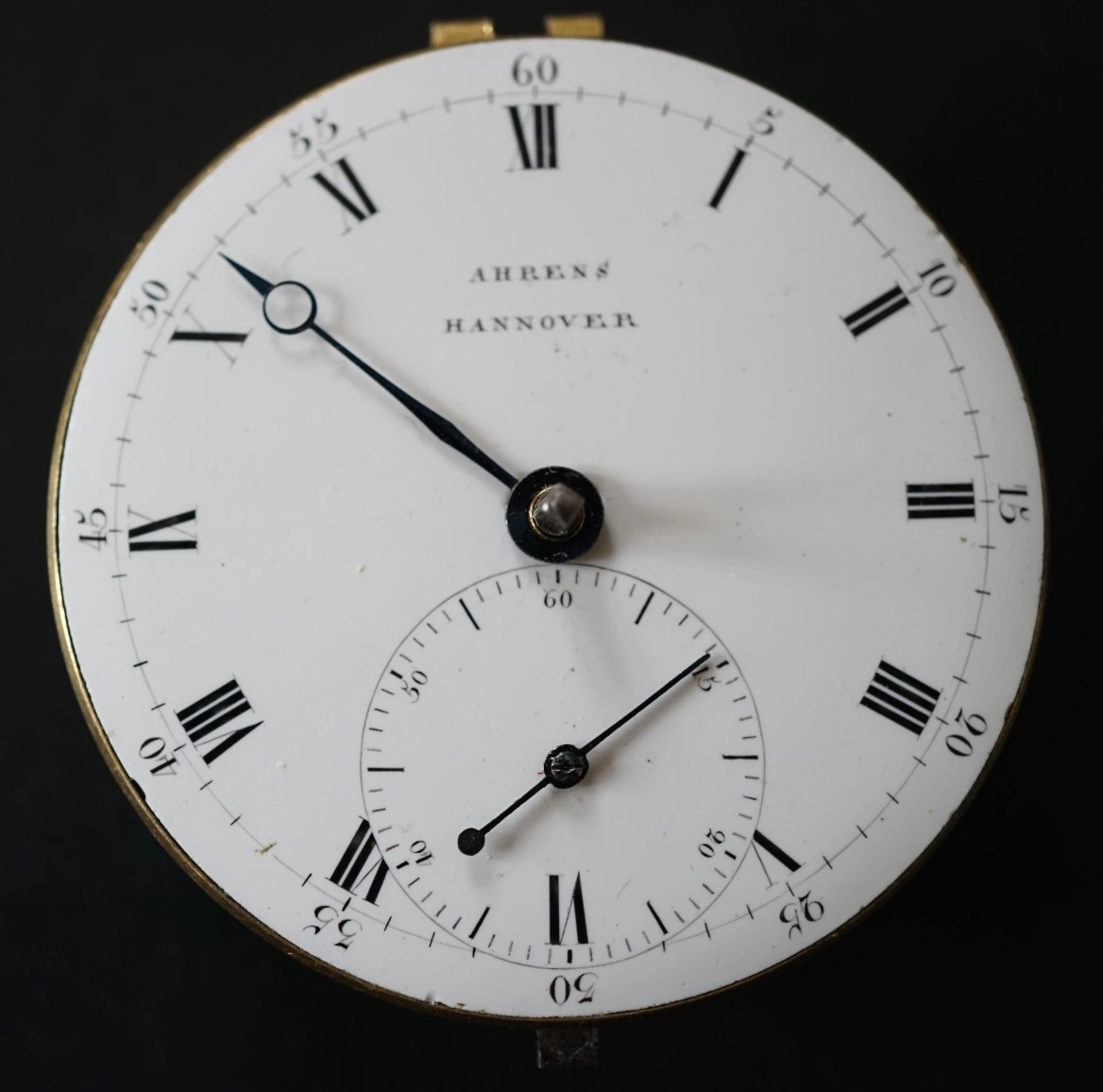

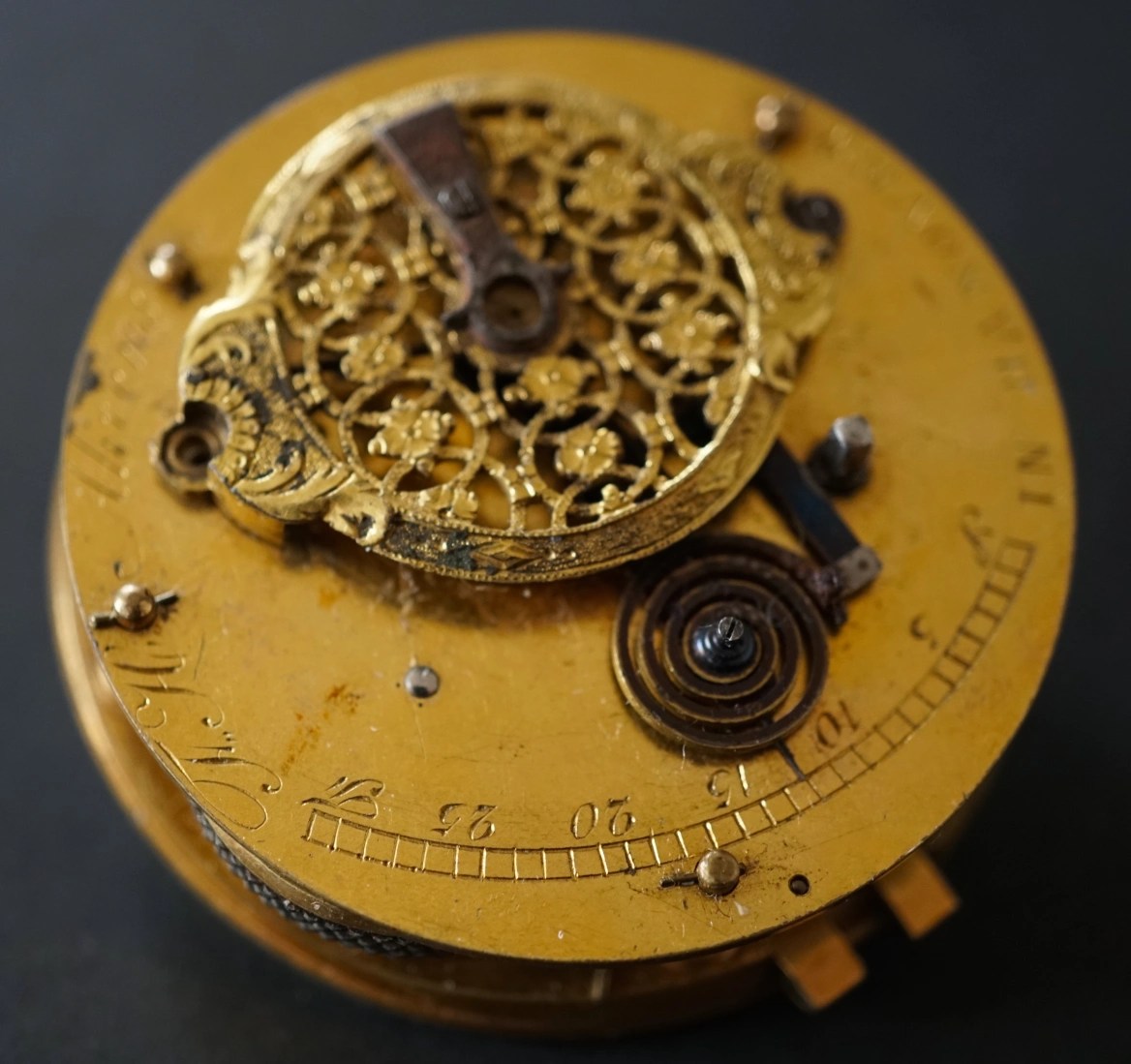
Description: Gilt brass, full plate movement (diameter: 43mm) with going-fusee of individual design, maintaining pawl spring mounted the dial side of the pillar-plate, with French/Swiss style balance-bridge with jewelled coquerette (French style as well), and spiral (Chelsea bun) compensation-curb mounted on the index. Cylinder (deadbeat) escapement with 15-tooth brass escape. Brass balance. spiral balance-spring. One-piece signed ‘Ahrens Hannover’ enamelled copper dial with subsidiary seconds at 6, blued-steel hands. Scratch numbered 2 on the brass edge and in the counter-enamel of the dial (A)
Additional Info:
A very rare movement, being one of the earliest with temperature compensation in Germany. (A)
Though of German manufacture and roughly of continental aesthetics, this movement is categorized among the English work, because of the compensation curb being the main feature and of English origin.
This movement, retaining a spiral shaped temperature compensation curb (used first by Thomas Mudge in the 1750’s, (A)) is clearly copied from the English work of Benjamin Vulliamy from whom he might have purchased the mentioned compensation curb. Vulliamy, who had bought the stock of the late Larcum Kendall in 1790, including the tool to fabricate spiral shaped compensation curbs, made watch movements witch resembled K2 and K3. It is unknown whether these movements were tributes to Kendall, as the performance of K2 and K3 were not as good compared to K1, despite the important ships they were assigned to as board chronometers.

As Hannover was politically and economically very tightly connected to the British Empire at that time, it is not surprising, that the accounts of the Kendall watches reached Ahrens. The manufacture of this movement differs quite a lot from those of Vulliamy, especially the French style balance bridge witch might have been been made by a worker trained in France or Switzerland. David Penney still confirms the bridge being original to the movement. It is not known, at least by David Penney, who was the first in Germany to make and fit compensation-curbs, but this movement shows all the signs of not being English, Swiss or French made, and the design and working of the curb on the index also makes him believe this is the work of Ahrens. Such curbs can be found, apart in the work of Vulliamy also in London work by Taylor others later in the 18th century. (1)
Friedrich Heinrich Gerhard Ahrens (31.10.1750 – 1.12.1822)
Not much is known about this watchmaker. He was watchmaker to the hanoverian court. Only few other pieces are recorded by him, one similar to the present was sold at auction (Crott, Auction 75, November 2007, Lot. 131), now part of the International Watch Museum in La Chaux – de – Fonds. Another piece is one of the earliest 1/60 of a second chronographs, now in a public collection in Germany. A written statement of a portable thermometer made between 1790 and 1800 is recorded as being made by Ahrens, in the style of the ones invented by Jaques – Frédéric Houriet and commercialised by Urban Jürgensen.
 Antiquarian Horology

