
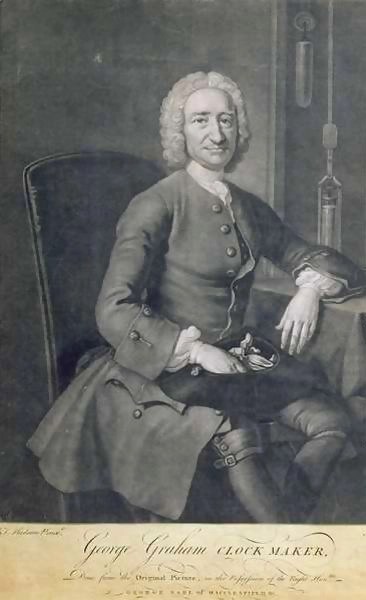
George Graham (7.07.1673 – 20.11.1751) was an English clockmaker, inventor, geophysicist, and a Fellow of the Royal Society. Graham was partner to the influential English clockmaker Thomas Tompion during the last few years of Tompion’s life. He is credited with inventing several design improvements to the pendulum clock, inventing the mercury pendulum and also the orrery. However his greatest innovation was perfecting of the dead-beat escapement in 1715, developed by Richard Towneley and Tompion in the mid-1670s.
Between 1730 and 1738, Graham had as an apprentice Thomas Mudge who went on to be an eminent watchmaker in his own right, and invented the lever escapement towards 1755.
He was widely acquainted with practical astronomy, invented many valuable astronomical instruments, and improved others. Graham made for Edmond Halley the great mural quadrant at Greenwich Observatory, and also the fine transit instrument and the zenith sector used by James Bradley in his discoveries. He supplied the French Academy with the apparatus used for the measurement of a degree of the meridian, and constructed the most complete planetarium known at that time, in which the motions of the celestial bodies were demonstrated with great accuracy.
His major contribution to geophysics was the discovery of the diurnal variation of the terrestrial magnetic field in 1722/23. He was also one of the first to notice that auroras are related to magnetic field variations. The compass needles he produced as an instrument-maker were used by many of contemporary magneticians. Around 1730, George loaned approximately £200 to John Harrison so that he could start work on his marine timekeeper known later as H1. George was commonly known in the trade as ‘Honest George Graham’. This is underlined by the fact, that he refused to patent his inventions, wanting to make them accessible for all watchmakers.
Successors of George Graham’s workshop

Other than mentioned in several references it was Thomas Colley, one of Graham’s employees, who was appointed by Graham to be his successor, after latter’s death in 1751 (A). Colley took Simon Barkley as partner, he was working for Graham as well (A). By the death of Barkley in 1753, John Priest, again a workman of Graham’s took Barkley’s place next to Colley (A). Justin Vulliamy is thought to have visited Grahams workshop to learn about the cylinder escapement. Larcum Kendall is known to have worked for Graham for several years, making cylinder escapements and it’s very likely that he continued to work for Thomas Mudge. Mudge, apprentice to Graham was an independent watchmaker from 1748 and took William Dutton, also apprentice of Graham, as partner from 1755 (A). Mudge was not the successor of Graham, even if it was him, who represented the quality and ingenuity of Graham on the long run. They apparently even had their placid and humble character in common.
All former workmen and employees of George Graham, including Larcum Kendall, used the same movement setups and workshop customs for simple movements, once they set up businesses on their own. All watches having cylinder escapement made by these men have brass cylinder escapements and most retained the 13 teeth and the banking by pin in the cylinder (A). All used enamelled dials, many of them on gold, especially pieces by Mudge. All pieces have cocks with solid, engraved foot and respective solid and engraved side plate. The centres of the cock plates are set with big diamond end stones held by a blued or sometimes polished, round, steel disc secured by two screws. All gilt brass caps are signed in the same style, and most bear the scratched movement number inside. Some also had the movement number embossed into parts of the movement, such as the back of the cock or on the top plate. Many of these traditions perdured in successors of Graham’s and then Mudge & Duttons’s workshop until the early 1800s, for example in some movements made by Matthew Dutton, William Dutton’s son (A).
 Antiquarian Horology