
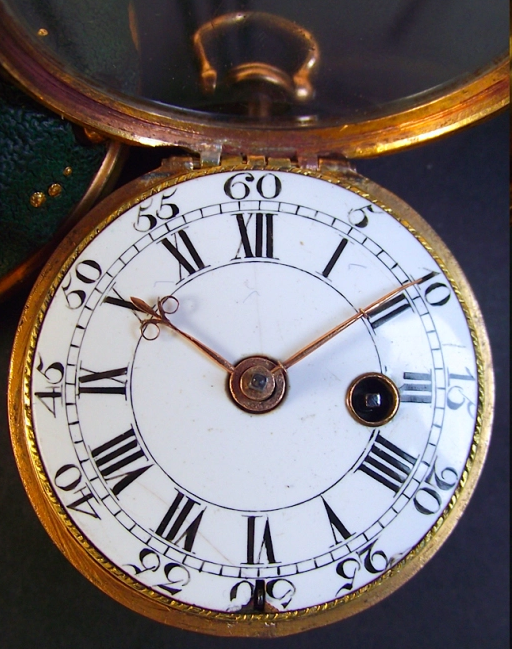


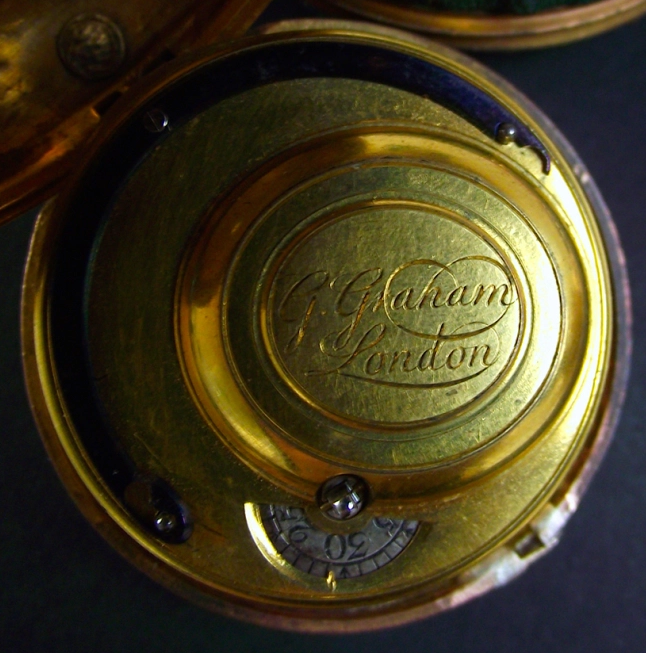
Description: Gilt brass, full plate cylinder movement in gilt and leather pair cases (diameter 48mm). Egyptian pillars, gilt dust cover, signed ‘G. Graham London’. Pierced and engraved cock with diamond endstone, solid engraved foot and plate for the silver regulator disc. Fusee and chain with worm and wheel barrel. Plain three arm steel balance, blued steel spiral hairspring. Polished steel cylinder, large brass escape wheel. Winding through the original gold, white enameled dial. Roman and Arabic numerals, gold beetle and poker hands. The minute hand is cranked in order to miss the winding square. Contemporary gilt inner case. Gilt outer case covered in green leather, decorated with gilt piqué pins.
Published: Listed in: Evans J, Thomas Tompion, at the Dial and Three Crowns, Antiquarian Horological Society, Ticehurst, 2006, P: 96
Additional Info:
The inside of the cap is scratched with the movement number, a typical Graham workshop custom. In addition to the movement number, also Graham’s initials ‘G G’ are scratched in cursive underneath the number, suggesting that Graham worked on this piece himself.
One of the earliest 13 known watches with cylinder escapement. This type of escapement had been designed by Tompion, and patented by Edward Barlow, William Houghton, and Tompion in 1695. Graham perfected the cylinder escapement around 1725/26 and used it exclusively over the verge type starting from production number 5182 and ending with 6590 in 1751 (A). Graham also introduced the white enameled dial (mostly enamelled on gold) for pocket watches in England about at the same time he switched for cylinder escapements, around 1726, replacing the champlève silver and gold dials (A). Surviving original white enamelled gold examples are rare (A). Also, he stopped using pierced cock foots and side plates only mounting plain engraved ones, as soon as he switched to cylinder escapements (A). Consequently he started also using gilt, brass caps, scratched with the movement number inside, not used for his former verge watches (A). All these changes were also applied by all his apprentices and employees, once they set up their own businesses.
The cylinder escapement increased the precision of watches considerably. One of the only negatives is, that its components are rather delicate and sensitive to damage. For this reason the French watchmakers preferred the more robust verge escapement over the cylinder for many years, until Julien Le Roy started to use it regularly around 1740.
 Antiquarian Horology