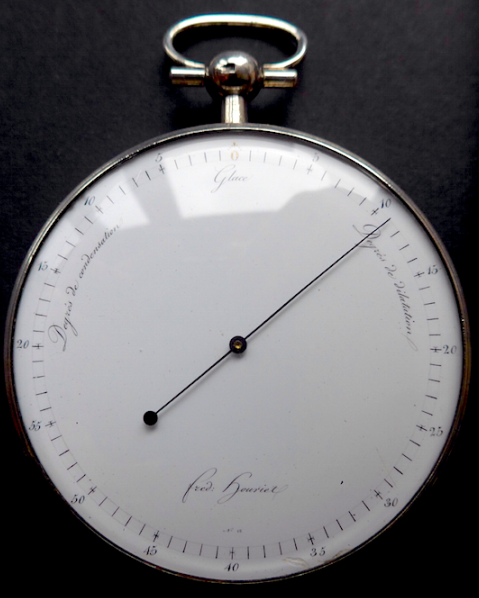
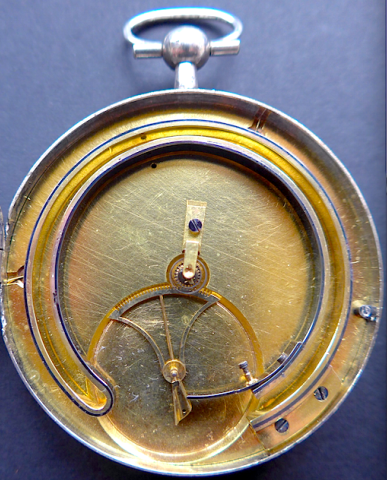

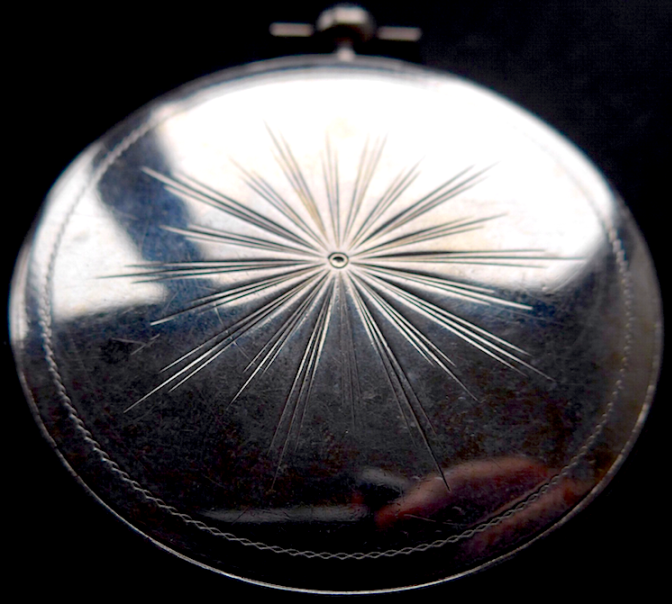
Description: Gilt brass, multi cocked thermometer mechanism with early bi-metallic curb, rack and pinion transmission with spiral coil return spring, white enamelled copper dial, Arabic Réaumur temperature degree scale, signed in cursive ‘Fred:(eric) Houriet’ and numbered below his signature ‘No. 12’, very thin blued steel hand, polished silver case with star design engraved on the back. Total diameter: 63mm.
Additional Info:
Houriet was as Abraham – Louis Breguet an experimental horologist. The common interest and quest for ultimate precision and scientific approach to horology ensured a deep friendship for many years. More so, as Houriet worked together with Breguet during his exile in Switzerland between 1793 and 1795. Houriet’s manuscripts from 1777 state the idea for a single handed watch having as few pieces as possible. This will be the inspiration for Breguet’s ‘souscription’ watches. If one also looks at the shown pocket thermometer closely, which precedes Breguet’s ‘souscription’ watches by a few years, one can see great parallels in the construction and material of the case (the earliest ‘souscription’ cases were all silver), the arrangement of the dial, the overall size and the single hand. Of course there is no direct connection to Breguet’s ‘souscription’ watches, but the style and aesthetics are very similar.
The pocket thermometer shown above is the only one known to us which is numbered and which retains the early type of double bent bimetallic curb, a rack with central stabilizing strut and recess in the plate for the rack. Later versions lack latter features and show a more simplified construction. Reference literature states that the bimetallic thermometer has been invented by Urban Jürgensen. We do not agree with this, as the reference literature does not provide proof for this statement and we believe that Frédéric Houriet had worked on the physical properties of bimetallic strips long before Urban Jürgensen, and one can find notes about this research in Houriet’s manuscripts. The bimetallic strip intended for temperature compensating balances in chronometers, was introduced, we believe by Houriet, as the central feature towards 1790 (dating confirmed by a similar pocket thermometer by Houriet to the one above sold at Sotheby’s in 2010). The temperature dependent deformation of the intricately formed bimetallic strip is transmitted by a quite simple arrangement of rack and wheels onto a single hand, pointing to the temperature in degrees Réaumur. Houriet stated, that the cases of such thermometers shall be made of silver for a better temperature transmission to the bimetallic curb and the hand shall be as light as possible and well balanced. Around 1801 Urban Jürgensen modified the system simplifying the shape of the bimetallic strip and thus made pocket thermometers on his own (signing them as ‘invenit et fecit’ from then on) following Houriet’s design. Breguet first adopted, then further developed the system by adding a second rack for more precise transmission from the bimetallic curb. This system (the simplified version by Urban Jürgensen) has also been miniaturised by Houriet and then included into high end pocket watches of his own and of other manufacturers such as Breguet’s No. 160, the ‘Marie – Antoinette’.
Réaumur scale

(°Ré, °Re, °R), also known as the ‘octogesimal division’, is a temperature scale in which the freezing and boiling points of water are set to 0 and 80 degrees respectively. The scale is named after René Antoine Ferchault de Réaumur, who first proposed it in 1731. The Réaumur scale saw widespread use in Europe, particularly in France and Germany as well as Russia. By the 1790s, France officially chose the Celsius scale for the metric system over the Réaumur measurements, but it was used in some parts of Europe until at least the mid-19th century. Its only modern application is in the measuring of milk temperature in cheese production. It is used in some Italian dairies making ‘Parmigiano Reggano’ and ‘Grana Padano’ and in Swiss Alp cheeses. In the Netherlands the Réaumur scale is used when cooking sugar syrup for desserts and sweets.
 Antiquarian Horology

