
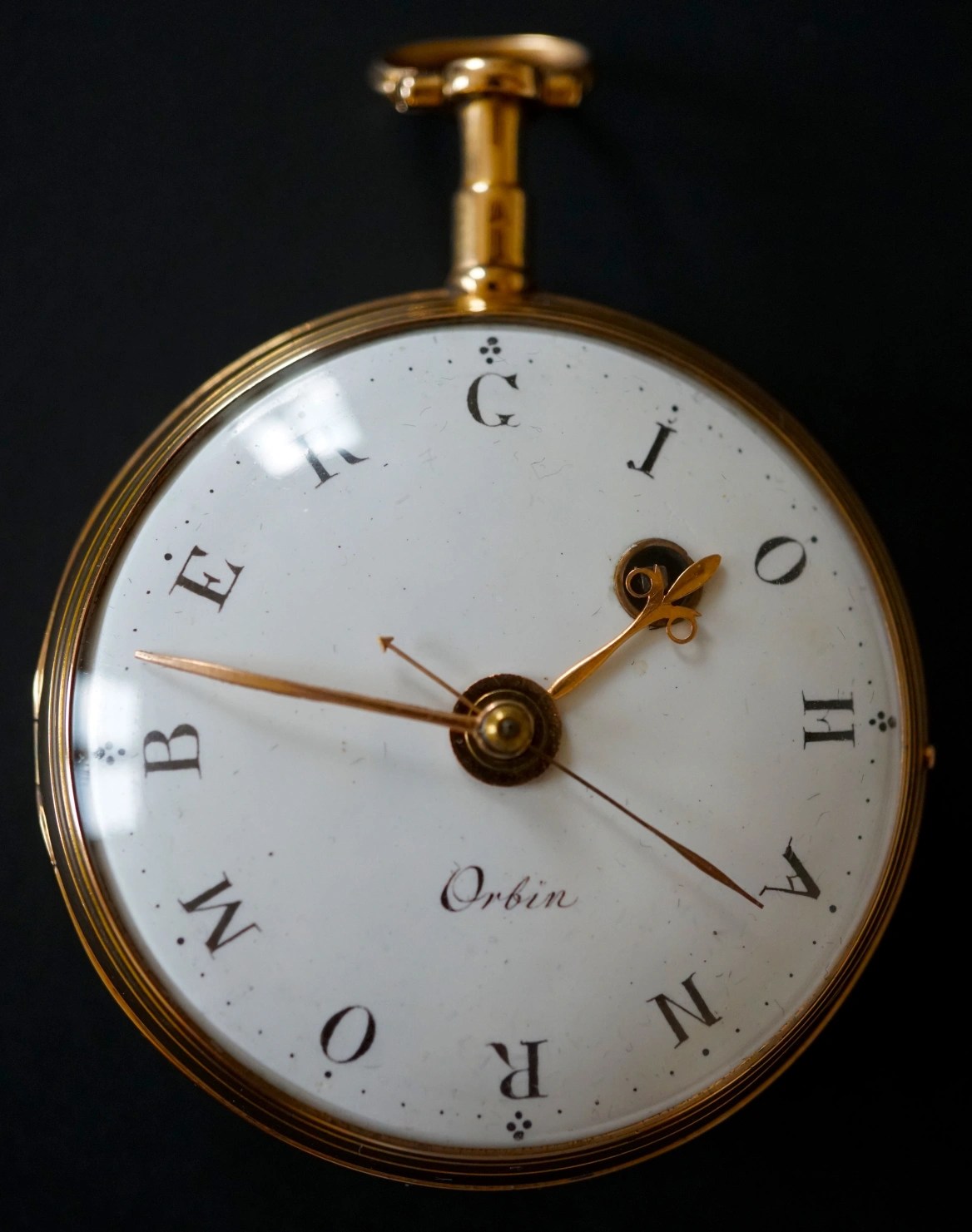
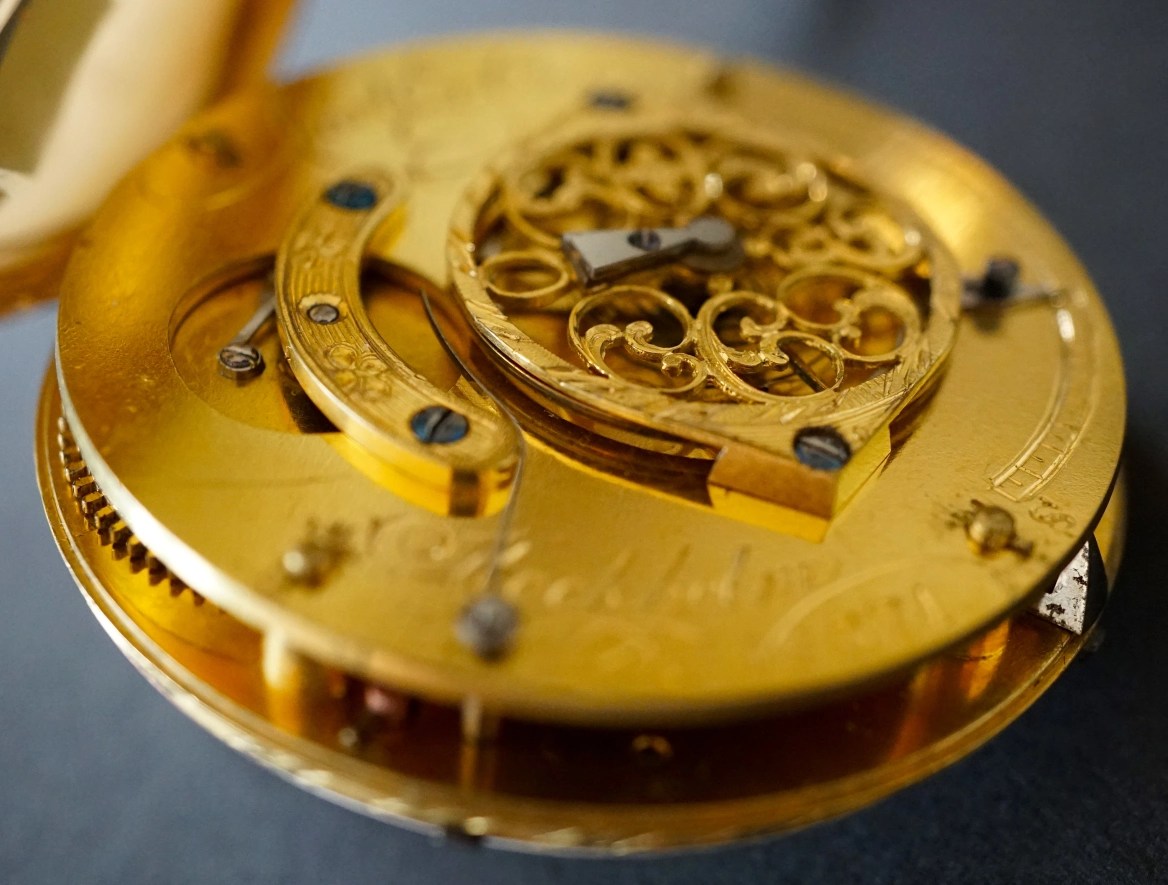


Description: Gold consular cased, gilt brass full plate cylinder movement of unique transitional Lépine caliber (between second and third type), going barrel held by arched and engraved cock, engraved balance cock of French style. Brass cylinder escape wheel. Back plate engraved ‘Carl Er(ick) Orbin Stockholm No. 371’. Regulator index engraved on backplate. Balance cock engraved with Orbin’s initials ‘C E O’, un-jewelled steel cockerel. Lever at edge of the dial (4 position) operates the stopwork lever witch acts as balance brake and can be used to stop the movement. Centre seconds work underneath the dial with seconds hand between hour and minute hand. Enamelled copper dial with the name of the owner (name – dial) as hour markings ‘Johan Romberg’. Dial signed ‘Orbin’. Original gold hands of English style.
Additional Info:
The developments of Lépine spread and were sold quite fast over all of Europe and probably because of the connection of Jean – Antoine Lépine with André Hessen, an expatriated Swede living and working in Paris (see below), it reached also the Scandinavian peninsula.
This movement incorporates several new developments, such as a unique transitional calibre by Lépine, with going barrel, pierced back plate and his new system of barrel brake at the level of the back plate. Also it retains the cylinder escapement and his new concentric type of balance spring regulator hand with wide circular steel corpus. Taken together, all technical features lead to an attribution of this movement as being between the second and third transitional type, also including some features of the first transitional calibre. New developments are never obtained in a linear progression, this movement shows the search for the optimal compromise and the trial – and error type of research. The balance brake activated by a lever makes this watch a scientific tool which may be synchronised with a reference precision clock for precise timekeeping. Such watches were used as observation watches in an astronomical context.
The balance brake activated by a lever at the border of the dial is often misinterpreted as allowing the movement to be a form of primitive chronograph. This system was only used to stop the movement in order to synchronise it with precision clock for most precise timekeeping. (A)
Johann Friedrich Wilhelm Moritz von Romberg 1724 – 1792
Son of Konrad Stephan Baron of Romberg (1691 – 1755), head of the Knights of the county of Mark and Mechtel Matia Christine von Botlenberg (1700 – 1771). Johann Romberg made a steep career in the Prussian army getting General Major and chief of the Infantry Regiment ‘Schottenstein’ Nr. 16 in Königsberg (Prussia) the 22nd of May 1785.

Königsberg, once part of Prussia has been since renamed Kaliningrad in 1946 and is now the capital of a Russian exclave named ‘Oblast Kaliningrad’ between Poland and Lithuania. The city has a direct maritime connection to the bay of Danzig and thus to the eastern see. Königsberg (Kaliningrad) is only about 600km away from Stockholm and readily reachable by boat. It is understandable that Romberg commissioned the watch in Stockholm, as no other main watchmaking centres existed around the region of Königsberg.
 Antiquarian Horology

