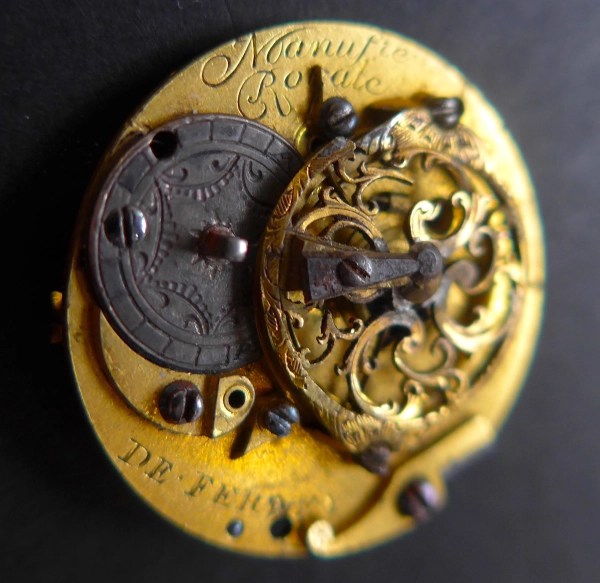
Description: Gilt brass back plate (23.3mm) with small double footed cock and steel and brass cockerel. Featuring a silver regulator dial. Signed ‘Manuf(actu)re Royale de Ferney’. This movement was one of the first ones made in the ‘Royal facilities in Ferney’ and is numbered No.6.
Additional Info:
The few surviving examples are signed ‘Manufacture Royale de Ferney’, but strange enough no reliable records of the founding of this manufacture can be found (see below).
Voltaire (21.11.1694 – 30.05.1778)

François – Marie Arouet, known by his ‘nom de plume’ Voltaire, was a French Enlightenment writer, historian and philosopher famous for his wit, his attacks on the established Catholic Church, and his advocacy of freedom of religion, freedom of expression, and separation of church and state. Voltaire was a versatile writer, producing works in almost every literary form, including plays, poems, novels, essays, and historical and scientific works. He wrote more than 20,000 letters and more than 2,000 books and pamphlets (Candide 1759 and many others). He was an outspoken advocate, despite strict censorship laws with harsh penalties for those who broke them. As a satirical polemicist, he frequently made use of his works to criticize intolerance, religious dogma, and the French institutions of his day.
Manufacture Royale de Ferney

Voltaire was fleeing Paris and its intrigues and moving to Ferney near Geneva where he bought a Chateau. Ferney had 40 inhabitants in 1740. With the aim of sustaining his new hometown he founded a factory for silk stockings there in 1768, which was not very successful. Voltaire took advantage of the political instability in Geneva, which made many watchmakers leave and welcomed them in Ferney, where he allowed them to settle and lent them money. The watch workshops flourished and the ‘Royal watch manufacture’ was born. However, there never was a royal patron-ship and there is no written proof of the founding of this manufacture.
In 1773 there were 600 craftsmen, 1776 already 1200. The production was manyfold: from simple movements to repeaters, also engraved and enamelled (genevan style) cases.
Voltaire was personally involved in the distribution of the production in Ferney, taking advantage of his many contacts. Like this, he convinced Lépine (then already ‘horloger du Roi’) to open a workshop there which ran until 1792, years after Voltaire’s death in 1778.
 Antiquarian Horology


