

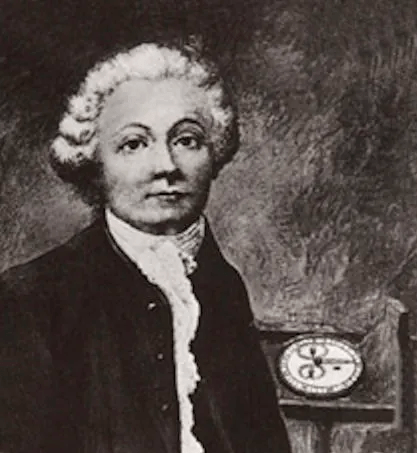
Julien Le Roy (1686 – 1759) was a major 18th-century Parisian clock- and watchmaker. He was born in Tours in 1686, and by the age of 13, had already made his first clock. In 1699, he moved to Paris for further training. He became maitre horloger in 1713 and later juré of his guild. Further appointments followed, including the Directorship of the Société des Arts, but the pinnacle of his achievement was being appointed clockmaker (Horloger Ordinaire du Roi) to King Louis XV in 1739. 1732 he invented the ‘Répétition à Toc’, where the hammer of the repeater movement strikes on the watch case. 1740 he rearranges the repeater mechanism. Latter improvement exhibited as engraving on the ridge of the typically thick dial plates: ‘Inventé par Julien LeRoy 1740’. Le Roy also used the chain driven repeating mechanism ‘all or nothing’, which invention is attributed to him by some experts. Le Roy also introduced the adjustable bracket for the verge escapement wheel called ‘potence’ in French watches around 1730. He carried on his business from premises in the Rue du Harlay until his death in 1759. Of the about 5000 watches made in Julien Le Roy’s workshop between 1729 and 1779, only 1-2% have survived.
His son Pierre Le Roy (1717 – 1785), a brilliant clock – and watch maker in his own right, carried on his father’s business until the early 1780s. He experimented a lot with the cylinder escapement. Some watches with experimental and unique escapements exist. In 1748, he invented a pivoted detent type of escapement, or detached escapement, which makes him the inventor of the detent escapement. He was also a gifted chronometer maker and a rival of Ferdinand Berthoud. Due to special circumstances he lost the affiliation ‘Horloger du Roi et de la Marine’ to Berthoud. Le Roy kept a big resentment against Berthoud, who recognised the genius of Pierre le Roy after his death in 1785. Pierre le Roy signed his watches with ‘Julien Le Roy’ to honor his father. Some cocks even bear his fathers initials ‘JLR’. The numbering system allows to attribute the watches with the signatures ‘Julien Le Roy’ to each of the makers: Julien Le Roy numbered his watches from 1 to about 3500 (1759), whereas all watches bearing the signature ‘Julien Le Roy’ and being numbered 3500 to 5000 are of Pierre Le Roy’s manufacture who continued his fathers numbering. Some rare watches made by Pierre have an inverted fusee, an invention made around 1760 by Pierre’s brother Jean – Baptiste Le Roy. This invention allowed for a more even distribution of forces to the fusee chain.
Julien’s brother also named Pierre Le Roy (born 1647) was also a watchmaker working independently but collaborating with Julien, with whom he had a very good relationship. He introduced a new type of dead beat escapement, a modified version of Debaufres’ escapement and made other contributions to horology. He signed his work with ‘P(ie)re Le Roy’ enabling to distinguish his watches from Pierre Le Roy, Julien’s son.
 Antiquarian Horology