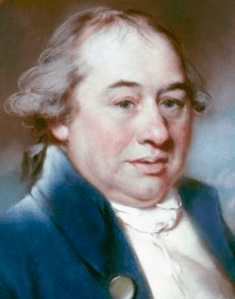
Larcum Kendall (21. 09. 1719 – 22. 11. 1790) was born in Charlbury, Oxfordshire to Moses Kendall and Ann Larcum. Though mostly now remembered for his work in creating the highly successful copy of Harrisons Longitude Timekeeper H4, Kendall was one of the most able watchmakers working in London in the 18th century. Despite a long life at the bench, very few watches and clocks are known to bear his name. This is not an indication of his lack of employment, but points to the fact that perhaps he did not have the ambition, or did not see the need, to seek retail orders. What is certain is that he was involved with the London watch trade at the highest level.
Kendall was apprenticed to John Jefferys, as repeating motion maker, for seven years on 7th April 1735 and it was Jefferys who was to bring Kendall into direct contact with John Harrison and provide what was probably the strongest influence on Kendall and his future work (A). Kendall set up his own business in 1742. He is also known to have worked for George Graham for several years making cylinder escapements and seems to have continued doing this for the firm of Thomas Mudge and William Dutton after Grahams death in 1751 (A).
It has been assumed that Jefferys played the principle role in helping Harrison produce H4 but new evidence has uncovered the fact that Jefferys died in 1754, before construction of H4 began. It is probable that the role of Harrison’s main workman would have passed to Kendall at this time and is almost certainly the reason why Kendall was appointed as one of the practical experts to the Board of Longitude in 1765 together with Rev. William Ludlam, Fellow of St. Johns College, Cambridge, Rev. John Mitchell, F.R.D, Woodwardian Professor of Geology, Thomas Mudge and William Mathews of Fleet Street, watchmakers; and John Bird of the strand, instrument maker. Latter was on a ‘replacement list’ together with Justin Vuillamy. All six alongside the Astronomer Royal, Nevil Maskelyne spent several days been shown the construction of H4, and on the 22nd of August, 1765 signed the certificate stating that all details had been declared by Harrison to their entire satisfaction.
More significant is the fact that Kendall was given the honour of proving the worth of Harrison’s designs by being commissioned to make a copy of H4 in 1766. He started with the manufacture in May 1767 and finished in late 1769.
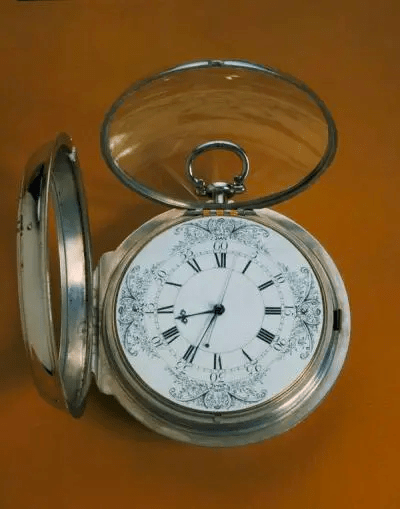
K1 cost 450 guineas and was handed over to the Board of Longitude in January 1770. After the trials at Greenwich it was then assigned to Captain James Cook for his second voyage of discovery to the South Seas in 1772 – 75, where Cook and ships astronomer William Wales had high praise for the watch and for Kendall, and on his return in 1775 Cook wrote to the Secretary of the Admiralty, “Mr Kendall’s watch has exceeded the expectations of its most zealous advocate…”. K1 now resides at Greenwich and is a testimony to Kendall’s skills of a watchmaker. The back plate is signed Larcum Kendall LONDON and dated 1766. Despite the success of K1 Kendall made no further copies and, instead produced two simplified timekeepers K2 and K3.
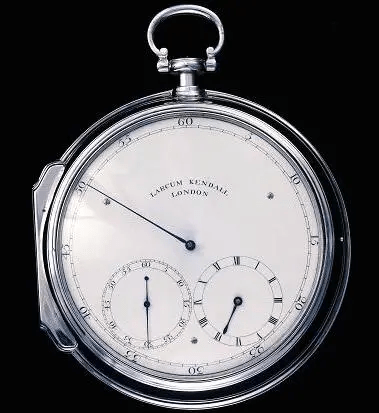
K2 was handed over to the board of Longitude In March 1772, at a cost of 200 guineas, this time the dial was signed LARCUM KENDALL LONDON and on the back plate: Larcum Kendall 1771 London.
This new version has a regulator dial. The wheel work needed for separating the three hands has less play as compared to the conventional concentrical system, which usually increases precision. Thomas Mudge will use this system for his wooden cased marine timekeeper built in 1774, which will be the most precise watch for over 100 years. Latter piece by Mudge is in the British Museum (Reg. No. 1958,1006.2119).
K2 lacked the precision of K1 but it is chiefly famous because it was with William Bligh on the Bounty in 1787 when, as a result of the mutiny, it was taken by Fletcher Christian to Pitcairn Island. It was found in 1808 by an American and was bought on Pitcairn from the last survivor of the mutiny and only returned to England in 1840.
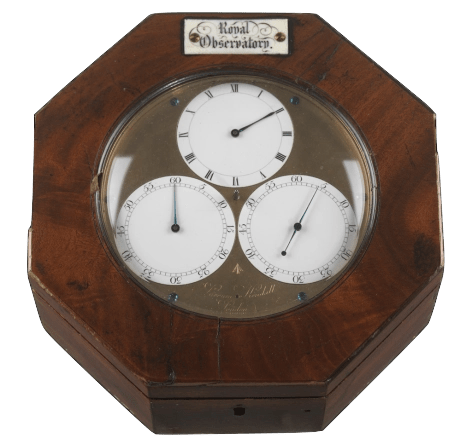
K3 was completed in 1774 at a cost of 100 guineas, it is signed LARCUM KENDALL LONDON and on the back plate: Larcum Kendall 1774 London. Its style is vastly different from K1 and K2 as it has three small dials for hours, minutes and seconds and is fitted into a octagonal wooden case. It was on board HMS Discovery in 1776 with the Astronomer William Bayly. But as K2 it was lacking the precision of K1.
K1 – K3 are preserved in the Royal Observatory museum at Greenwich.
Kendall produced a pocket chronometer, which is now in the Museum of the Worshipful Company of Clockmakers, Guildhall, London it is signed on the back plate L. Kendall London B+y and is in a silver pair case hallmarked for 1786, inside the case are watch papers printed Vulliamy & Sons, 74 Pall Mall, London this watch was presented to the Clockmakers Company in 1849 by B.L. Vulliamy and was almost certainly purchased by his father Benjamin Vulliamy at the sale of Larcum Kendall’s Workshop in December 1790, Lot 37.
The sale of Kendall’s workshop was held at Kendall premises at No. 6 Furnivals Inn Court on the 23rd of December 1790 by Christie’s, many watch making tools and parts were sold and of note were was an unusual wheel cutting engine, and a curious foot lathe.
Lots 37-39 in the sale were of interest and are listed below:
37. A time keeper, complete in silver cases, by ditto scapement 36 guineas
38. A Time keeper, with silver cases, by ditto, complete except scapement
39. A gold horizontal seconds watch, cappd and jeweld by ditto 30 guineas
The sale must have been a fascinating place to be, with famous clock and watchmakers present, another important name at the auction was that of William Bayly Astronomer on Board Cooks ship Adventure 1772 – 75 and Discovery in 1776 – 80. Principal Astronomer on Cooks second voyage was William Wales. Latter was born in Yorkshire in 1734 and in 1765 he was appointed by the Astronomer Royal Nevil Maskelyne as one of four computers to work on calculations for the first Nautical Almanac, which was published in 1767. In 1772 he was proposed by Maskelyne to be astronomer on Cook’s Resolution, where he was appointed to judge the effectiveness of K1. Wales owned a pocket time piece by Kendall which was sold at auction for 20 guineas 9 shillings and 6 pence after his death in 1798.
The quality of Kendall’s work was second to none, as is shown by the few watches, signed by him, which remain today, but he never showed any real ingenuity of his own. He was primarily a watchmaker to the top retail trade, producing first rate products to the design of those with greater imagination; the majority of his work, which also included some clocks and precision regulators, would appear to have been sold under other retailer’s names.
He died at Furnival’s Inn Court on 22 November 1790. His obituary states that the Quakers ‘…received his body into the bosom of their church at his death…’ and he was buried in the Quaker cemetery at Kingston in Surrey on 28 November 1790. As well as leaving a large sum in trust for his brother and family, his will, written on 6 November 1790 and proved on 8 December, also leaves his ‘implements in trade’, personal effects etc., to Moses, who evidently then arranged for them to be sold by auction; (see above). It is not known whether Kendall ever married. No wife or children are mentioned in his will and the furniture and effects sold at auction strongly suggest the home of a lifelong bachelor.
 Antiquarian Horology