


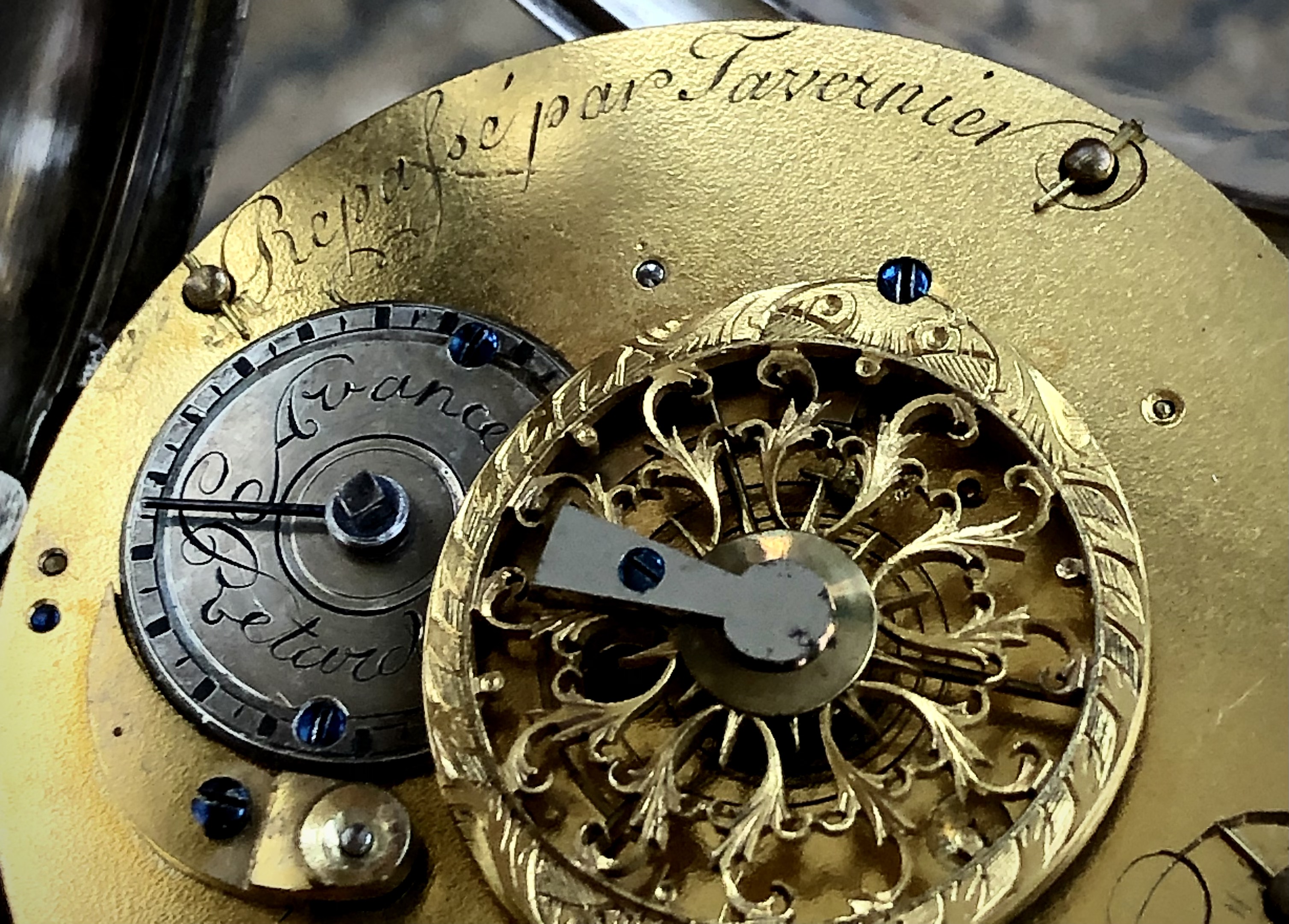


Description: Silver, consular cased, gilt, front wound brass movement (55mm diameter). Two plate verge fusse movement, back plate engraved ‘Repassé par Tavernier à Paris No. 3294’. White enamelled copper dial with black Arabic numerals and star symbols for the minutes. Stylised gold ‘fleurs’ de lys as hour markers. The dial is unsigned. Original gilt Lépine hands.
Additional Info:
The term ‘repassage’ in French means ‘finished’. Watches marked that way indicate, that the watch movement was bought as a pre-fabricated piece, but then finished in the workshop which signs it.
This method is used for pieces of lower quality, where important workshops declare that the piece is not of their conception, but retains the best possible finishing for what it is. The fact that the quality of the piece does not reflect the image of the workshop, dials of such pieces are not signed.
At the beginning of Breguet’s career, he does not differentiate between pre-fabricated watches and own developments, at least not on the watches itself (with rare exceptions marked ‘Repasée par Breguet’). The dials of watches of this type are not signed, following the reasoning above. However, in the ledgers it can be seen, which pieces received more or less attention from the workshop.
The same procedure will be applied during Breguet’s exile (1793/94). During the ‘terror years’, when A. – L. Breguet was absent from his workshop in Paris, latter sold a big amount of such pre-fabricated pieces, which sometimes were not even finished in Paris, but completely build in external workshops. Such pieces are sometimes not even numbered, so they must be identified applying George Daniel’s suggestion of ‘judging them on their quality’.
Starting from 1806, as a marketing genius, Breguet will introduce the term of ‘Etablissement Mixte’, which means ‘mixed workshop’ and which indicates that the watch is not completely made in house, without outing which procedures were made in external facilities and which in his own workshop.
In rare instances watches are double signed, one signature for the workshop producing the pre-fabricated piece, the second declares the ‘repassage’ by another workshop, which then finally sells the watch.
Sometimes French clockmakers (who not always had the expertise to build watches) would also buy completely pre-fabricated watches, which are signed with their name, but build in external workshops. These watches would complement their offer and allow for additional income.
 Antiquarian Horology
