
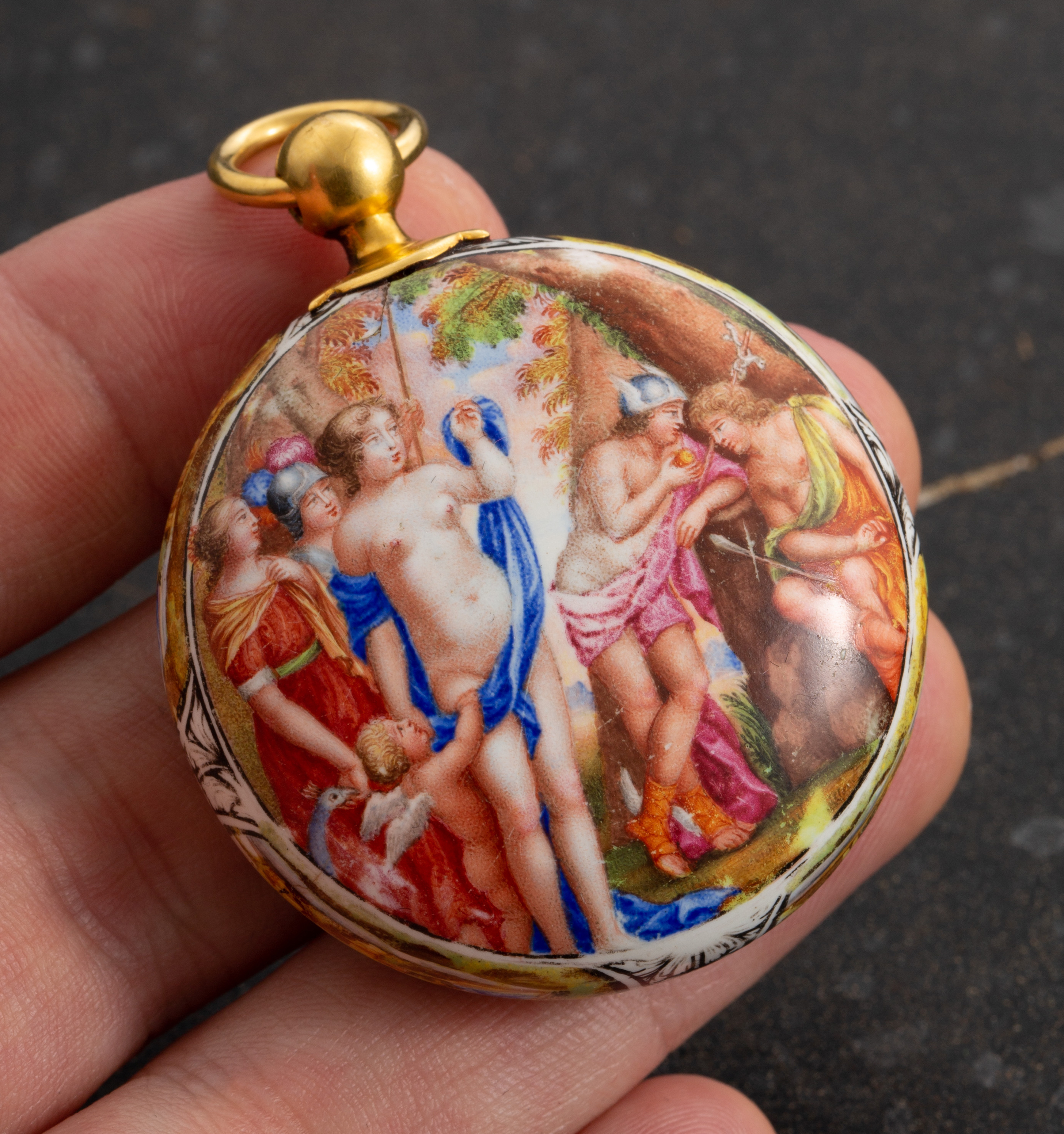


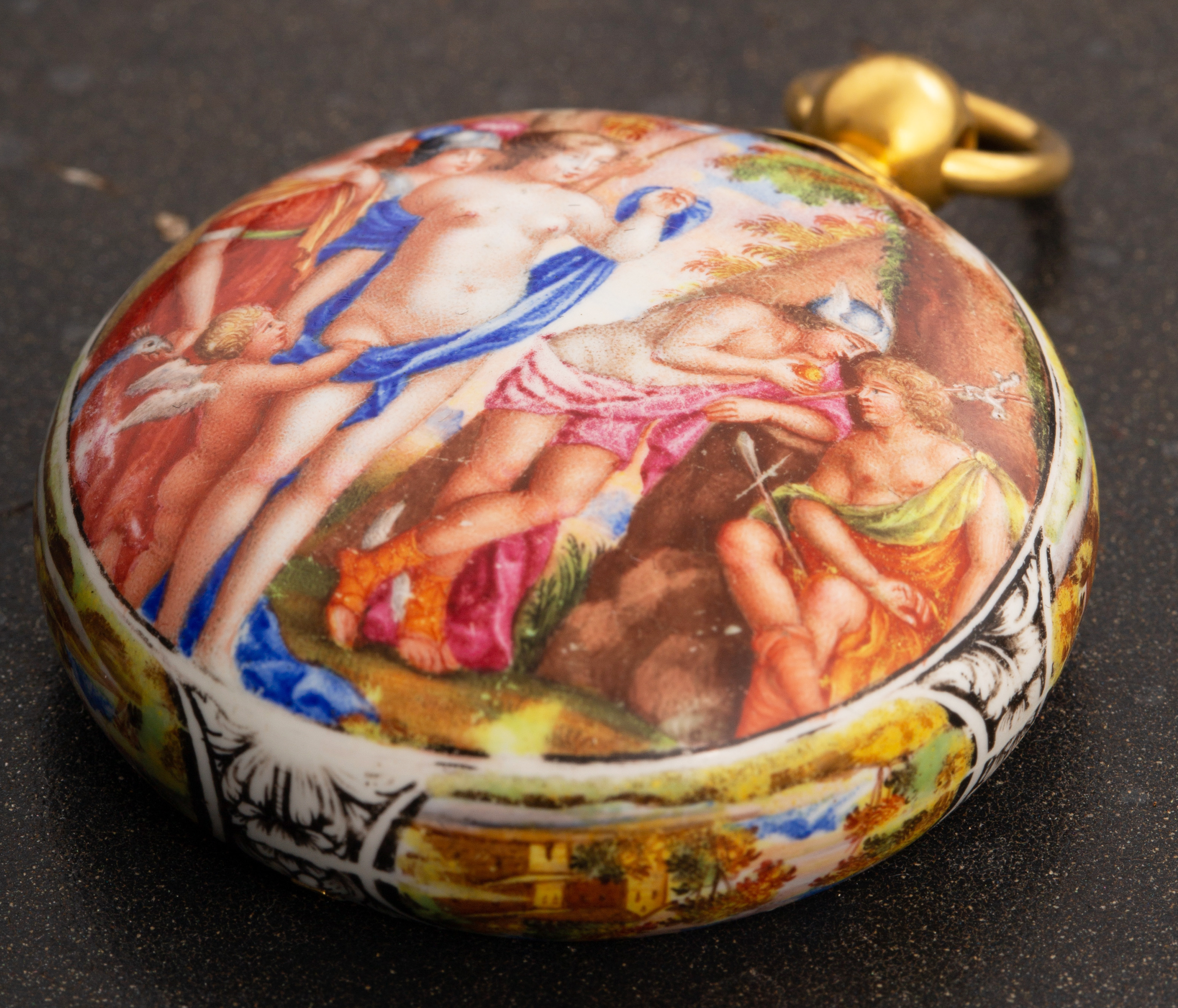
Description: Gold case (40mm diameter) enamelled on the back with a scene depicting the ‘Judgement of Paris’ after an engraving by Antoine de Fer (d.1673) after a painting of Laurent de la Hyre (27.2.1606 – 28.12.1656) which he painted after a painting of Peter Paul Rubens (ca. 1636).

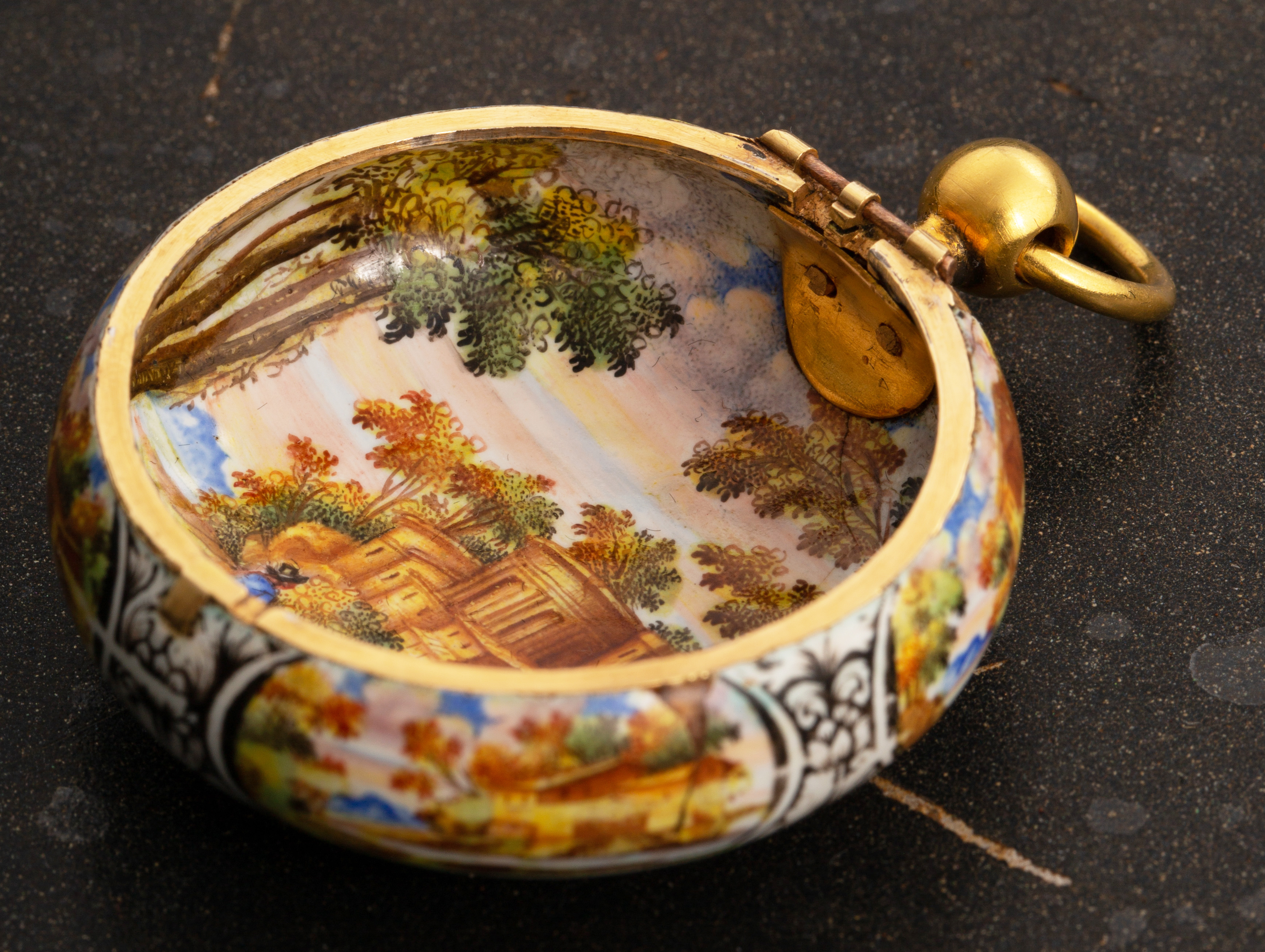
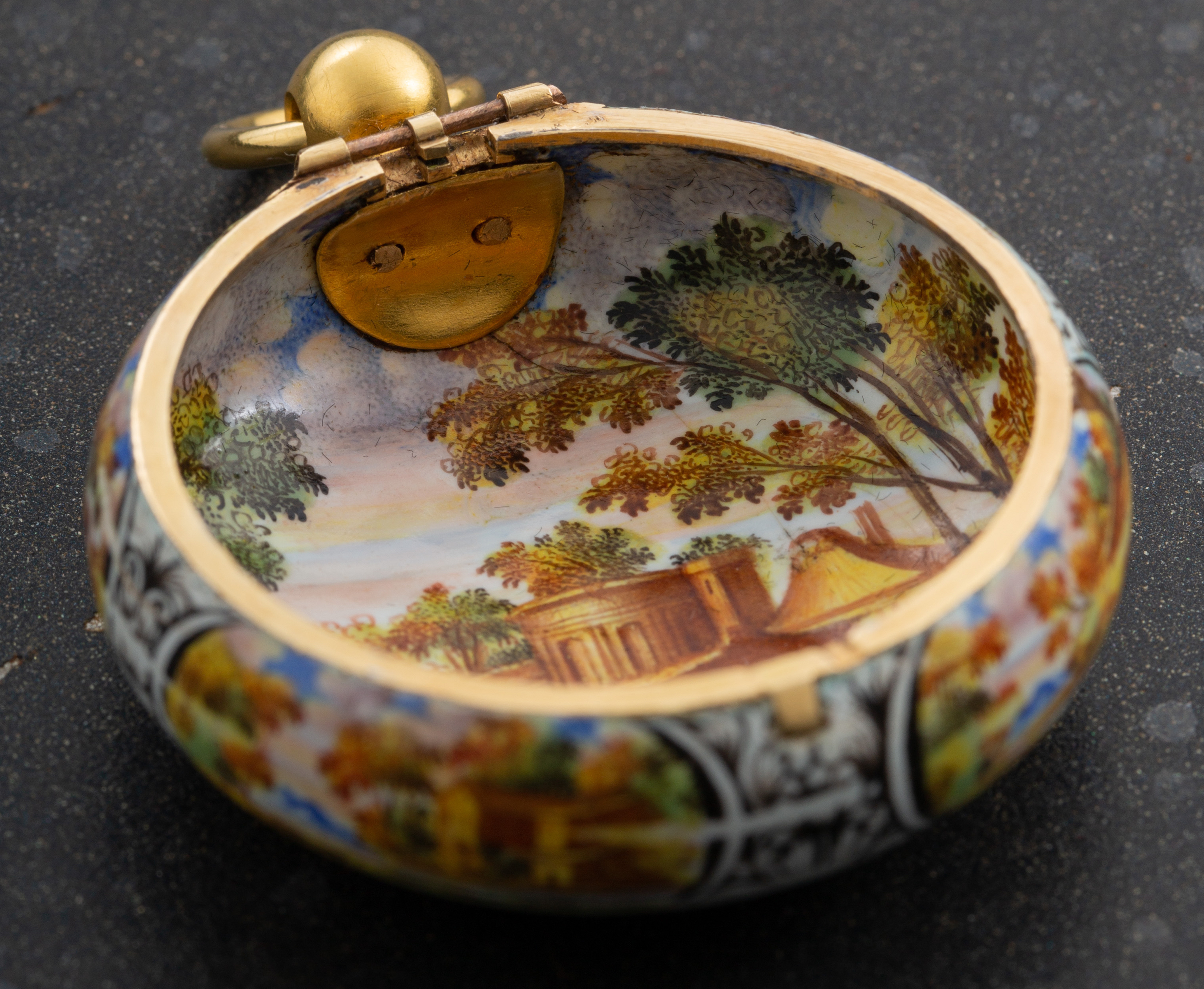
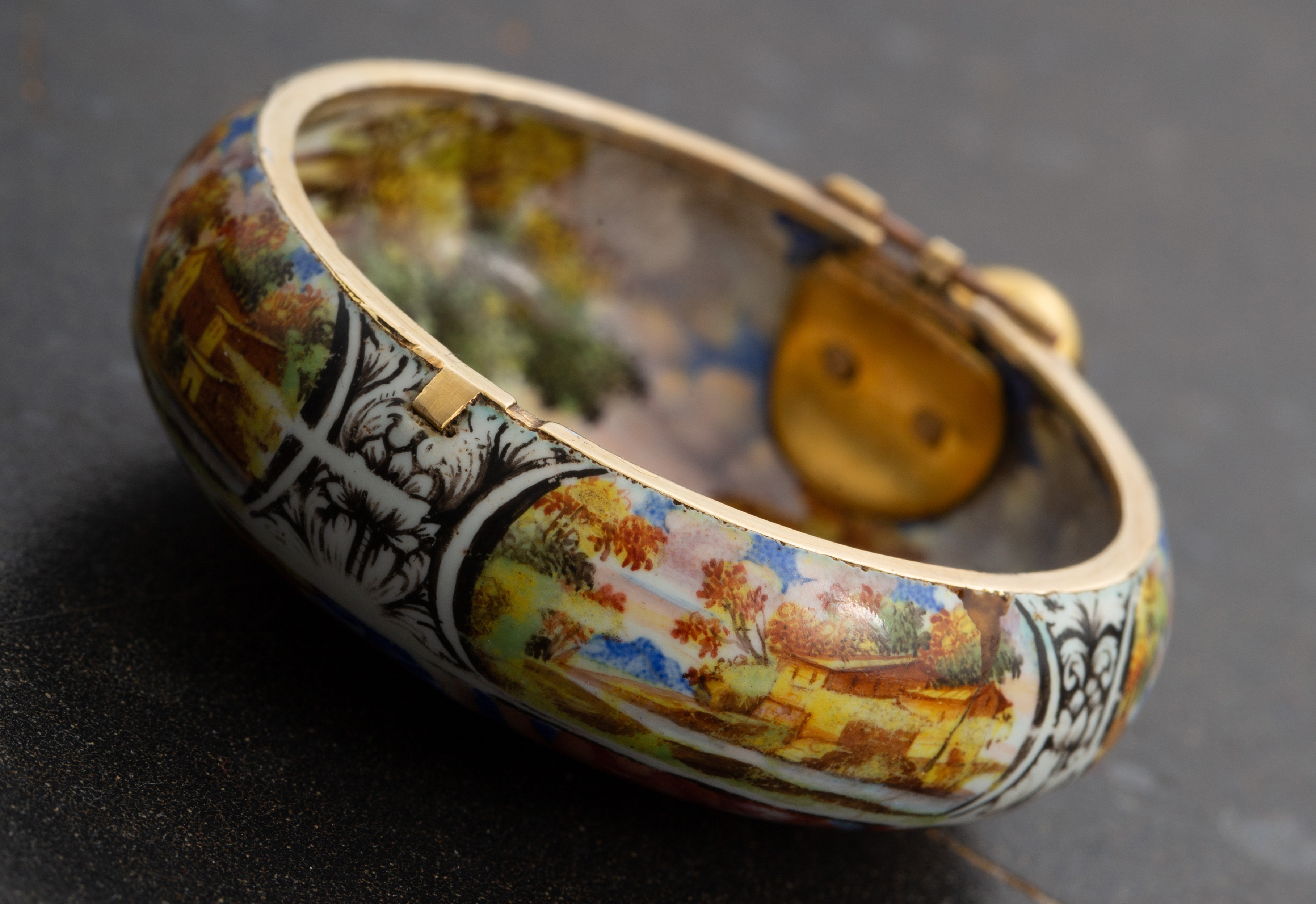
The border is enamelled with idyllic landscape vignettes separated by black and white scrolls. The inside of the case is enamelled with a view of an imaginary villa surrounded by high trees with a bridge over a river (the Rhone?) and a person with hat. On the background one can see what looks like lake Geneva and the Italo-French alps. The enamelling survived in very good condition, only little rubbing to the surfaces, a few slight cracks and a small loss are visible. Pendant and bow are in good condition, they have a little darker aspect as the cold case, this is due to the heating up of the gold case when firing the enamel. This procedure makes the gold appear slightly lighter in color. This case was most probably made for the English market, as per the shape of the pendant.
Additional Info:
According to literature less than 100 cases enamelled by a member of the Huaud family survive (most survivors being made by Jean – Pierre and Amy), most of which in public collections such as the Louvre (Paris), British Museum, Victoria and Albert Museum (London), Uhrenmusem Beyer (Zurich), Frick collection, Metropolitan Museum of Art (New York), Haus zum Kirschgarten (Dr. E. Gschwind collection, Basel), International Watch Museum (La Chaux-de-Fonds), Musée d’horlogerie (Le Locle), Patek Philippe Museum, Musée de l’horlogerie et de l’emaillerie (Geneva).
Please note that on the 24.11.2002 several important pieces have been stolen from the ‘Musée de l’horlogerie et de l’emaillerie’ in Geneva (among those, 9 pieces with cases enamelled by the Huaud family).
We would like to emphasise, that the purchase of stolen cultural goods is prohibited by international law (UNESCO Convention on the Means of Prohibiting and Preventing the Illicit Import, Export and Transfer of Ownership of Cultural Property, 1970).
Pierre II Huaud (Huaud l’Aîné, 2.2.1647 – c.1698) was apprenticed to his father. Taking his inspiration from the pointillé technique employed by bis father, and being extremely gifted artistically, he painted many mythological and historical scenes such as the ‘Judgment of Paris’, ‘the Abduction of Helen’, ‘Roman Charity’, and ‘Cleopatra’. 1685/6 he went to Berlin to work in the service of the Brandenburg Elector.
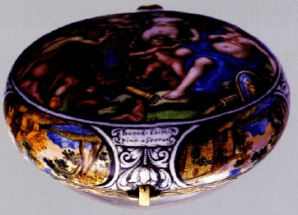
After a brief stay there, he returned to Geneva in 1686. Pierre II went back to Germany at the end of 1689, and in 1691 he was named painter-miniaturist to Frederick I. Pierre II was the most talented of the three sons, only few watch cases with its signature are known (most of them are unsigned). Two signed examples reside in a public collection in Switzerland, a third one is in the Frick collection in New York. He signed bis work in various fashions: ‘P. Huaud l’aisné pinxit a Geneve’, ‘Petrus Mayor Natus Pinxit Geneva’, ‘Huaud l’aisne pinxit a Geneve’, ‘P. Huaud P. a G’ or just ‘P. Huault’. The signature is often enclosed in a cartouche on the band, under the VI; it is rarely found under the scene.The unsigned works can be distinguished from the ones of his brothers by the better quality and the higher precision of the enamelling. Moreover he continued to use the black and white elements typical of his fathers work integrating them as separators between the usual landscape scenes on the border of the cases. All three sons were inspired by the same subjects, as was their father: Greek mythology, paintings by Peter Paul Rubens (28.6.1577 – 30.5.1640), nature and architecture.
Jean-Pierre Huaud (Huaud le Puîné, 1655 – 1723) and his brother Ami Huaud (9.8.1657 – 16.11.1724) became partners from 1682 to 1688. They, like their older brother, were appointed painters to the Court of the Brandenburg Elector in 1686, and went to Berlin where they lived and worked until 1700, at which point they returned to Geneva. Although much of their work was done in partnership, they also often worked alone.
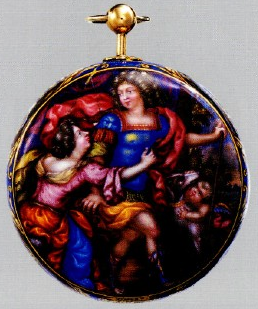
When working alone Jean-Pierre signed: ‘Huaud le Puîné’, ‘P • Huaud L ‘aisne pinxit a Genève or ‘Huaud Le puisné fecit’. When working together the two brothers signed: ‘Les •f• Huaut’ , ‘L. deux frères Huaut les jeunes’ or ‘Les deux frère Huaut pintre deSon A[ltesse] • [l’]E[lecteur] de B[randebourg] • a berlin’. The work of the Huaud family was sought-after by watchmakers from all over Europe. Watchmakers would order a case from them and then build a watch to fit it. After the invention of the balance spring in 1675, when the old movements became obsolete, older cases were still cherished to the point that, for many of them, the owners would order a new balance spring movement. The Huauds created a true school of painting on enamel. Their work and reputation helped to popularise the art throughout the world. As was the case for Blois and Limoges, the characteristics of this type of painting on enamel led it to be named after its city of origin: ‘Email de Genève’.
 Antiquarian Horology

