
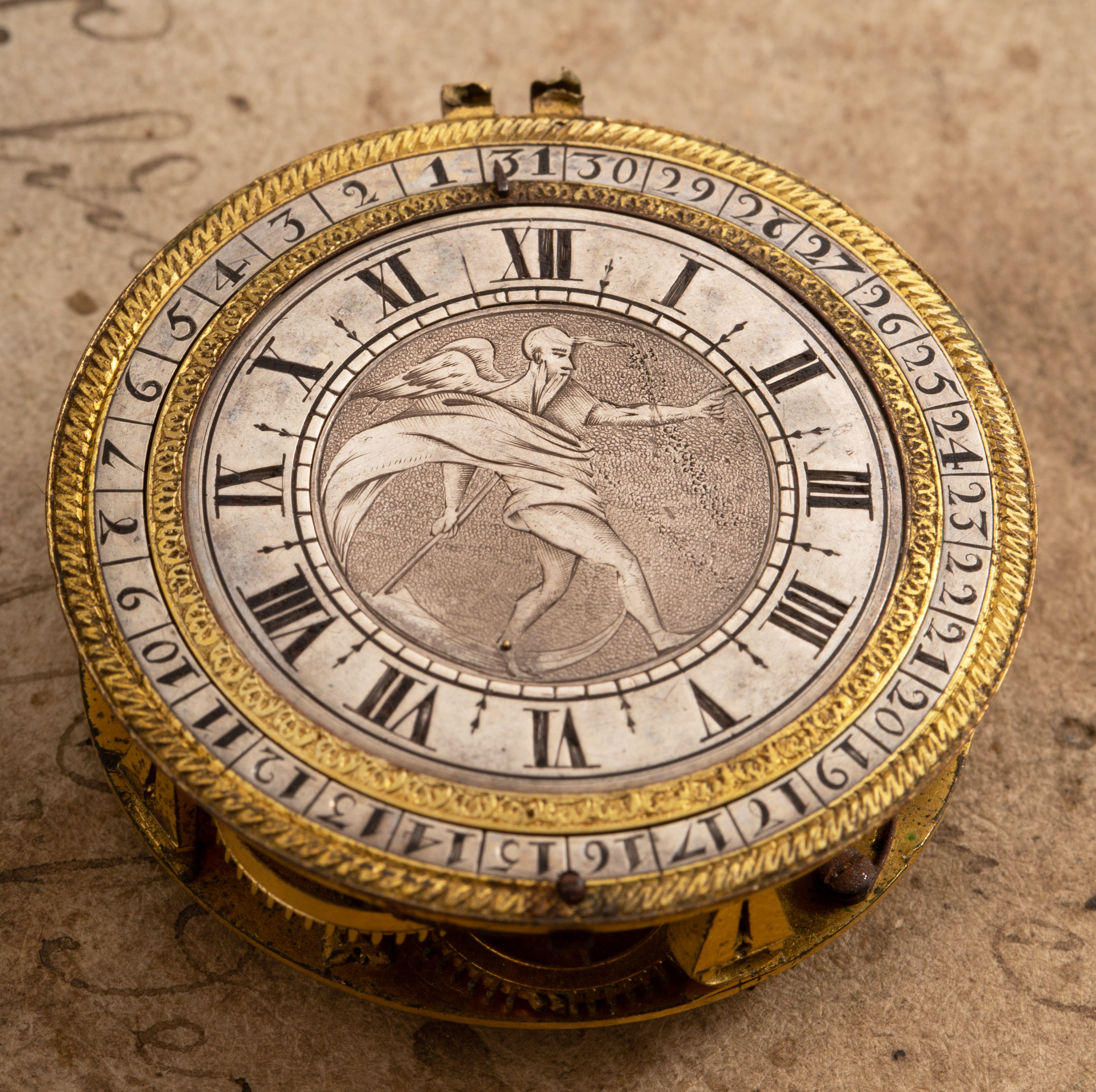

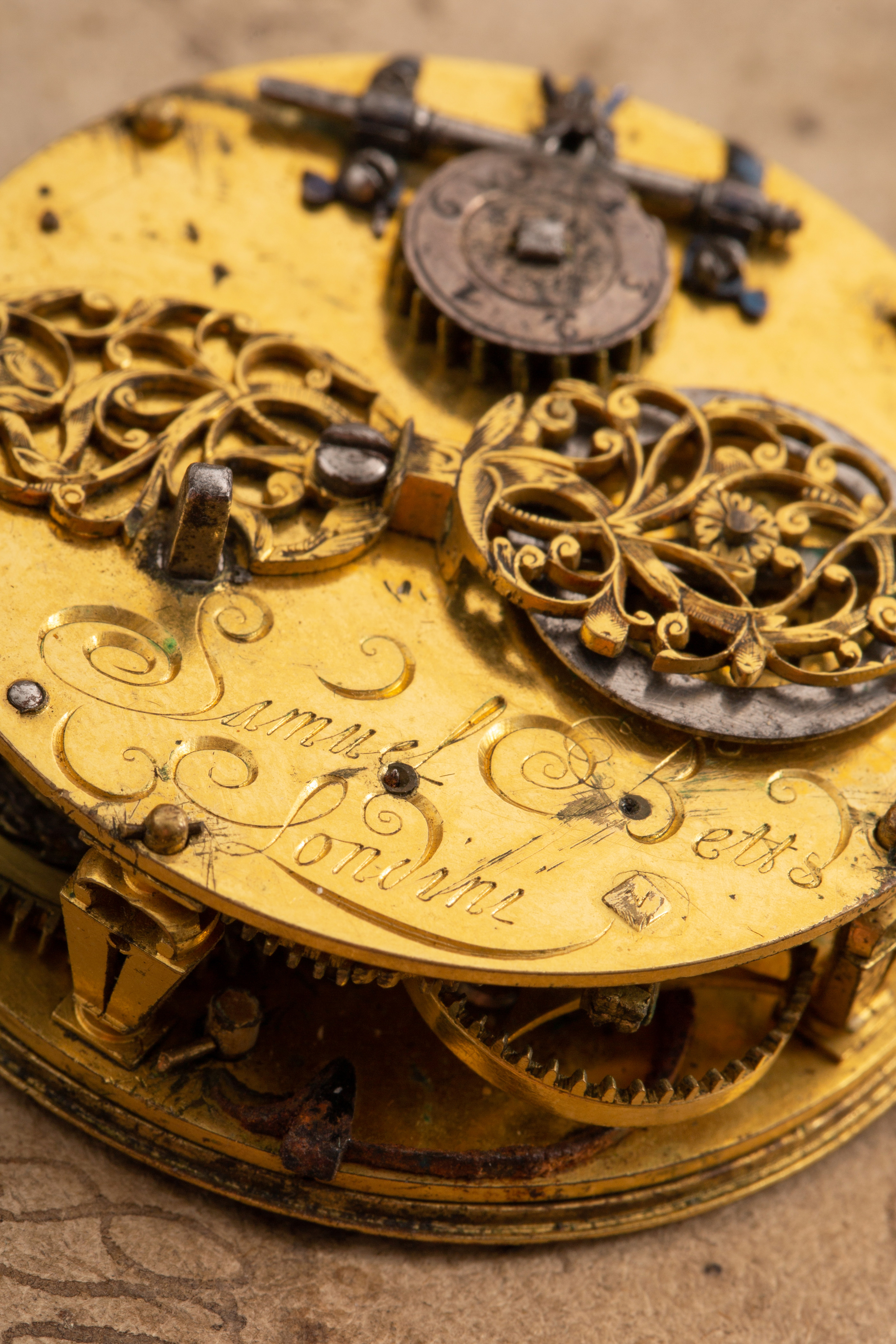
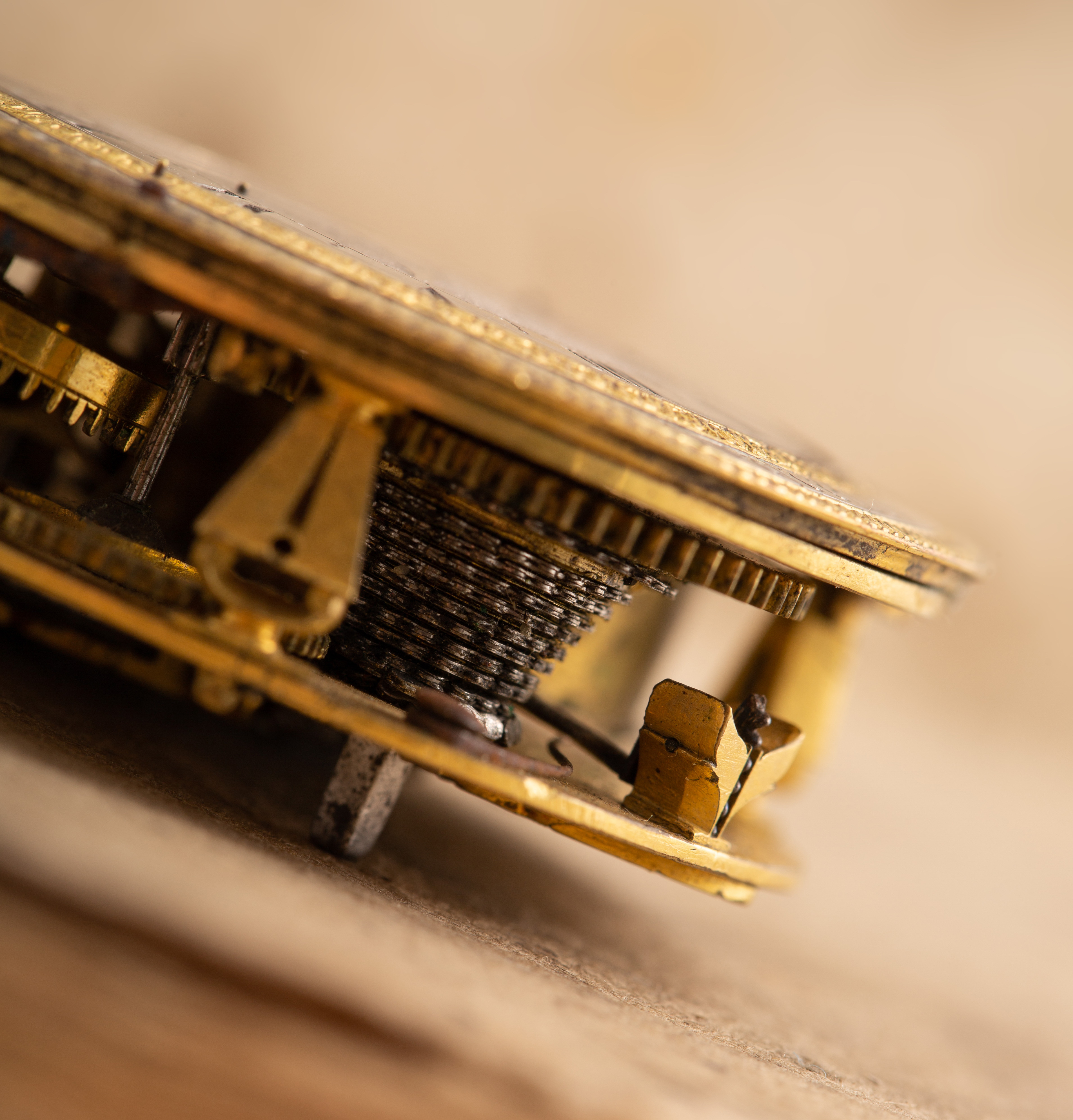
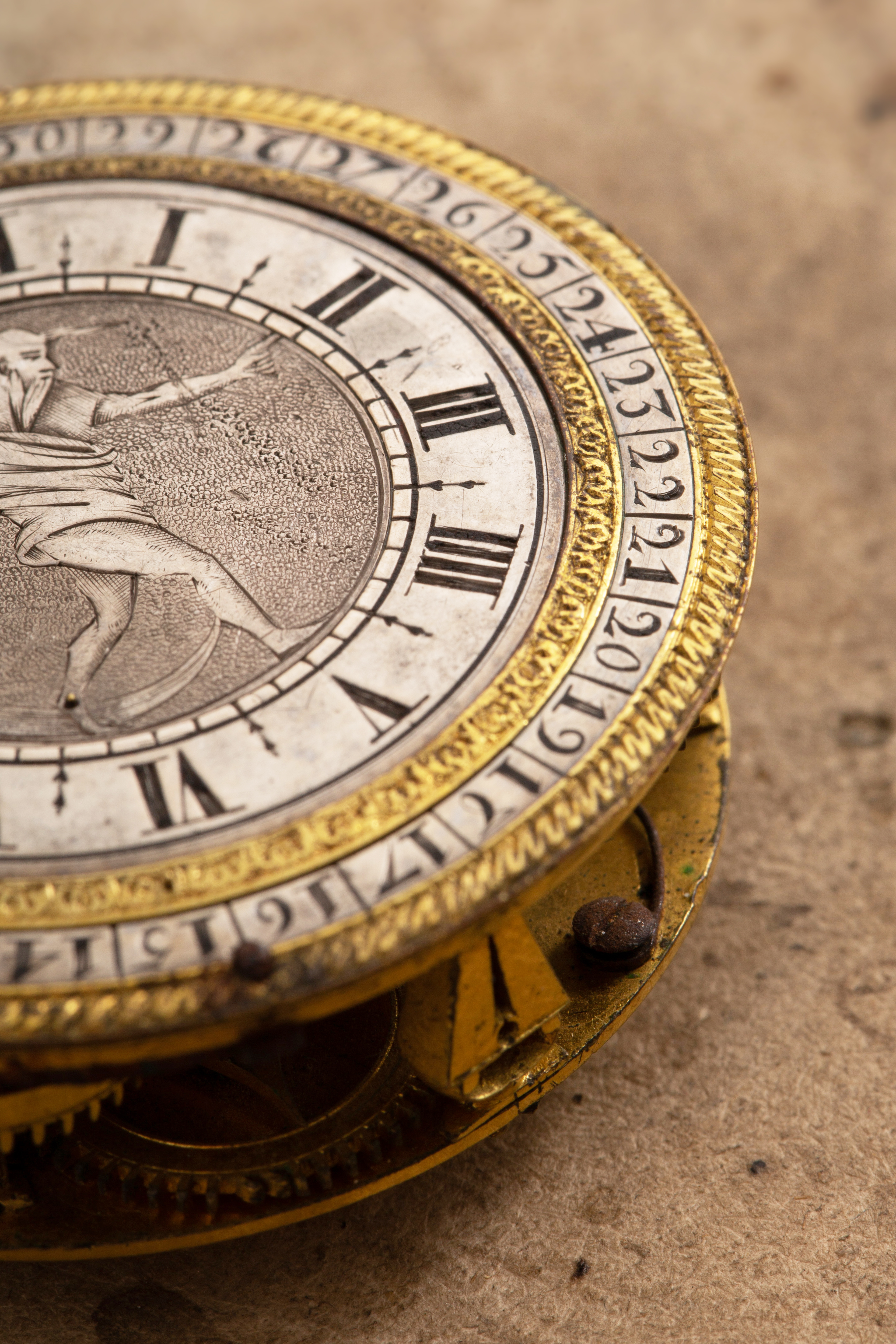
Description: Gilt brass, verge fusee movement (dial plate 39.1mm, 8mm between plates) with worm and wheel set-up, symmetrical oblong cock fixed with a screw. Featuring Egyptian pillars, metal chain, two armed pre-balance-spring balance of small diameter. The normally blued steel single hour hand is replaced by a turning silver disc engraved with Chronos who shows the time by pointing his left index finger to it. On the outer edge of the dial, a ‘Fleur de Lys’ shaped steel pointer marks the date engraved in a silver disc (running counter clockwise). The early Egyptian pillars, the pre-balance spring balance, the small cock (fixed with a screw) and worm regulator system for the main spring help to date this watch. The engraving ‘AD 1682’ was added later.
Additional Info:

During the mid 17th century the movements got more elaborate and featured different complications. This movement has a date function and the single hour hand is replaced by a disc representing Chronos, the Greek god of time. He was also attributed to death and taken as a symbol for the shortness of life (Memento Mori).
Only about 5 watches of this type are known, one of them is in the Dover Museum, Dover (GB), tanother other made by John Cooke (London) is in the British Museum Collections. The subject of Chronos got reintroduced in watches made during the 19th century. One watch with similar representation is exposed at the Ashmolean Museum in Oxford. Other as the one made by Samuel Betts it has not a date complication but an alarm.The silver cased watch by Nicholas Fetters has a ‘Fleur de Lys’ alarm setting hand screwed to the alarm setting dial which engraved with the Greek god Mercury pointing his index. The blued steel hour hand is not original.
Samuel Betts (active 1645 – 1673), carried on business at the back of the Royal Exchange, and appears to have died prior to 1673, when “Mr. Marquet” (Markwick?) advertises himself in the London Gazette as the successor of ” Mr. Samuel Betts, deceased”. In 1656 Betts attested the genuineness of Jas. Lello’s masterpiece to the Clockmakers’ Company. Betts is often associated with Edward East (1610-1693), who is generally regarded as one of the finest clockmakers of the period and served as clockmaker to Charles I and Charles II.
One identical complete watch by Samuel Betts is part of the watch collection of the ‘Musée Paul – Dupuy’ in Toulouse, France: Inv. Nr. 18224
 Antiquarian Horology