

While perfecting parts of the watch movements, especially concerning cylinder and virgule escapements and searching for the ultimate aesthetics in dial and hands design, Lépine made the most radical step in the history of horology sequentially abandoning the full plate movement towards a better serviceable version, where the wheels, balance and the escapement would be fixed to the top plate for one pivot and with a system of bridges on the other side. The fusee was omitted (again) which this time did not influence precision as not necessary with cylinder or virgule escapements, and thus the movements got much thinner. To further enhance the regularity he used a tapered main spring, thinner on the outer part. The development of the bridged movement took place in several steps, which overlap. However, Lépine never stopped to use the full plate verge system throughout.
The advantage of the new caliber is obvious: each wheel can be serviced and adjusted without the need of disassembling the whole movement and the new arrangement allowed the watches to be thinner.
Other continental watchmakers developed the bridged movement further, the ultimately aesthetics in arrangement of the bridges being perfected by Abraham – Louis Breguet. After Breguet the development followed the spirit of simplifying and automatising manufacture leading to the bridged Lépine movement derivates still found today in all modern mechanical watches. This development being made throughout the 19th century.
Type I – First transitional calibre, 1762 – 1764

This version was developed with the goal of creating the smallest and slimmest movement possible. The most important feature of this calibre is the barrel showing through the back plate. Many movements of this later type have an English type steel or brass cylinder escapement, which saves a lot of space as compared to the verge escapement. These movements are still wound from the dial side and are still hinged to a consular case. Only very few of these movements survive and all were used by Lépine or Paris watchmakers linked to Lépine’s workshop.
Type II – Second transitional calibre, 1767 – 1770

Only five watches with this calibre are known. They have either a double virgule, a virgule or a mixed escapement. One of these watches has a pump winding mechanism through the stem, the others are wound from the dial side. The feature of this caliber is the big opening in the back plate for the balance axis, leaving a clear view of the escapement. Because of this big opening the balance can be placed very low, the balance spring being on the level of the back plate. The balance cock has changed its shape, being an arc fixed by two screws.
Type IIIa / Type IIIb – Third transitional calibres, 1770 – 1771

Only two representatives of this calibre are known. One has a cylinder escapement (IIIa, left picture), the other features a virgule escapement (IIIb, right picture). These movements are fitted into the case from the back, they are not hinged any longer. The winding is made from the back, and the setting of the hands as well. Latter being an invention of Lépine and getting standard in later versions. This caliber has a cuvette (dust cap, not hinged as in later versions) with the instructions for winding and hand setting directions. The barrel pierces the back plate, which had been reintroduced, holding the escapement and the other train wheels. The balance and the barrel are attached by a bridge. IIIb variant has a bridge holding the main spring barrel with one screw only.
Type IV – Fourth transitional calibre, 1771

This calibre has almost all features of the definitive bridged version. The movement retains the top plate, all wheels, the escapement and the balance being held by bridges. The cuvette is articulated and spring activated upon depression of a small button on the rim of the movement. The only difference between this transitional version and the definitive version is the bridge holding the main spring barrel, the definitive versions having a freely ‘hanging’ barrel.
Type V – Classical Lépine bridged calibre, 1772 – 1792

Different escapements are used, but one can note that in earlier movements the virgule escapements prevails, whereas in movements after 1785 with a production number over 5000, the cylinder escapement is more present. The movement is as flat as it gets. Following features are seen in these movements:
- No back plate, all wheels including balance held by bridges
- Hanging main spring barrel, held by a strong circular steel clip
- Caliber fixed on a ring with a hinge for the spring activated cuvette. Latter inscribed with instructions, signature and production number.
- Hand setting and winding is performed from the back

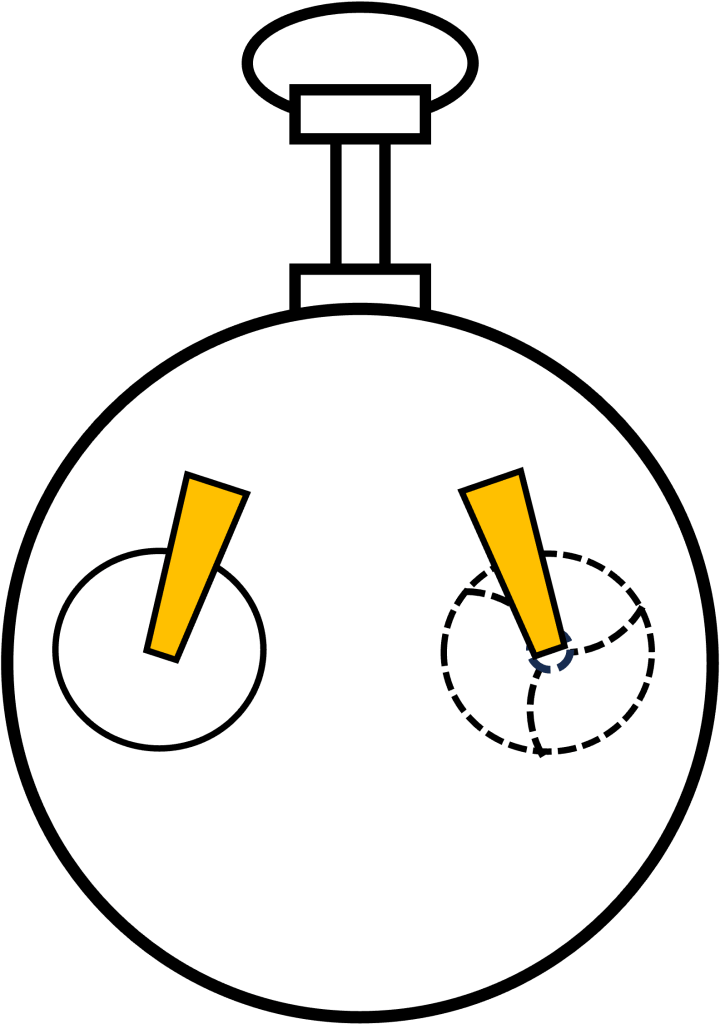
There are some features permitting to discern earlier from later versions of the Lépine caliber. One feature is the shape of the spring retaining the main spring axis (from left to right): the oldest and rarest version (a) is horseshoe shaped ad rather large, used before 1775. The second version (b) is of feather shape, used between 1775 and 1780. The last and most common type (c) is small and of circular shape, used from 1780. The last version can come with different shapes of indentations. Later versions are made of two wheels of different shapes with triangular or multiple triangular edges.
The other possibility of dating Lépine calibers is looking at the ‘Retard’ (slow, R) and ‘Avance’ (fast, A) indications on the balance bridge: On movements before 1780, the abbreviations are on the edge of the balance spring bridge table. The earliest versions (1772 – 1775) have the A,R engraved upside down, readable when seen from the balance spring side, later (1775 – 1780) the orientation is inverted. After 1780 the abbreviations are engraved onto the balance bridge foot.
 Antiquarian Horology


