
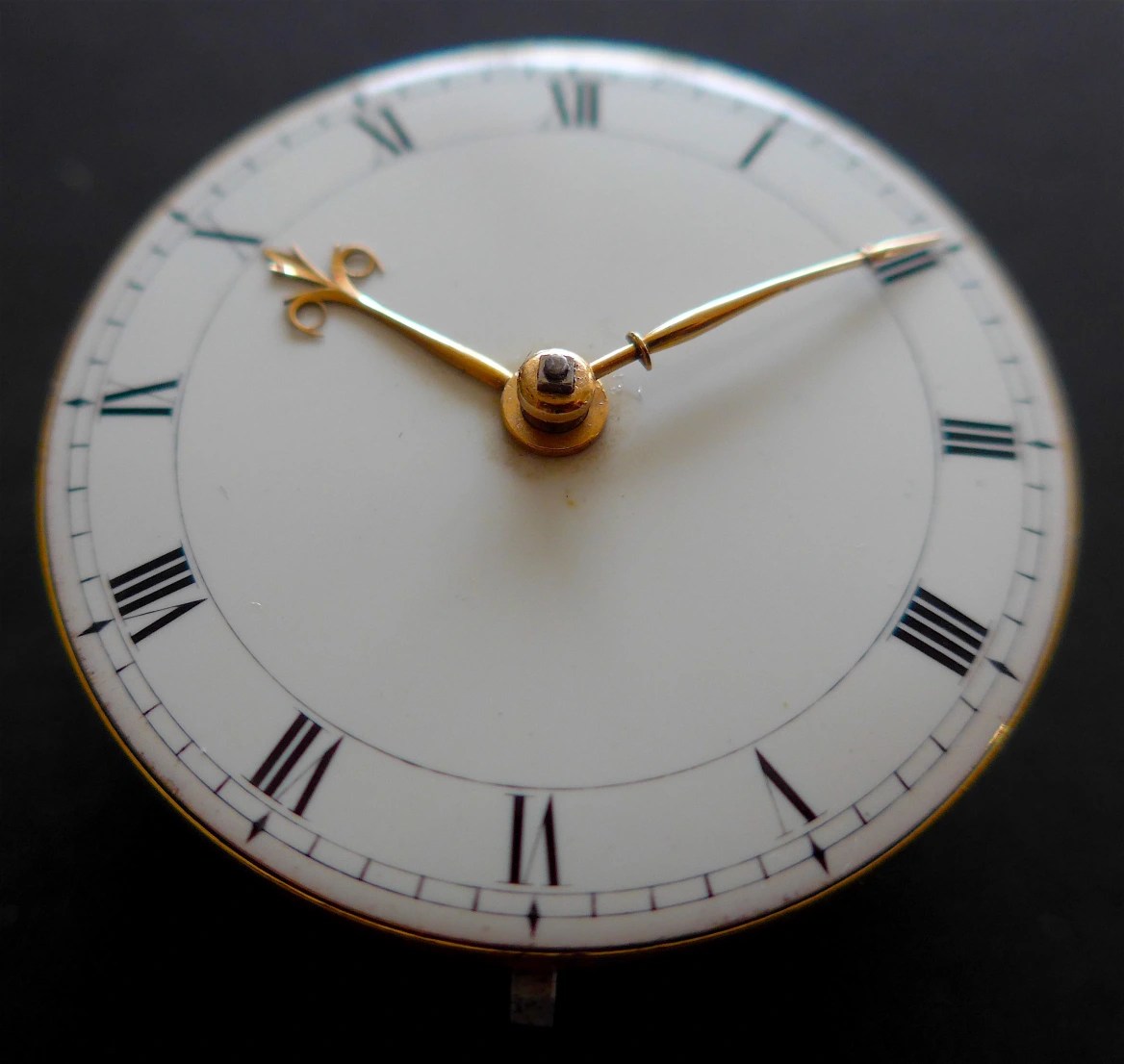


Description: Gilt brass, full plate fusee movement (46.5 mm diameter) with square baluster pillars and finely engraved balance cock. Diamond end stone. Signed back plate Tho(mas) Mudge W(illiam) Dutton London 1392’. Graham-type cylinder (deadbeat) escapement with original banking, brass escape with 13 teeth. Enamelled gold dial. Original gold, late type beetle and poker hands. Gilt brass cap signed ‘Tho(mas) Mudge W(illiam) Dutton London’, scratched with movement number ‘1392’ as per Graham workshop custom (A).
Additional Info:
Thomas was rather ill at the time this movement was made and he already left the premises in London to join his brother. This is one of the last movements of the firm co-signed with the name of Thomas Mudge. Starting from No. 1448, the movements were signed William Dutton & Sons. (A)
William Dutton (1738 – 1794) the son of Matthew Dutton of Marston in Buckinghamshire, was apprenticed to George Graham on 5th January 1738. He received his freedom on 7th July 1746. He was a liveryman of the Clockmakers Company from 1766-94. Most probably Dutton worked for Thomas Mudge from the beginning of the opening of latter’s workshop in 1748, he then entered into a partnership with Thomas Mudge around 1765 taking care of the watch production and took over the whole business in 1771, when Mudge retired due to illness. For some time the firm’s name remained the same until the late 1780s when he started to sign his work as ‘William Dutton’ or ‘W. Dutton’.
For a short period of time he ran the firm together with his two sons: Matthew and Thomas, signing the output ‘W. Dutton & Sons’ (A).
 Antiquarian Horology