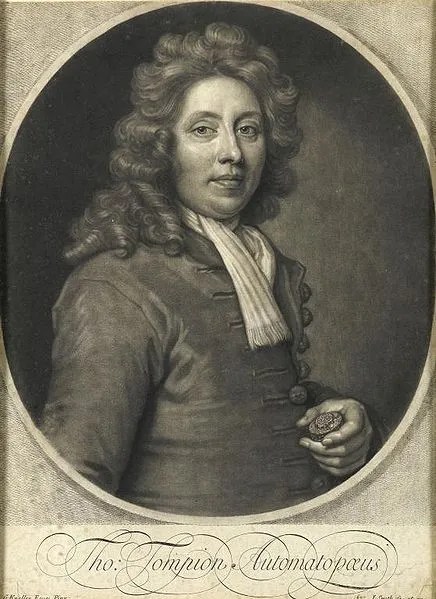
Tompion (1639 – 1713) was an English clock maker, watchmaker and mechanician who is still regarded to this day as the ‘Father of English Clockmaking’. Tompion’s excellence was based on the sound design of his productions as well as the high quality of the materials used. This together with the outstanding skills of the workmen he employed gave him an unrivalled reputation throughout the known world. Many of these workmen had French and Dutch Huguenot origins, for example Daniel and Nicholas Delander, Henry Callot and Charles Molyns, the latter possibly related to the family Windmills. Importantly, those Huguenots who worked for him in the sphere of decorative arts were able to execute Tompion’s demands for the high quality workmanship on which he founded his unrivalled reputation. Tompion was an early member of the Clockmakers’ Company of London — he joined in 1671 and became a master in 1704. He was also one of the few watchmakers to become a member of the Royal Society.
Tompion’s workshop built about 5,500 watches and 650 clocks during his career.
Law imposed that not more than 2 apprentices at once can be instructed (B). Because of the high social status of Tompion he managed to circumvent this law (B). Tompion’s apprentices included George Allett, Edward Banger, Henry Callowe (Callot), Robert Creed, Daniel Delander, Richard Emes, Ambrose Gardner, Obadiah Gardner, William Graham (nephew of George Graham), George Harrison, Whitestone Littlemore, Jeremiah Martin, Charles Molins (Molyns), William Mourlay, Charles Murray, Robert Pattison, William Sherwood, Richard Street, Charles Sypson, William Thompson, James Tunn and Thomas White, many of whom became important makers and workmen in their own right (A).
Tompion went into partnership with Edward Banger in 1701 until about 1707 or 1708, when it was dissolved in circumstances which are not at all clear. Certainly from around 1711 it was George Graham who was in partnership with Tompion, some of his later productions are jointly signed, and mysteriously some clocks have this signature on a separate plate which overlays that of Tompion and Banger engraved on the dial plate. Some watches with a joined signature of Tompion and George Graham are known, starting from 1713, after Tompions death Graham signed the watches with his own name and continued Tompions production numbering (A).
 Antiquarian Horology