
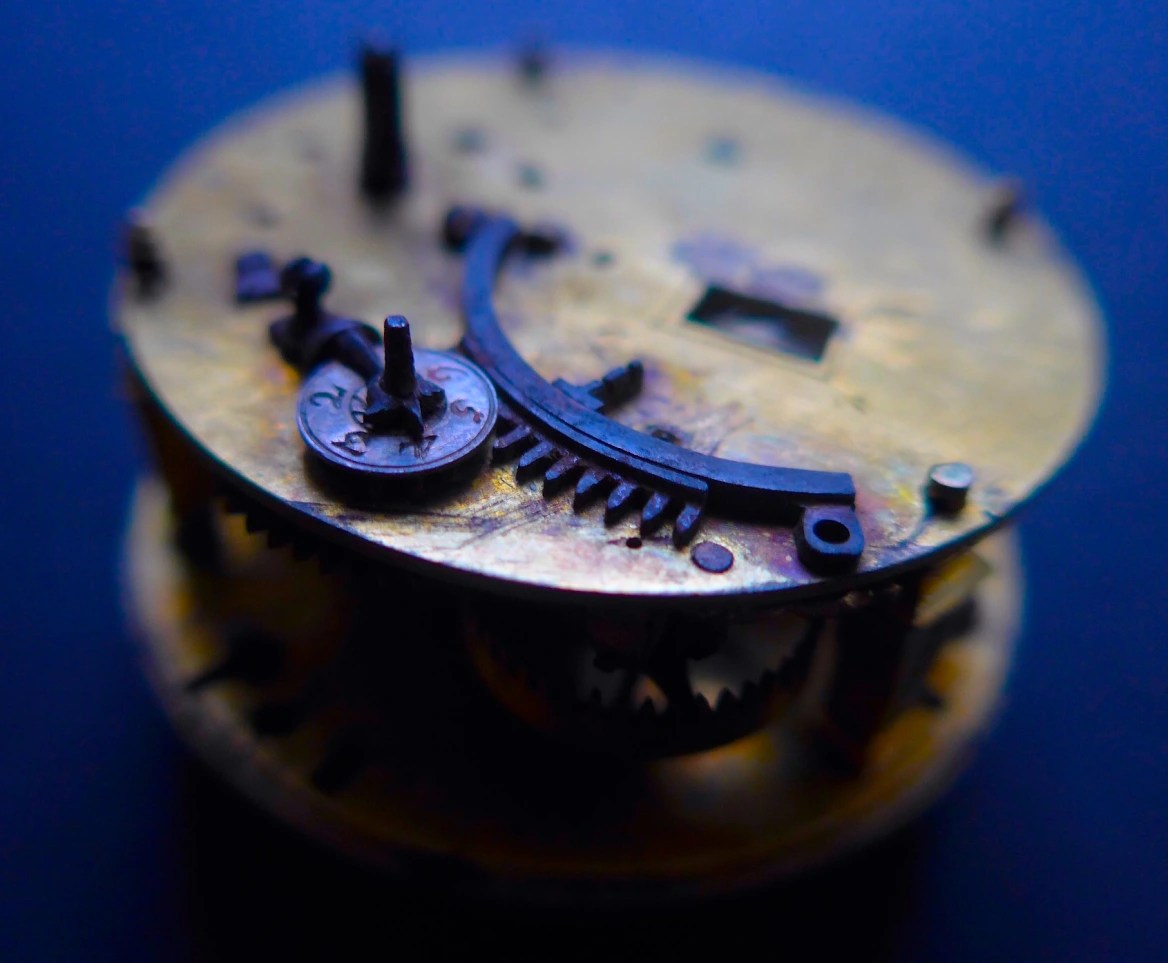

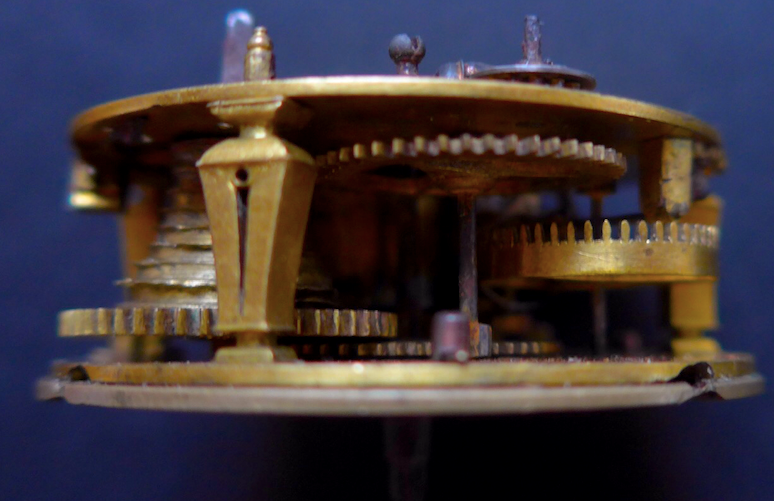
Description: Gilt brass, verge fusee movement (dial plate 42.5mm, 12.2mm between plates) with old type Tompion regulator dial. Featuring Egyptian pillars and lacking chain, cock (cock-foot would not have been of D shape yet), balance, motion work, dial and hands.
Additional Info:
Early balance spring regulation; Nathaniel Barrow and Thomas Tompion
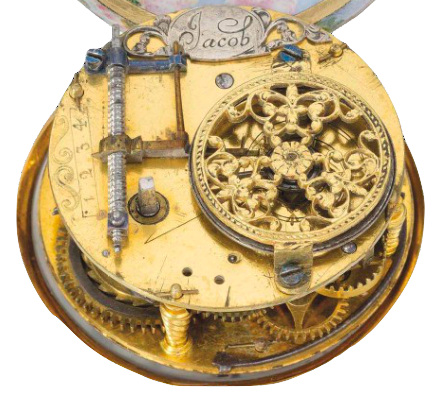
From the moment watchmakers started to use the balance spring, towards 1675, the tension of latter needed to be regulated in order to control the oscillation speed of the balance, thus the running speed of the watch. It is important not to mix the tension regulation systems of the main spring (worm and wheel set-up, already used in the early 17th century) with the balance spring regulation system. The earliest balance spring regulating systems used worm screws (Barrow regulator), most didn’t allow to adjust the balance spring tension according to indexes. This changed with the introduction of the regulator dial. The first regulator dials were very small and were held by a blued steel arm (one or two fixing screws), like in the movement by Torin above. Later the dials got bigger and were fixed by a pin in their axis as in the movement below. The indexes can be marked as Roman -or Arabic numerals, with lines or dots. Although named after Thomas Tompion (Tompion regulator) who most probably introduced this system in England, it was certainly invented in France by Isaac Thuret, the first who ever used a balance spring in a watch. A further balance spring regulation system will be invented by Joseph Bosley in 1755.
 Antiquarian Horology