
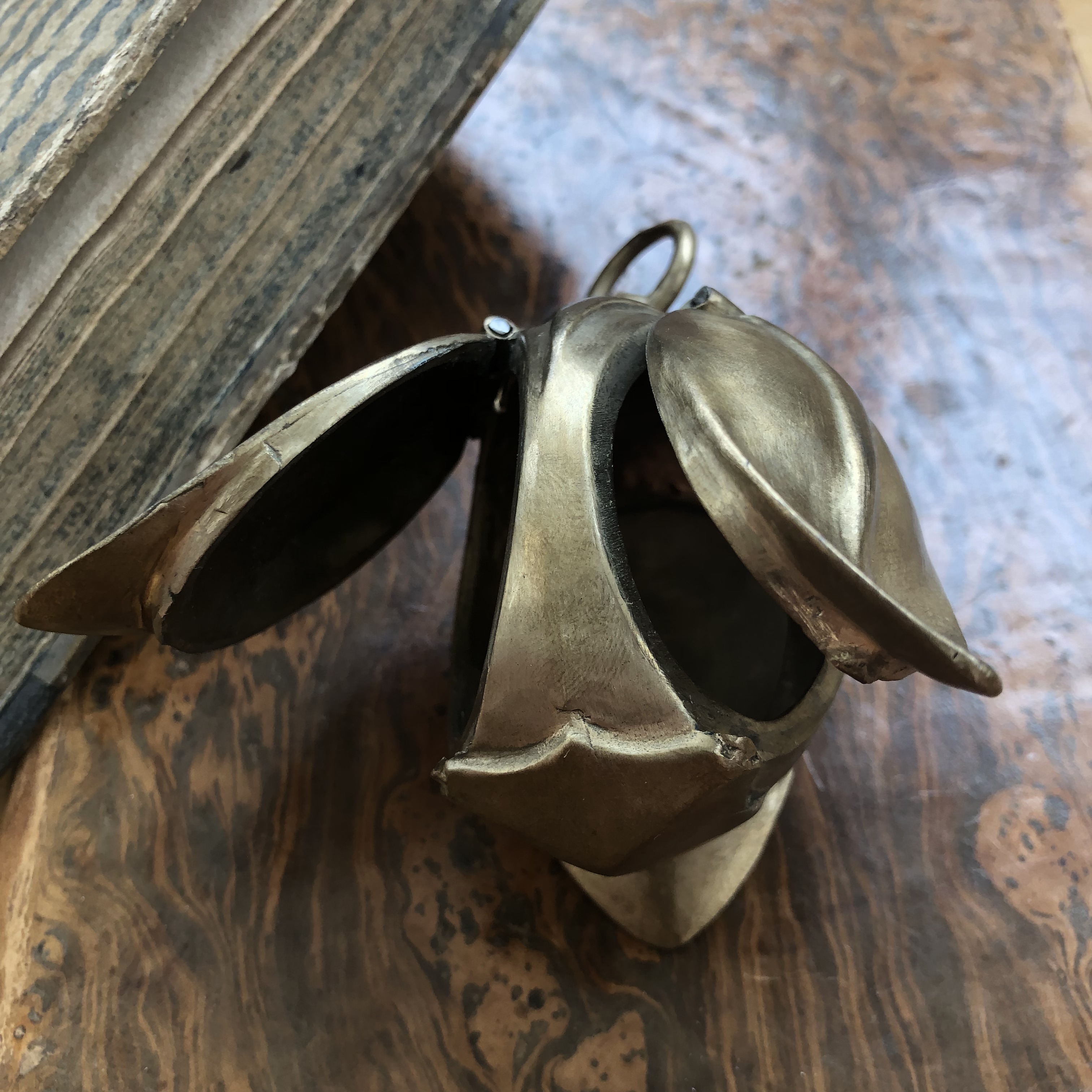


Description: Bronze, modern reproduction of a tulip shaped early 17th century watch case. Usually of quite small shape, this form-watch case was imitating the then very expensive flower, especially grown in the Netherlands.
Additional Info:
Sometimes the ‘petals’ are inlayed with rock crystal or painted porcelain panels. Cultivation of the tulip began in Persia, probably in the 10th century. Carolus Clusius is largely responsible for the spread of tulip bulbs in Europe in the final years of the sixteenth century. He finished the first major work on tulips in 1592, and made note of the variations in colour. While a faculty member in the school of medicine at the University of Leiden (The Netherlands), Clusius planted both a teaching garden and his private garden with tulips. In 1596 and 1598, over a hundred bulbs were stolen from his garden in a single raid.
Between 1634 and 1637, the enthusiasm for the new flowers triggered a speculative frenzy now known as the ‘tulip mania’. Tulip bulbs became so expensive that they were treated as a form of currency, or rather, as futures. Around this time, the ceramic ‘tulipière’ was devised for the display of cut flowers stem by stem. Vases and bouquets, usually including tulips, often appeared in Dutch still-life paintings. To this day, tulips are associated with the Netherlands, and the cultivated forms of the tulip are often called “Dutch tulips.” The Netherlands have the world’s largest permanent display of tulips at the Keukenhof.
 Antiquarian Horology
