
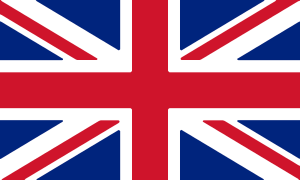
The political union that joined the kingdoms of England and Scotland happened in 1707 during the reign of Queen Anne, when the Acts of Union ratified the 1706 Treaty of Union and merged the parliaments of the two nations, forming the Kingdom of Great Britain, which covered the entire island. Prior to this, a personal union had existed between these two countries since the 1603 Union of the Crowns under James VI of Scotland and I of England.
As queen regent, Anne’s coat of arms before (left picture)the union were the Stuart royal arms, in use since 1603: Quarterly; I and IV grandquarterly, Azure three fleur-de-lis Or (for France) and Gules three lions passant guardant in pale Or (for England); II, Or, a lion rampant within a double tressure flory-counter-flory Gules (for Scotland); III, Azure, a harp Or stringed Argent (for Ireland). In 1702, Anne adopted the motto semper eadem (‘always the same’), the same motto used by Queen Elisabeth I. The Acts of Union declared that: ‘the Ensigns Armorial of the said United Kingdom be such as Her Majesty shall appoint’.
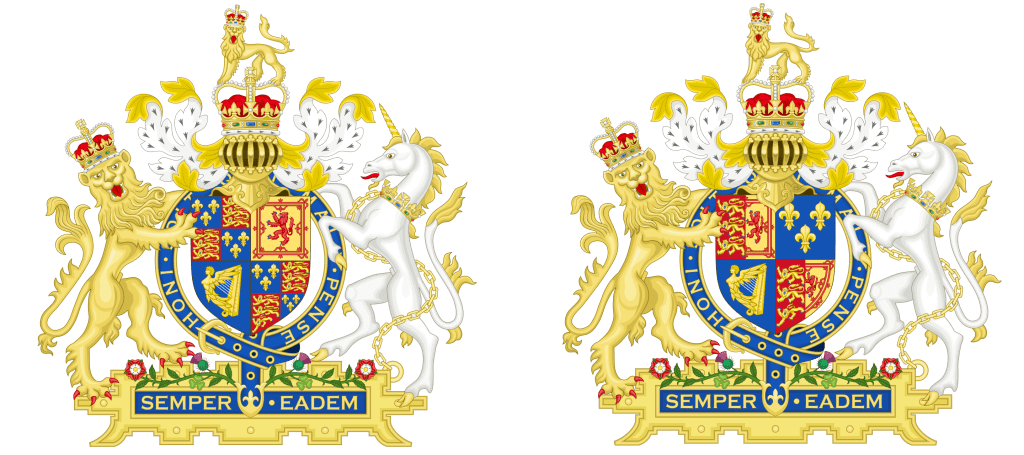
In 1707, the union was heraldically expressed by the impalement, or placing side-by-side in the same quarter, of the arms of England and Scotland, which had previously been in different quarters. The new arms (right picture) were: Quarterly; I and IV, Gules three lions passant guardant in pale Or (for England) impaling Or a lion rampant within a double tressure flory-counter-flory Gules (for Scotland); II, Azure, three fleurs-de-lis Or (for France); III, Azure, a harp Or stringed Argent (for Ireland). In Scotland, a separate form of arms was used on seals until the Act of Union.
Queen Anne (6.2.1665 – 1.8.1714)
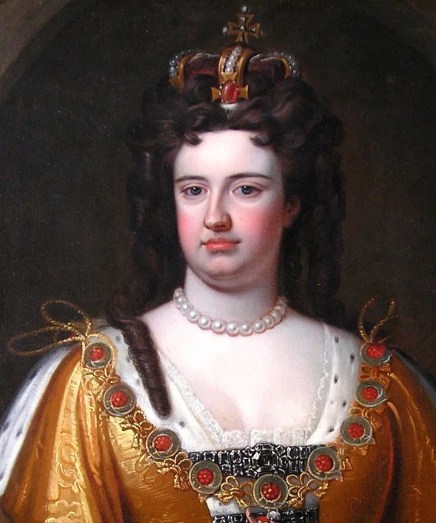
Anne became Queen of England, Scotland and Ireland on 8.3.1702. On 1.5.1707, under the Acts of Union, two of her realms, the kingdoms of England and Scotland, united as a single sovereign state known as Great Britain. She continued to reign as Queen of Great Britain and Ireland until her death.
Anne was born in the reign of her uncle Charles II, who had no legitimate children. Her father, James, was first in line to the throne. His Catholicism was unpopular in England and on Charles’s instructions Anne was raised as a Protestant. Three years after he succeeded Charles, James was deposed in the ‘Glorious Revolution’ of 1688. Anne’s Protestant brother-in-law and cousin William III became joint monarch with his wife, Anne’s elder sister Mary II. Although the sisters had been close, disagreements over Anne’s finances, status and choice of acquaintances arose shortly after Mary’s accession and they became estranged. William and Mary had no children. After Mary’s death in 1694, William continued as sole monarch until he was succeeded by Anne upon his death in 1702.
As queen, Anne favoured moderate Tory politicians, who were more likely to share her Anglican religious views than their opponents, the Whigs. The Whigs grew more powerful during the course of the War of the Spanish Succession, until in 1710 Anne dismissed many of them from office. Her close friendship with Sarah Churchill, Duchess of Marlborough turned sour as the result of political differences.
Anne was plagued by ill health throughout her life. From her 30s onwards, she grew increasingly lame and obese. Despite seventeen pregnancies by her husband, Prince George of Denmark, she died without any surviving children and was the last monarch of the House of Stuart. Under the terms of the Act of Settlement 1701, she was succeeded by her second cousin George I of the House of Hanover, who was a descendant of the Stuarts through his maternal grandmother, Elizabeth, daughter of James VI and I. In July 1714, the parliament released the Longitude Act and the founding of the Board of Longitude. Queen Anne died at around 7:30 a.m. on 1.8.1714. Anne was buried beside her husband and children in the Henry VII chapel on the South Aisle of Westminster Abbey on 24th of August.
 Antiquarian Horology