

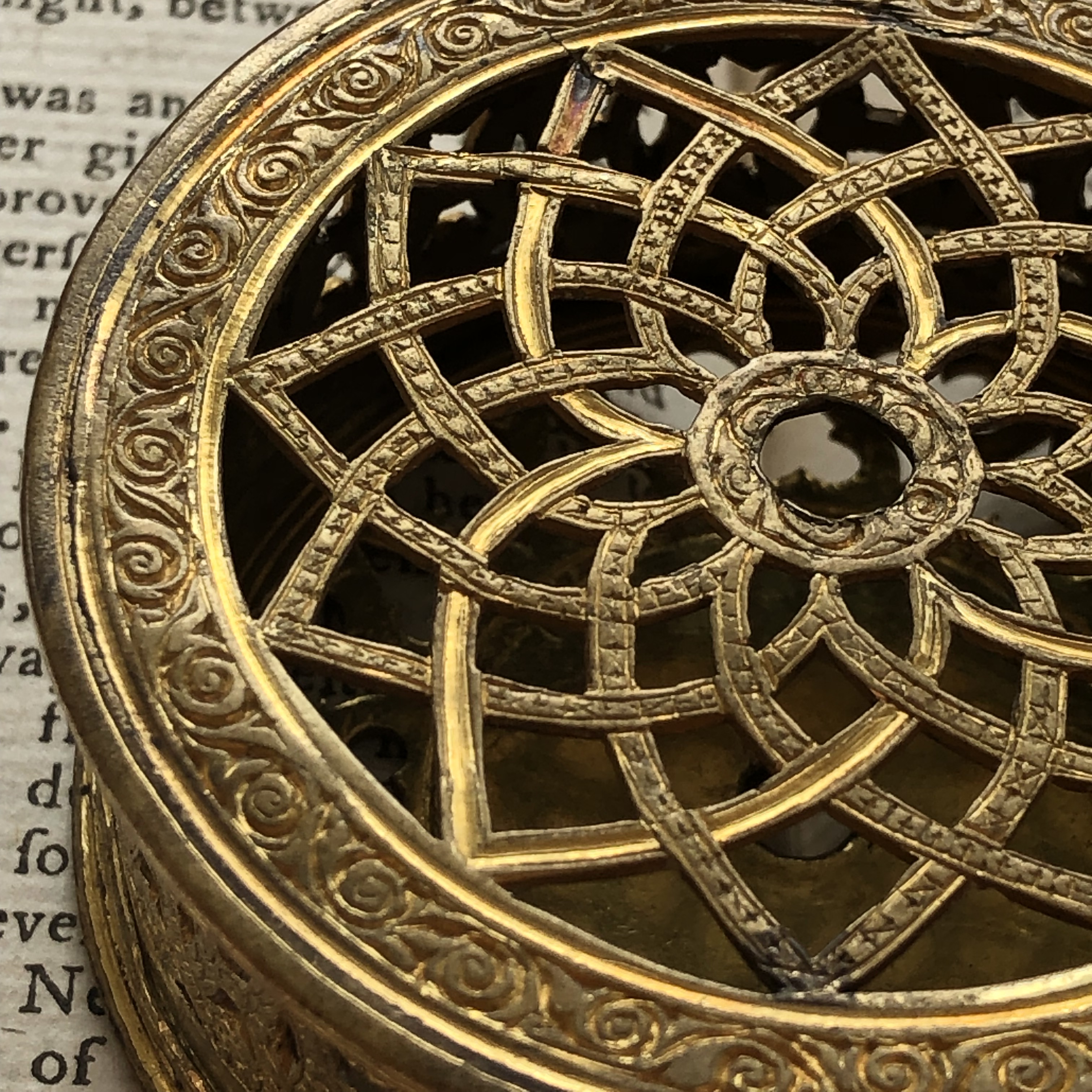


Description: This fire gilt brass case (diameter: 62.7mm, hight: 24.5mm) was most probably made in Germany to house a full steel stackfreed movement. The heart shaped openings in the lid would have permitted to read the time shown by a single, blued steel hand. The hole in the central part of the lid would have been used for setting the time. There is no evidence of a bell mount inside the case, so it was most probably a simple watch with no complications such as alarm. The circular wall of the case is made of one sheet of metal welded near the hinge. The base of the case is welded and riveted with two pins onto the wall. The original loop is still present and would have accommodated a chain. The whole surface is superficially carved with geometric, celtic motives, scrolls and flowers.
Additional Info:

The shape resembling a drum is taken from the table clocks which were slightly bigger than the first portable watches. The dials were highly engraved with geometric motives and covered a movement made entirely of iron. The movements of these watches have mostly the stackfreed or early verge fusee system. Later the stackfreed will be completely replaced by the more reliable verge system.
These new type of watches, ‘Halsuhren’ (neckwatches) were most probably not worn around the neck but around the waist as they were extremely heavy.
 Antiquarian Horology

