
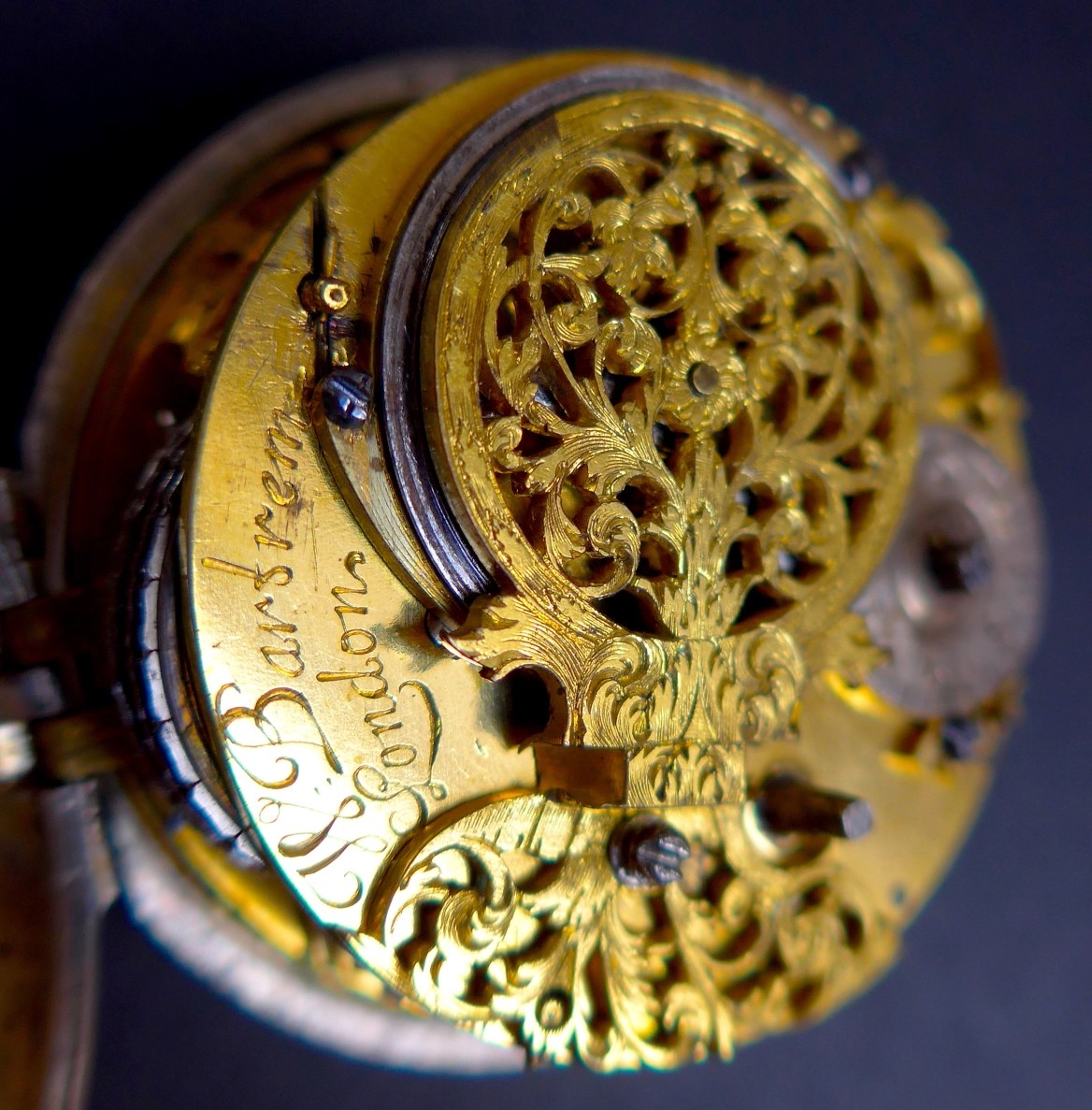

Description: Gilt brass, verge fusee movement (dial plate 41.3mm, 10mm between plates) with Tompion regulator, cock-foot has not the D shape yet. Featuring primitive style tulip pillars, lacking dial and hands.
Additional Info:
William Bartrem, most probably son of Simon Bartram, is registered as member of the ‘Clockmakers Company of London’ in 1684. Simon Bartrem (active 1630 -1690) was part of the first Court (as assistant) of the Clockmakers Company in 1631.
The Clockmaker’s Company of London
During the sixteenth century, clockmaking by native English craftsmen was mostly confined to the production of tower and church clocks. Domestic clocks and watches were mostly imported or the work of immigrants from the Continent. Because tower clock making involved working in ferrous metal, clockmakers within the City of London tended to be freemen of the Blacksmiths’ Company. Blacksmiths in this sense meant general metal workers, the shoeing of horses being the province of the Farriers.
The growth of the domestic clock making industry however led to a feeling within the trade that it was a craft apart. Resentment grew up between the clockmakers who had become established in London and outsiders who came to set up in or near the City and who threatened their market. From 1622 onwards groups of London makers undertook a series of political manoeuvres designed to undermine the opposition, both through the Blacksmiths Company and in their own right. They failed at first to gain the recognition they sought, but by 1629 they had accumulated sufficient credibility to petition the Crown for an independent Company. To the considerable distress of the Blacksmiths, who believed themselves to be the rightful repository of the clockmaker’s Art, the clockmakers were granted their Charter by King Charles I on the 22nd August 1631.
The Charter gave the Clockmakers power to control the horological trade in the City of London and for a radius of ten miles around. It incorporated a controlling body which should have ‘continuance for ever under the style and name of The Master, Wardens and Fellowship of the Art and Mystery of Clockmaking’. It provided that the Fellowship should be governed by a Master, three Wardens and ten or more Assistants who would form the Court. It went on to appoint the first incumbents by name.
The first Master was David Ramsay, a Scot, who had been appointed watchmaker to James VI of Scotland, later James I of England.
The museum of the Clockmaker’s Company constitutes the oldest collection specifically of clocks, watches, and sundials in existence founded 1814. The collection has been moved to be part of the ‘Time gallery’ of the Science Museum (London).
 Antiquarian Horology